
Ramadan effect on levothyroxine use in hypothyroid: a single center experience
Ramadan effect on levothyroxine use
Authors
Abstract
Aim We aimed to determine the effect of levothyroxine (LT4) use at iftar or suhur during Ramadan, compared to other times, on thyroid-stimulating hormone (TSH) and free T4 (FT4) levels.
Methods 245 patients with primary hypothyroidism receiving LT4 treatment were included in our study. The patients were divided into those who used LT4 within 30 minutes to 1 hour before the iftar meal (dinner) (group 1) and those who used LT4 within 30 minutes to 1 hour before the suhur meal (pre-dawn meal) (group 2). The TSH and FT4 values of the patients in the 4 weeks before Ramadan were compared with the TSH and FT4 values in the 1-4 weeks after Ramadan.
Results The change in drug intake time (suhur /iftar) did not have a significant effect on FT4 and TSH values (p>0.050). While there was no dose change after Ramadan in 70.2% (n = 172) patients, the need for medication increased in 18% (n = 44) and decreased in 11.8% (n = 29). When FT4 and TSH levels were compared before and after Ramadan, the LT4 dose change in patients taking medication at suhur was higher than those taking medication at iftar, but it was not found to be statistically significant.
Conclusion The most important parameter in the treatment of hypothyroidism is ensuring continuity in drug treatment. In Ramadan, unlike other months, drug use during suhur /iftar times did not create a significant difference in treatment.
Keywords
Introduction
Hypothyroidism is a clinical condition that occurs as a result of a decrease in the thyroid hormone level in the blood due to deterioration of the functions of the thyroid gland, due to autoimmune thyroid disease, iodine deficiency, postthyroidectomy, and radioactive iodine treatment. The main treatment for the disease is to replace the missing hormone levothyroxine (LT4). Hypothyroidism requires lifelong thyroid hormone replacement with LT4.1 LT4 is absorbed from the small intestine. Medications taken with food and on an empty or full stomach affect blood LT4 levels. It is recommended to take the drug with water on an empty stomach, at least half an hour before breakfast, to prevent interaction with food and to increase intestinal absorption.2,3 Every year, Muslims fast for a month during Ramadan, abstaining from food and drink from morning (suhur) to sunset (iftar). In addition, the dates and fasting periods of Ramadan change every year according to the Islamic calendar. Patients with chronic diseases such as hypothyroidism need to adjust the timing of taking medication according to their eating and sleeping habits.4 For these reasons, patients have difficulty taking LT4 on an empty stomach and complying with waiting periods. This situation makes hypothyroidism treatment difficult.4,5 Some studies report that thyroid function tests are negatively affected after Ramadan in patients with hypothyroidism, and different results have been reported between studies.5,6
In this context, we aimed to evaluate the change in drug dose, thyroid hormone, and thyroid-stimulating hormone levels according to the use of levothyroxine at iftar and suhur due to hypothyroidism before and after the month of Ramadan.
Materials and Methods
Study DesignA retrospective review of the files of 245 patients diagnosed with primary hypothyroidism in our Recep Tayyip Erdogan University Internal Medicine Outpatient Clinic between January 2023 and August 2023, and whose data were available, was included in the study.
Selection of PatientsPatients over the age of 18 who were diagnosed with primary hypothyroidism(chronic lymphocytic thyroiditis-Hashimoto’s thyroiditis) in our internal medicine clinic, whose TSH was measured within 4 weeks before Ramadan, and who fasted for 30 days during the month of Ramadan, that is, between 23/03/2023 and 20/04/2023, were included in the study. Those whose LT4 dose has changed in the 4 weeks before Ramadan, those who are pregnant, those who use steroids that affect LT4 drug absorption, proton pump inhibitors, sucralfate, drugs that affect stomach acid levels, antiepileptics, preparations containing iron and calcium, those who have inflammatory bowel disease, celiac disease, and those who have gastric bypass, patients with atrophic gastritis, chronic renal failure, liver failure, and participants with missing data were excluded from the study. The time the patients took their medications was recorded from the files. No clear information could be obtained about the amount and content of the meals.
MethodThe collection of study data was done by an experienced internal medicine specialist. The demographic characteristics, clinical features, accompanying comorbid conditions, additional medications used, LT4 tablet dose, duration of use, number of fasting days during Ramadan, food, beverages, and dietary supplements were recorded. The patients were divided into those who used LT4 within 30 minutes to 1 hour before the iftar meal (dinner) (Group 1) and those who used LT4 within 30 minutes to 1 hour before the suhur meal (pre-dawn meal) (Group 2). We examined the weekly drug dose and thyroid hormone changes according to the use of LT4 at iftar and suhur during Ramadan by looking at the patients’ TSH and FT4 values in the 4 weeks before Ramadan and the TSH and FT4 values in the 1-4 weeks after Ramadan.
Ethical ApprovalThis study was approved by the Ethics Committee of Recep Tayyip Erdogan University (Date: 08.02.2024, Decision No: 36).
Statistical AnalysisR software was used to obtain the analysis findings. (R Core Team, 2023, Vienna, Austria). Application results were obtained with the WRS2 (Mair P, Wilcox R, 2020) library in the R software. The suitability of the variables to normal distribution was examined with Kolmogorov-Smirnov and Shapiro-Wilk tests. By calculating the change in TSH and T4 values after and before Ramadan, since the change in drug intake time and LT4 drug doses was not normally distributed, it was compared with Robust two-way analysis of variance. Statistical analyses were evaluated at the p<0.05 significance level. Analysis results are presented as mean ± standard deviation, mean ± standard error, and frequency (percentage).
Reporting GuidelinesThis study was reported according to the STROBE guidelines.
Results
The average age of the patients included in the study was 41.57 ± 11.13. 89.9% of the patients are women. It was observed that at most 16.8% of patients with comorbidities had diabetes. It was observed that patients using additional medication mostly used oral antidiabetic drugs (OAD) with a rate of 17.2% Table 1. The change in medication intake time (suhur/iftar) did not have a significant effect on FT4 and TSH values (p>0.050). When ST4 and TSH levels were compared before and after Ramadan, the LT4 dose change in patients taking medication at suhur compared to those taking it at iftar was higher, but it was not found to be statistically significant (Table 2 and Table 3).
Discussion
In Türkiye, where the majority of the population is Muslim, the Eastern Black Sea region is a region where hypothyroidism is common due to iodine deficiency. Therefore, it is important in this region to monitor the LT4 dose of hypothyroidism during Ramadan and to regulate the treatment according to the changes in TSH and LT4 serum levels.7
In a study, ensuring adequate food intake before suhur time, this important change in eating habits and sleep cycle, was stated as an obstacle that prevents most hypothyroid patients from complying with LT4 recommendations at this time.8 Another study concluded that although circadian rhythms affect LT4 administration, whether the stomach contains food or other digested substances is an important factor affecting the LT4 dose change when oral LT4 is administered.9 Silva Perez et al. In a prospective and randomized study comparing the administration of LT4 on an empty stomach for 90 days with the administration of LT4 with breakfast for 90 days, they found the TSH level to be higher in the breakfast group than in the group taking it on an empty stomach.10,11 In our study, although it was not statistically significant, the dose change after Ramadan was seen more in those taking medication at suhur than at iftar. One of the factors that may cause this is that the people of the region continue to eat and drink until suhur throughout the month of Ramadan, and the interval between iftar and suhur is short. In addition, people who wake up for the suhur (pre-dawn) meal cannot wait at least 30 minutes on an empty stomach.
In a randomized clinical study conducted by Mazhari M. et al., they found that TSH and FT4 levels increased after Ramadan. However, it has been observed that the timing of levothyroxine intake alone has no effect on TSH or free T4 levels.5 In many studies, it was found that in patients who were euthyroid before Ramadan, it was associated with a statistically significant increase in TSH, while the FT4 level was stable. Another study reported a significant increase in TSH levels after Ramadan in hypothyroid patients consuming L-thyroxine.12,13 In many studies, no significant change in TSH was observed in fasting patients who received LT4 before iftar, while this was observed in patients who received LT4 after iftar or before suhur.14,15 Since the empty stomach time is longer before iftar, drug absorption is faster, and therefore fluctuations in TSH levels are less than during suhur. In our study, the fact that there was no change in drug dosage compared to before Ramadan (70.2%) can be attributed to the fact that the participants continued to use medication without interruption, regardless of stomach fullness and intake time.
Limitations
While being a single center and having a small sample size are limitations of the study, its strength is that there are no patients with hypothyroidism due to different reasons. Another limitation of the study is that the nutritional contents of suhur or iftar that may impair the absorption of drugs are not known.
Conclusion
The most important parameter in the treatment of hypothyroidism is ensuring continuity in drug treatment. In Ramadan, unlike other months, drug use during suhur / iftar times did not create a significant difference in treatment. Compared to before and after Ramadan, the LT4 dose change was found to be greater in patients taking medication at suhur than in patients taking medication at iftar.
Declarations
Animal and Human Rights Statement
All procedures performed in this study were in accordance with the ethical standards of the institutional and/or national research committee and with the 1964 Helsinki Declaration and its later amendments or comparable ethical standards.
Informed Consent
Written informed consent was waived due to the retrospective study design.
Data Availability
The data supporting the findings of this study are available from the corresponding author on reasonable request.
Conflict of Interest
The authors declare that there is no conflict of interest.
Funding
None.
Author Contributions (CRediT Taxonomy)
Conceptualization: B.K., O.C.
Methodology: B.K., O.C., Y.E.G.
Formal Analysis: O.C.
Investigation: B.K., L.M.Y.
Data Curation: B.K., L.M.Y.
Writing – Original Draft Preparation: B.K.
Writing – Review & Editing: O.C., Y.E.G., L.M.Y.
Supervision: O.C.
AI Usage Disclosure
The authors declare that no AI-assisted technologies were used.
Abbreviations
FT4: Free thyroxine
LT4: Levothyroxine
NSAID: Nonsteroidal anti-inflammatory drugs
OAD: Oral antidiabetic drugs
T4: Thyroxine
TSH: Thyroid-stimulating hormone
References
-
Chaker L, Bianco AC, Jonklaas J, Peeters RP. Hypothyroidism. Lancet. 2017;390(10101):1550-1562. doi:10.1016/S0140-6736(17)30703-1
-
Skelin M, Lucijanić T, Amidžić Klarić D, et al. Factors affecting gastrointestinal absorption of levothyroxine: a review. Clin Ther. 2017;39(2):378-403. doi:10.1016/j.clinthera.2017.01.005
-
Caron P, Grunenwald S, Persani L, Borson-Chazot F, Leroy R, Duntas L. Factors influencing the levothyroxine dose in the hormone replacement therapy of primary hypothyroidism in adults. Rev Endocr Metab Disord. 2022;23(3):463-483. doi:10.1007/s11154-021-09691-9
-
Karoli R, Fatima J, Chandra A, Mishra PP. Levothyroxine replacement and Ramadan fasting. Indian J Endocrinol Metab. 2013;17(2):318-319. doi:10.4103/2230-8210.109700
-
Mahzari M, Al Remthi F, Ajwah I, et al. Levothyroxine timing during Ramadan: a randomized clinical trial. Int J Endocrinol. 2023;2023:2565031. doi:10.1155/2023/2565031
-
Dabbous Z, Alowainati B, Darwish S, et al. A prospective study comparing two- time points of thyroid hormone replacement during the holy month of Ramadan. Int J Endocrinol. 2019;2019:9843961. doi:10.1155/2019/9843961
-
Or Koca A, Dağdeviren M, Altay M. Should the dose of levothyroxine be changed in hypothyroidism patients fasting during Ramadan? Turk J Med Sci. 2020;50(4):784-788. doi: 10.3906/sag-1911-28
-
Laway BA, Ashraf H. Basic rules of Ramadan: a medico-religious perspective. J Pak Med Assoc. 2015;65(5 Suppl 1):S14-7.
-
Bolk N, Visser TJ, Nijman J, Jongste IJ, Tijssen JG, Berghout A. Effects of evening vs morning levothyroxine intake: a randomized double-blind crossover trial. Arch Intern Med. 2010;170(22):1996-2003. doi:10.1001/archinternmed.2010.436
-
Elsherbiny TM. Twice or thrice weekly versus daily thyroxine in hypothyroid fasting Ramadan: a pilot study. Indian J Endocrinol Metab. 2022;26(3):265-268. doi:10.4103/ijem.ijem_1_22
-
Zaboon IA, Alidrisi HA, Hussein IH, et al. Best time for levothyroxine intake in Ramadan (THYRAM): Basrah experience. Int J Endocrinol Metab. 2020;18(2):e94325. doi:10.5812/ijem.94325
-
Perez CL, Araki FS, Graf H, de Carvalho GA. Serum thyrotropin levels following levothyroxine administration at breakfast. Thyroid. 2013;23(7):779-784. doi:10.1089/thy.2012.0435
-
Sajid KM, Akhtar M, Malik GQ. Ramadan fasting and thyroid hormone profile. J Pak Med Assoc. 1991;41(9):213-216.
-
Belal MM, Youssef AR, Baker H, et al. Effect of Ramadan fasting on thyroid functions in hypothyroid patients taking levothyroxine: a systematic review and meta-analysis. Ir J Med Sci. 2024;193(2):741-753. doi:10.1007/s11845-023- 03526-z
-
Al-Qahtani KM, Aldeeri IA, Alshaibi AM, et al. Jammah AA. Optimal timing of thyroid hormone replacement during Ramadan fasting: a randomized controlled trial in patients with prior total thyroidectomy. Thyroid. 2022;32(9):1029-1036. doi:10.1089/thy.2022.0110
Tables
Table 1. Descriptive statistics of patients’ demographic and clinical characteristics
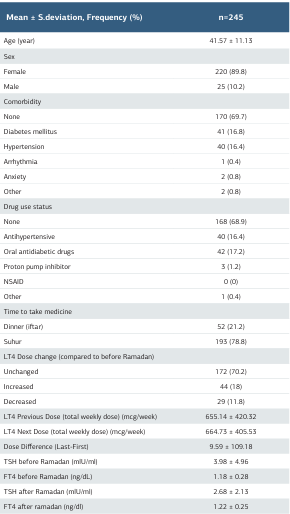
NSAID: Nonsteroidal anti-inflammatory drugs, LT4: Levothyroxine, FT4: Free T4, TSH: Thyroid stimulating hormone
Table 2. Investigation of the effect of drug intake time and LT4 dose change on TSH and FT4 values
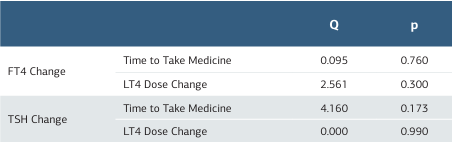
FT4: Free T4, TSH: Thyroid stimulating hormone, Q: Robust two-way analysis of variance method of trimmed means (level 0.2)
Table 3. Descriptive statistics of TSH and FT4 values according to drug intake time and LT4 dose change
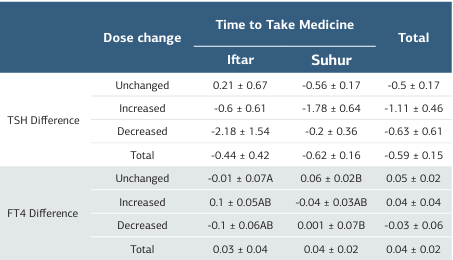
TSH: Thyroid stimulating hormone, FT4: Free T4, Trimmed mean ± std. Error, A-B: There is no difference between interactions with the same letter
Additional Information
Publisher’s Note
Bayrakol MP remains neutral with regard to jurisdictional and institutional claims.
Rights and Permissions

This work is licensed under a Creative Commons Attribution-NonCommercial 4.0 International License (CC BY-NC 4.0). To view a copy of the license, visit https://creativecommons.org/licenses/by-nc/4.0/
About This Article
How to Cite This Article
Bayram Kizilkaya, Osman Cure, Latife Merve Yildiz, Yasemin Emir Gunay. Ramadan effect on levothyroxine use in hypothyroid: a single center experience. Ann Clin Anal Med 2026;17(1):1-4. doi:10.4328/ACAM.22508
- Received:
- November 28, 2024
- Accepted:
- May 12, 2025
- Published Online:
- May 27, 2025
- Printed:
- January 1, 2026