
Abstract
AimIt aimed to investigate the compliance and attitudes of senior anesthesia assistants, specialist physicians, and faculty members in Türkiye with PROSPECT recommendations for oncological breast surgery (OBS).Materials and MethodsThe survey, consisting of 24 questions, was sent to participants electronically. The answers to the questions were evaluated according to the PROSPECT recommendations for OBS.ResultsIn general, pain management faculty members tend to prefer regional methods, while specialists and assistants tend to prefer IV analgesics. Physicians had similar attitudes among the medical career groups regarding the administration of acetaminophen, NSAIDs, gabapentin, dexamethasone, and opioids. While the faculty members had attitudes more compatible with the PROSPECT recommendations in recommended regional methods such as local anesthetic infiltration, paravertebral block, and PECS block, the faculty members and the assistants had attitudes incompatible with the PROSPECT recommendations in retrolaminar block, erector spinae plane block, and transverse thoracic plane block, for which there are no recommendations yet.ConclusionThis study assessed the compliance of anesthesia and reanimation physicians, including senior anesthesia residents, in Türkiye with the PROSPECT recommendations in the OBS. Compliance with the PROSPECT recommendations of specialists and anesthesia assistants can be increased through postgraduate practical training programs that provide an organized, multidisciplinary approach by authorized institutions.
Keywords
Introduction
Oncologic breast surgery (OBS) is related to postoperative pain, whether acute or chronic.1 A study was conducted in collaboration with PROSPECT in 2006.2 Subsequently, due to advances in pain management, an updated systematic review on the topic was conducted in OBS in 2020. This guideline provides clinicians with evidence-based recommendations for pain management following OBS.3
PROSPECT recommends that basic analgesics (acetaminophen and nonsteroidal anti-inflammatory drugs (NSAIDs), etc.) be administered preoperatively or intraoperatively and maintained postoperatively in OBS. Additionally, preoperative gabapentin and dexamethasone are recommended. In OBS, it is reported that regional anesthesia techniques (paravertebral block (PVB), pectoral nerve block (PECS), and local anesthetic wound infiltration (LAI), etc.) can be considered for pain relief, and PVB can be maintained via postoperative catheterization. Opioids are recommended as rescue analgesics in the postoperative period. Finally, PROSPECT reports that research is required to appreciate the role of new regional analgesic techniques such as erector spinae plane block (ESP), transverse thoracic plane block (TTP), or retrolaminar plane block (RLP).3
Currently, no study has been found in the literature on physicians’ compliance with PROSPECT recommendations in OBS and on physicians' practice preferences in the relevant branch. The purpose of this study is to investigate the compliance and attitudes of senior anesthesia assistants, specialists, and faculty members in Türkiye towards PROSPECT recommendations for OBS.
Materials and Methods
This study was conducted between January 15, 2024, and June 15, 2024. Survey data were collected via an electronic data form. The survey was sent electronically to 1200 senior anesthesia assistants (AR-A), anesthesiology and reanimation specialists (AR-S), and anesthesia and reanimation faculty members (AR-T). It was also communicated directly to the participants at the Mustafa Kemal University congress held in 2024. Since online responses were expected from all individuals in the population in this study, it was concluded that the sample size should be 190 doctors, with 95% confidence, given the highest response rate (50%) in the response distribution and a tolerable error of 7%. The survey form consisted of 24 questions evaluating participants’ personal information, basic approaches to pain management, and compliance with PROSPECT recommendations for OBS. The survey was prepared as a Google Form and presented to the participants in a virtual environment. Participation in the study was voluntary. Consent to participate in the survey was obtained, and participants' identities were kept confidential. “Senior anesthesia assistants” were defined as anesthesiology and reanimation specialist students who had completed their 3rd year. Ethical Approval This study was approved by the Ethics Committee of Mustafa Kemal University School of Medicine (Date: 25.12.2023, Decision No: 10/21). Statistical Analysis In this study, data were analyzed using SPSS 25 (Armonk, NY: IBM Corp.). Based on the survey responses, descriptive statistics such as frequency, percentage, mean, standard deviation, median, and interquartile range were used. The relationship between categorical variables was examined utilizing the chi-square test. Student’s t-test and Mann-Whitney U test were utilized for continuous variables. For all calculations, the significance limit was set as P < .05. Reporting Guidelines This study was reported in accordance with the STROBE guideline.Results
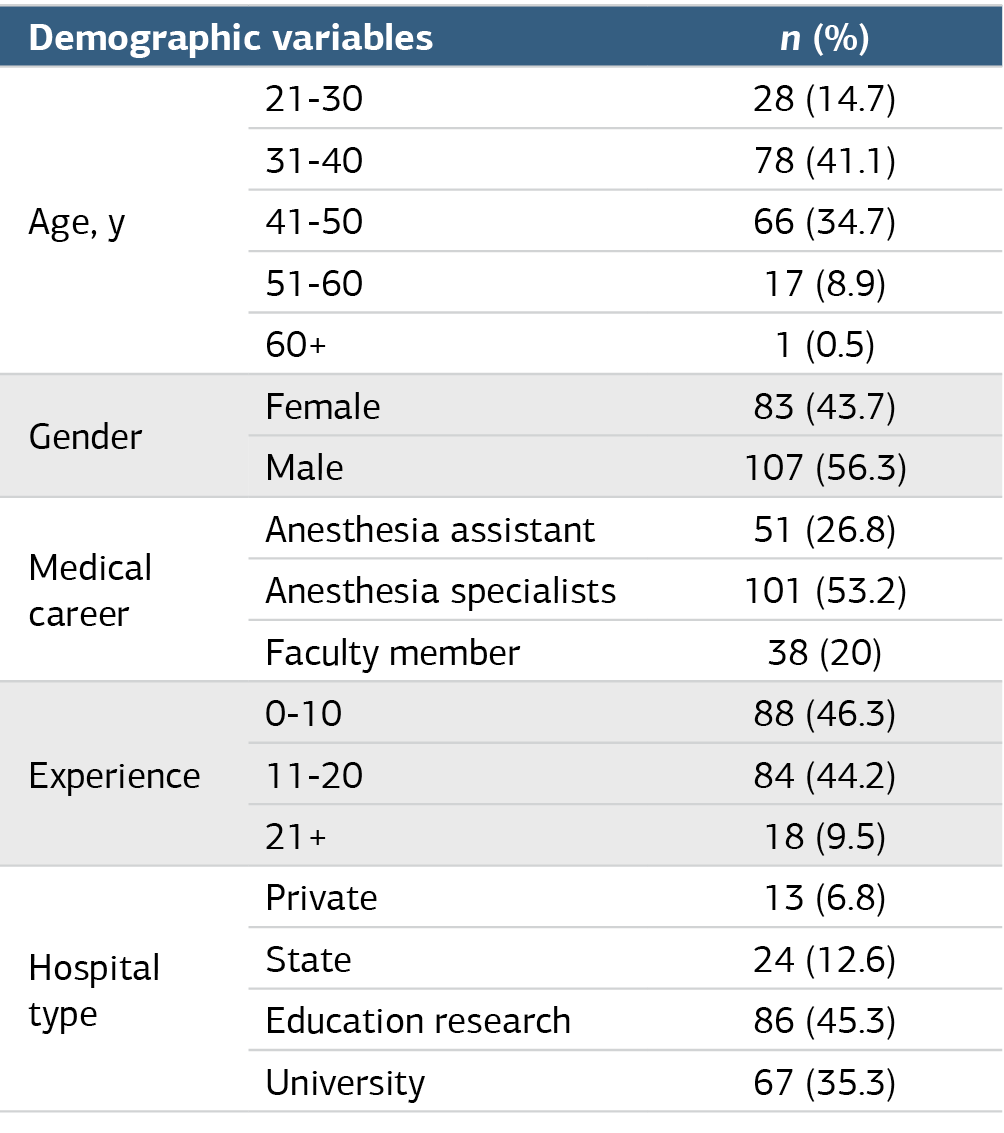
Demographic characteristics of the participants are listed in Supplementary Table 1. In general, faculty members tend to favor regional methods, while specialists and assistants tend to prefer IV analgesics. The faculty members’ follow-up level of PROSPECT recommendations was high. Preoperative and intraoperative pain management preferences (Supplementary Table 2): -The rate of participants’ “pre- or intraoperative use of paracetamol and NSAIDs or selective COX-2 inhibitors in OBS (minor and major)” was 92.6%, and no significant difference was found between the medical career groups (P = .127). -The rate of participants’ “pre- or intraoperative gabapentin use in OBS (minor and major)” was 4.7%, and no significant difference was found between the medical career groups (P = .404). -The rate of participants’ “pre- or intraoperative single-dose dexamethasone use in OBS (minor and major)” was 29.5%, and no significant difference was found between the medical career groups (P = .853). -The rate of participants’ “use of pre- or intraoperative LA infiltration in OBS (minor)” was 47.9%, and a significant difference was found between the medical career groups (P = .009). When examined according to medical career, a significant difference was found between the AR-A and AR-T groups and between the AR-T and AR-S groups (P = .024 and P = .007, respectively). The faculty members (63.1%) were more consistent with PROSPECT recommendations than the assistants (56.8%) and specialists (37.6%). -The rate of participants’ “first choice use of preoperative PVB in OBS (major)” was 11.6%, and a significant difference was observed between the medical career groups (P = .031). When examined according to medical career, a significant difference was observed between the AR-T and AR-S groups (P = .011). Furthermore, the faculty members (23.6%) demonstrated a higher degree of adherence to the PROSPECT recommendations than the specialists (7.9%). -The rate of participants’ “intraoperative continuous PVB use if a PVB catheter was inserted in OBS (major)” was 15.3%, and no significant difference was found between the medical career groups (P = .098). -The participants’ rate of “use of PECS block if PVB was contraindicated in OBS (major) or axillary lymph node dissection was not performed” was 56.8%, and a significant difference was observed between the medical career groups (P < .001). When examined according to the medical career, a significant difference was observed between the AR-A and AR-S groups and between the AR-T and AR-S groups (P < .001 and P < .001, respectively). The faculty members (78.9%) and assistants (76.4%) demonstrated a higher degree of adherence to the PROSPECT recommendations than the specialists (38.6%). -The rate of participants “using LAI for T1 dermatome if pre- or intraoperative regional anesthesia techniques were used in OBS (major)” was 25.3%, with a significant difference between the medical career groups (P = .006). When examined in the context of medical careers, a significant difference was observed between the AR-T and AR-S groups (P = .001). The faculty members (44.7%) were more compatible with the PROSPECT recommendations than the specialists (15.8%). Postoperative pain management preferences (Supplementary Table 2): -The rate of participants’ “use of postoperative paracetamol and NSAIDs or selective COX-2 inhibitors, if not contraindicated in OBS (minor and major)” was 92.6%, and no significant difference was found between the medical career groups (P = .419). -The rate of participants’ “postoperative opioid use in OBS (minor and major)” was 76.8%, and no significant difference was found between the medical career groups (P = .127). -The rate of participants’ “continuous postoperative use of PVB if a PVB catheter was inserted in OBS” was 25.8%, and a significant difference was observed between the medical career groups (P = .016). When examined in the context of medical careers, a significant difference was observed between the AR-T and AR-S groups (P = .003). The faculty members (44.7%) were more compatible with the PROSPECT recommendations than the specialists (16.8%). Pain management preferences not recommended in the guideline (Supplementary Table 3): - The rate of participants’ “intraoperative RLP block use in OBS (minor and major)” was 3.2%, and a significant difference was observed between the medical career groups (P = .023). When examined within the medical career, significant differences were observed between the AR-A and AR-S groups and between the AR-T and AR-S groups (P = .004 and P = .02, respectively). The specialists (0%) were more compatible with PROSPECT recommendations than the faculty members (5.2%) and assistants (7.8%). -The rate of participants’ “use of intraoperative ESP block in OBS (minor and major)” was 34.2%, and a significant difference was observed between the medical career groups (P = .001). When examined within the medical career, significant differences were found between the AR-A and AR-S groups and between the AR-T and AR-S groups (P = .009 and P = .001, respectively). The specialists had a compatibility rate of 22.7% with the PROSPECT recommendations, lower than that of the faculty members (52.6%) and assistants (43.1%). The rate of participants’ “use of adjuvant agents in addition to LA in intraoperative blocks in OBS (minor and major)” was 36.8%, and no significant difference was found between the medical career groups (P = .768). -The rate of participants’ “use of postoperative TTP block in OBS (minor and major)” was 16.8%; a significant difference was observed between the medical career groups (P < .001). When examined according to the medical career, a significant difference was observed between the AR-A and AR-S groups and between the AR-T and AR-S groups (P < .001 and P < .001, respectively). The specialists (5.9%) were more compatible with PROSPECT recommendations than the faculty members (28.9%) and assistants (29.4%).Discussion
In this study, physicians’ compliance with and attitudes towards PROSPECT recommendations, which include optimal analgesic regimens in patients undergoing OBS, were investigated. In addition, physicians’ general pain management tendencies and their attitudes about methods not recommended for pain management in OBS were also investigated.
In OBS, PROSPECT recommends preoperative or intraoperative administration of analgesics (acetaminophen and NSAIDs, etc.), as well as continuing postoperatively unless contraindicated. In addition, preoperative or intraoperative gabapentin and a single dose of dexamethasone are recommended. While PVB is considered the gold standard in major surgery, PECS block is suggested as an alternative to PVB. Opioids are recommended as rescue medication only when other analgesic techniques cannot provide effective pain control.
According to the PROSPECT initiative, basic analgesia (acetaminophen and NSAIDs, etc.) should be administered preoperatively or intraoperatively and maintained postoperatively unless there are contraindications.3 Compliance with this recommendation was very high across all physicians, and there was no difference between the medical career groups. This very high compliance suggests that this is due to the basic and traditional nature of these drugs.
According to the PROSPECT approach, preoperative gabapentin is recommended since it reduces postoperative pain scores and opioid consumption.3 Compliance with this recommendation was very low across all physicians, and no difference was found between the medical career groups. This may be due to the wide dose range of this drug in clinical studies, the lack of documented dose-response effects, and the fact that side effects such as giddiness, blurred vision, or sedation are concerns at high doses in outpatients.4 However, in this study, the reasons for the approach to the prospect proposal were not questioned.
Dexamethasone (IV) administration is recommended because it provides additional analgesic effect and also reduces postoperative nausea and vomiting.5 Compliance with this recommendation was 29.5% among all physicians, with no difference between medical career groups.
LAI to the surgical incision site is recommended for patients scheduled for minor to moderately invasive surgical procedures (partial mastectomy, etc.), but provides limited-duration postoperative analgesia. Postoperative pain after these procedures is usually mild to moderate and decreases in intensity during the first few days postoperatively.3 A high level of compliance with this recommendation was observed among all physicians, and when examined by medical career, faculty members had the highest compliance rate at 63.1%.
PVB is recommended for major breast surgery.3 PVB is associated with lower postoperative pain scores, reduced systemic analgesic intake, reduced postoperative nausea and vomiting, and shorter hospital stays. Additionally, some studies report that continuous use of PVB is associated with improved functional outcomes and less severe chronic pain.6-9 In this study, firstly, compliance with the recommendation “use of preoperative PVB as the first choice in OBS (major)” was low when all physicians were considered (11.6%), yet when examined in terms of medical career, the faculty members demonstrated the highest level of adherence, achieving a rate of 23.6%. Secondly, the compliance rate with the recommendation of “continuous intraoperative use of PVB if a PVB catheter was inserted” was 15.3%, and no significant difference was observed between the medical career groups. Finally, compliance with the recommendation to “continuous postoperative use of PVB if a PVB catheter was inserted” was 25.8%, and faculty members (44.7%) were more compliant with the PROSPECT recommendations. These results suggest that PVB is a complex regional method and requires experience and skill. Therefore, there may be potential to close this gap through postgraduate applied training programs.
Interfascial plane blocks have positive effects in providing postoperative analgesia.10 However, the available data on the utilization of these blocks is restricted, and the selection of the suitable block for OBS (PECS 1, 2, and serratus plane blocks) has not yet been validated. Furthermore, it is stated that neither PECS nor PVB can reliably provide adequate analgesia to the axilla (T1 dermatome, intercostobrachial nerve) for anatomical reasons.11 As a result, additional LAI to the wound site may be beneficial for these cases. In this study, the participants’ “use of PECS block when PVB was contraindicated in OBS (major) or axillary lymph node dissection was not performed” was 56.8%, and no significant difference was found between the medical career groups. The faculty members (78.9%) and assistants (76.4%) were more compliant with the PROSPECT recommendations than the specialists (38.6%). In addition, the rate of participants’ “use of LAI for T1 dermatome if pre- or intraoperative regional anesthesia techniques were used in OBS (major)” was 25.3%, and no significant difference was observed between the medical career groups. When examined in terms of their medical careers, the faculty members (44.7%) were more compatible with the PROSPECT recommendations. These results are also consistent with the level of faculty follow-up on the PROSPECT recommendations.
RLP block, Serratus plane block, and ESP block are alternative interfascial plane blocks described in recent literature.12-14 Although the ESP block is also used in mastectomy, studies on the LA volume used are ongoing. The ESP block has been compared with other interfascial blocks (e.g., the PECS block) in a limited number of studies, with conflicting results.15 However, there are limited studies on the RLP block in breast surgery.12 These blocks should be compared with PVB and PECS blocks for inclusion in pain management strategies for OBS.3 In this study, the rate of participants’ “use of intraoperative RLP, ESP and TTP block in OBS (minor and major)” was 3.2%, 34.2% and 16.8%, respectively, and the faculty members (RLP: 5.2%, ESP: 52.6%, TTP: 28.9%) and assistants (RLP: 7.8%, ESP: 43.1%, TTP: 29.4%) differ from the specialists (RLP: 0%, ESP: 22.7%, TTP: 5.9%) in terms of employ these methods, which are not recommended. These findings may have arisen from the dynamic process of research and development in education.
Limitations
Firstly, the national cross-sectional electronic survey nature of the study may limit the broad applicability of the findings. Secondly, this study is subject to bias due to the subjectivity inherent in physicians’ self-evaluations of their practices. Finally, the study's cross-sectional design limits the ability to detect cause-and-effect relationships and precludes causal interpretation of the results.
Conclusion
In conclusion, this study revealed the compliance levels of anesthesia and reanimation physicians in Türkiye with the PROSPECT recommendations in the OBS. Compliance with the PROSPECT recommendations of specialists and anesthesia assistants can be increased through postgraduate practical training programs that provide an organized, multidisciplinary approach by authorized institutions.
Declarations
Animal and Human Rights Statement
All procedures performed in this study were in accordance with the ethical standards of the institutional and/or national research committee and with the 1964 Declaration of Helsinki and its later amendments, or comparable ethical standards.
Informed Consent
Electronic informed consent was obtained from all participants before inclusion in the study.
Data Availability
The datasets used and/or analyzed during the current study are not publicly available due to participant confidentiality but are available from the corresponding author on reasonable request.
Conflict of Interest
The authors declare no conflict of interest.
Funding
None.
Author Contributions (CRediT Taxonomy)
Conceptualization: C.Ö.P., E.A.
Methodology: C.Ö.P., B.T.
Investigation: C.Ö.P., E.A., B.T., İ.E., F.A.
Data Curation: C.Ö.P., E.A.
Formal Analysis: C.Ö.P., B.T.
Writing – Original Draft: C.Ö.P.
Writing – Review & Editing: E.A., B.T., İ.E., F.A.
Supervision: B.T., İ.E.
AI Usage Disclosure
The authors declare that no AI-assisted technologies were used.
Abbreviations
AR-A: Anesthesiology and reanimation senior assistant
AR-S: Anesthesiology and reanimation specialist
AR-T: Anesthesiology and reanimation faculty member
ESP: Erector spinae plane block
LAI: Local anesthetic infiltration
NSAID: Nonsteroidal anti-inflammatory drug
OBS: Oncologic breast surgery
PECS: Pectoral nerve block
PROSPECT: Procedure-Specific postoperative pain management
PVB: Paravertebral block
RLP: Retrolaminar plane block
TTP: Transverse thoracic plane block
References
- Vadivelu N, Schreck M, Lopez J, Kodumudi G, Narayan D. Pain after mastectomy and breast reconstruction. Am Surg. 2008;74(4):285-96. doi:10.1177/000313480807400402
- Jacobs A, Lemoine A, Bonnet F, Van de Velde M. ESRA19-0255 evidence-based management of pain after non-cosmetic breast surgery: a prospect review update. RAPM. 2019;44(Suppl 1):A114. doi:10.1136/rapm-2019-esraabs2019.134
- Jacobs A, Lemoine A, Joshi GP, Van de Velde M, Bonnet F, PROSPECT working group collaborators. PROSPECT guideline for oncological breast surgery: a systematic review and procedure-specific postoperative pain management recommendations. Anaesthesia. 2020;75(5):664-73. doi:10.1111/anae.14964
- Tiippana EM, Hamunen K, Kontinen VK, Kalso E. Do surgical patients benefit from perioperative gabapentin/pregabalin? A systematic review of efficacy and safety. Anesth Analg. 2007;104(6):1545-56. doi:10.1213/01.ane.0000261517.27532.80
- Gan TJ, Diemunsch P, Habib AS, et al. Consensus guidelines for the management of postoperative nausea and vomiting. Anesth Analg. 2014;118(1):85-113. doi:10.1213/ane.0000000000000002
- Offodile AC 2nd, Sheckter CC, Tucker A, et al. Preoperative paravertebral blocks for the management of acute pain following mastectomy: a cost-effectiveness analysis. Breast Cancer Res Treat. 2017;165(3):477-84. doi:10.1007/s10549-017-4371-9
- Terkawi AS, Tsang S, Sessler DI, et al. Improving analgesic efficacy and safety of thoracic paravertebral block for breast surgery: a mixed-effects meta-analysis. Pain Physician. 2015;18(5): E757-80. doi:10.36076/ppj.2015/18/e757
- Abdallah FW, Morgan PJ, Cil T, et al. Ultrasound-guided multilevel paravertebral blocks and total intravenous anesthesia improve the quality of recovery after ambulatory breast tumor resection. Anesthesiology. 2014;120(3):703-13. doi:10.1097/aln.0000436117.52143.bc
- Fallatah S, Mousa WF. Multiple levels paravertebral block versus morphine patient-controlled analgesia for postoperative analgesia following breast cancer surgery with unilateral lumpectomy, and axillary lymph nodes dissection. Saudi J Anaesth. 2016;10(1):13-7. doi:10.4103/1658-354x.169468
- Çömez MS, Sağlambilen H, Çelik EC, Koyuncu O, Hakimoğlu S, Urfalı S. Efficacy of unilateral external oblique intercostal fascial plane block versus subcostal TAP block in laparoscopic cholecystectomy: randomized, prospective study. Surg Innov. 2024;31(4):381-8.
- Pawa A, Wight J, Onwochei DN, et al. Combined thoracic paravertebral and pectoral nerve blocks for breast surgery under sedation: a prospective observational case series. Anaesthesia. 2018;73(4):438-43. doi:10.1111/anae.14213
- Murouchi T, Yamakage M. Retrolaminar block: analgesic efficacy and safety evaluation. J Anesth. 2016;30(6):1003-7. doi:10.1007/s00540-016-2230-1
- Ahiskalioglu A, Yayik AM, Demir U, et al. Preemptive analgesic efficacy of the ultrasound-guided bilateral superficial serratus plane block on postoperative pain in breast reduction surgery: a prospective randomized controlled study. Aesthetic Plast Surg. 2020;44(1):37-44. doi:10.1007/s00266-019-01542-y
- Bıdak M, Çiftçi B, Basım P, Gölboyu BE, Atalay YO. The erector spinae plane block with 20 or 30 mL of 0.25% bupivicaine provides equivalent postoperative analgesia after mastectomy: a prospective randomized trial. Turk J Anaesthesiol Reanim. 2025;53(1):5-11. doi:10.4274/tjar.2024.241730
- Altıparmak B, Korkmaz Toker M, Uysal AI, Turan M, Gümüş Demirbilek S. Comparison of the effects of modified pectoral nerve block and erector spinae plane block on postoperative opioid consumption and pain scores of patients after radical mastectomy surgery: a prospective, randomized, controlled trial. J Clin Anesth. 2019;54:61-5. doi:10.1016/j.jclinane.2018.10.040
Tables
Additional Information
Publisher’s Note
Bayrakol MP remains neutral with regard to jurisdictional and institutional claims.
Rights and Permissions

This work is licensed under a Creative Commons Attribution-NonCommercial 4.0 International License (CC BY-NC 4.0). To view a copy of the license, visit https://creativecommons.org/licenses/by-nc/4.0/
About This Article
How to Cite This Article
Mehmet Selim Çömez, Hilmi Demirkıran. Procedure-specific postoperative pain management awareness survey for oncologic breast surgery. Ann Clin Anal Med 2026;17(9):916-920. doi:10.4328/ACAM.22878
Publication History
- Received:
- 05.09.2025
- Accepted:
- 06.10.2025
- Published Online:
- 25.01.2026
- Printed:
- 01.09.2026