
Abstract
Aim To evaluate the scope and homepage visibility of organ donation–related information on the official websites of authorized organ transplant centers in Türkiye and to assess the presence of referrals to the national digital declaration platforms (e-Government/e-Nabız).Methods This cross-sectional, descriptive web content analysis included organ transplant centers listed as active in the national registry (ORGANKDS) at the time of data collection. Centers sharing identical institutional URLs were merged, yielding 64 unique corporate websites. Websites were systematically audited for seven predefined content domains: basic donation information, legal framework, donation process, donation-specific contact information, physical unit/location information, religious/societal references, and direct referral to the e-Government donation registration system. A website content score (0–7) was calculated. Homepage visibility was categorized as direct homepage access, top menu/medical units tab placement, footer placement, or no visible homepage reference. The association between content score and transplant complexity (number of organ types performed) was examined using Pearson correlation.Results The mean website content score was 1.73 ± 1.62 (median 1; range 0–6). Basic donation information was present on 54.7% of websites, while only 1.6% provided a direct e-Government referral. Donation-related content was most commonly located under the top menu/medical units tab (53.1%); 23.4% had no visible homepage reference. Content score showed a weak-to-moderate positive correlation with transplant complexity (r = 0.318, p = 0.010).Conclusion Organ donation information on transplant center websites in Türkiye is limited in scope and visibility, and direct links to national digital declaration services are rarely provided. Standardized minimum web content may strengthen awareness-to-action pathways.
Keywords
Introduction
Organ transplantation is a standard treatment option for many organs that significantly increases life expectancy and quality of life in end-stage organ failure. However, the shortage of organs remains a fundamental problem limiting the global sustainability of transplantation services. Recent reports based on data from the Global Observatory on Donation and Transplantation (GODT) highlight that, despite an increase in transplantation activity worldwide, only a fraction of the need is being met, underscoring the importance of system-level initiatives to increase donation.1
Although organ transplant services have been effectively carried out in Türkiye for a long time, waiting lists pose a significant burden in terms of clinical and public health. According to public statements by the Turkish Ministry of Health, as of November 2023, the number of patients on waiting lists for various organs, primarily kidneys, livers, hearts, lungs, and pancreases, remains high.2 National-level monitoring of authorized centers and transplantation activities is conducted through ORGANKDS.3
Increasing organ donation is closely related not only to medical infrastructure but also to the level of knowledge, attitudes, and perception of trust within society. A national sample study conducted among the adult population in Türkiye reported that the level of knowledge about organ donation is insufficient and that behavior toward donation is influenced by various sociocultural factors.4 Similarly, studies conducted in Türkiye show that religious and cultural factors can be decisive in organ donation decisions.5
In societies with strong religious sensitivities, perceptions of religious appropriateness regarding organ donation and access to reliable religious references can be an important component in decision-making processes. In Türkiye, the decision texts of the High Council of Religious Affairs regarding organ transplantation outline the framework under which organ and tissue transplantation may be possible from a religious perspective under certain conditions.6 On the other hand, a national study covering religious officials reported that this group's knowledge and attitudes regarding organ donation varied and that there might be a correlation between education/knowledge level and attitudes.7 This context highlights the importance of accurate and verifiable guidance regarding the religious dimension in corporate communications.
The presentation of health information in a digital environment is an important communication channel that can influence individuals' decision-making processes. However, it has been shown that online content related to organ donation can be heterogeneous in terms of quality and readability.8 In Türkiye, there is an official service on e-Government for organ donation declarations, and the relevant regulations state that procedures related to organ donation can be carried out electronically via e-Government or e-Nabız.9,10 With this digital infrastructure in place, the potential for authorized organ transplant centers' official websites to direct users to accurate information, proper corporate communication, and, if necessary, the official digital declaration channel becomes increasingly important.
Evidence suggesting that the promotion and provision of information about donations on official websites in Türkiye may be limited has also been reported in donation-based fields other than organ donation. For example, it has been reported that information about body donation is scarce, and the content varies on the official websites of anatomy departments in Türkiye.11 Such findings justify the systematic evaluation of official web communication in the context of organ donation.
The purpose of this study is to systematically evaluate the scope of informative content related to organ donation on the official websites of authorized organ transplant centers listed in ORGANKDS and the accessibility (visibility) of the home page; and to examine the existence of e-Government/e-Nabız referrals, which are the national digital declaration channel, and their relationship with institutional characteristics (institution type and transplantation scope).
Materials and Methods
This study is a cross-sectional and descriptive web content analysis that aims to evaluate the level of information and visibility regarding organ donation on the official websites of authorized organ transplant centers in Türkiye. The study is based solely on the examination of publicly available digital content. It does not include any patient data, personal data, or human participants.
The study universe consists of organ transplant centers accessible through the Turkish Ministry of Health Organ Transplant Information System (ORGANKDS) and that were actively listed on the date of data collection.3 A total of 73 organ transplant centers have been identified in ORGANKDS records.
During the preliminary review, it was determined that some centers used the same corporate website. Centers sharing the same URL and digital content were merged to prevent duplicate data, and analyses were conducted at the unique website level. Accordingly, the final analysis was conducted across 64 unique corporate websites.
Each center's official website was reviewed manually and systematically in accordance with a protocol. During the review, the home page was evaluated first, followed by the top menu headings (e.g., “Medical Units,” “Centers,” “Services”). Where available on the websites, the internal search function was used to query the keywords “organ donation” and “organ transplantation.” News, announcements, and information pages were also scanned.
All evaluations were conducted during a single data collection period. Websites were evaluated according to predefined conceptual areas regarding the scope of information provided on organ donation. These areas were determined by considering public health communication standards and organ donation policy frameworks.The Content Areas Evaluated Are as Follows· The availability of an informational text containing the definition and basic information about organ donation,
· Providing information about the legal framework regulating organ donation in Türkiye,
· Explaining how the organ donation process is carried out,
· Providing direct contact information specific to organ donation (e.g., contact information for the coordination unit),
· Information on the physical location or application address of the organ transplant unit,
· Reference to the religious or social aspects of organ donation,
· Direct link to the national e-Government organ donation registration system.
The presence or absence of each content area has been systematically recorded. The sum of these areas was calculated to produce a “website content score” ranging from 0 to 7 for each website.
The accessibility of content related to organ donation or transplantation at the homepage level was also evaluated. Visibility was classified into four levels:
· Direct visibility on the home page (users can access content without entering any submenu),
· Placement under the top menu or the “Medical Units” tab,
· Placement in the footer section of the home page,
· No visible references on the home page.
The types of organ transplants performed at each center (heart, lung, kidney, liver, pancreas, and small intestine) were determined based on ORGANKDS records. The number of organ types performed at each center was calculated and used as a quantitative variable representing transplant complexity.Ethical ApprovalThis study did not require ethical approval according to the relevant guidelines, as it was based solely on publicly available institutional website content and did not involve human participants or personal data.Statistical AnalysisDescriptive statistics are presented as mean ± standard deviation or median (minimum–maximum). Categorical variables are expressed as counts and percentages (%). The relationship between the website content score and transplant complexity (number of organ types performed) was evaluated using Pearson correlation analysis.
Content components and content scores were reported comparatively across institution types.
All statistical analyses were performed using R statistical software (R Foundation for Statistical Computing, Vienna, Austria). Analyses were conducted in R (version 4.3.2), and a two-tailed p-value < 0.05 was considered statistically significant.Reporting GuidelinesThis study was reported in accordance with the STROBE guidelines.
Results
A total of 73 organ transplant centers were identified in the national transplant registry system (ORGANKDS). After excluding centers sharing the same institutional website, analyses were conducted on 64 unique websites. The overall content score of the websites (on a scale of 0–7) was found to be 1.73 ± 1.62 (median: 1; range: 0–6). The distribution of individual content components is presented in Supplementary Table 1.
Basic organ donation information was available on 35 websites (54.7%). Information regarding the legal framework was found on 8 websites (12.5%). Explanations regarding the organ donation process were identified on 27 websites (42.2%). Direct contact information specific to organ donation was available on 15 websites (23.4%), while physical unit or address information was available on 11 websites (17.2%). Content containing religious or social references was identified on 14 websites (21.9%). Direct referral to the national e-Government organ donation platform was observed on only 1 website (1.6%).
Visibility levels are summarized in Table 1. Content related to organ donation or transplantation was found on 34 websites (53.1%) under the top menu or “Medical Units” tab. Eleven websites (17.2%) had direct homepage visibility. 4 websites (6.3%) had content in their footer sections. Fifteen websites (23.4%) had no visible reference to organ donation or transplantation on their homepage.
A moderate positive correlation was found between the number of organ types performed (Organ_Count) and the website content score (Pearson r = 0.318, p = 0.010).
The average content scores by institution type were as follows: foundation universities 2.62, private hospitals 2.00, Ministry of Health hospitals 1.43, and state universities 1.40. Detailed content distribution by institution type is provided in Supplementary Table 1.
Discussion
In this study, examining the unique corporate websites of organ transplant centers listed in ORGANKDS in Türkiye, it was observed that organ donation information was limited, heterogeneous, and insufficient in most centers at motivating users to take concrete action. Even in centers that provided content, the level of information visibility (accessibility from the home page) and the scope of the content (legal framework, process, contact/address, etc.) varied.
Another noteworthy finding was the almost complete lack of digital bridges that would strengthen the “awareness → action” chain, such as redirecting users to organ donation declarations via e-Government. Similarly, the limited availability of informative content that addresses religious sensitivities, which are known to influence organ donation decisions in Türkiye, indicates that institutional web communication does not sufficiently address fundamental barriers.
Studies on the factors determining organ donation behavior in Türkiye repeatedly emphasize the issues of lack of information and misinformation/incomplete information. In a large-scale national study, only about one-third of participants considered themselves “sufficiently informed” about organ donation, while the main reasons for refusing donation included “thinking it was too early” and “preserving bodily integrity after death”.4 This background suggests that the lack of or difficult access to basic information about organ donation (including the legal framework and process) on central websites risks perpetuating rather than closing the existing information gap in society.
Community-based data from earlier periods also points to the persistence of similar barriers. In a large field study conducted in Bursa in the early 1990s, “fear of the body being dismembered” and “religious beliefs” were reported at significant rates among the reasons for refusing organ donation.12 These findings show that current web content deficiencies can be seen not only as a “digital communication problem,” but also as a failure to produce an institutional response to long-known points of resistance.
The influence of religion is particularly evident in the Turkish context. In an analysis comparing Türkiye with Europe based on Eurobarometer data, “religious reasons” emerged as the most frequently reported reason for refusing organ donation; it was also noted that participants had low familiarity with national legislation.13 This finding suggests that the limited availability of reliable guidance on central websites, both in terms of legal information and addressing religious concerns, is inconsistent with the barriers identified in the literature and reflects an inadequate corporate communication profile.
When examining the decision dynamics of families in the context of intensive care and brain death, religious reasons and concerns about bodily integrity again stand out among the reasons for refusal. In a third-level intensive care data set, religious beliefs and the idea that bodily integrity would be compromised after death were reported as the main reasons for families refusing donation.14 The study also emphasizes the need for family meetings to be conducted by trained coordinators and for the community to be informed (through religious leaders when necessary).14
In this context, the lack of practical information, such as direct contact with the coordination unit and clear addresses on websites, could be interpreted as increasing uncertainty at the moment of decision; at the very least, it represents a missed opportunity to simplify the “application process”.
Findings regarding the role of religion in organ donation in Türkiye have been demonstrated not only in community studies but also in different samples. A study conducted with an online sample concluded that religious/cultural factors influence the decision to donate.7 However, in a national study directly addressing the role of opinion leaders, a significant portion of religious officials viewed organ donation as “the right thing to do,” and the majority stated that it was permissible from an Islamic perspective; however, it was also reported that there were areas of uncertainty/hesitation regarding the act of donation.5 Therefore, in a country where religious concerns are frequently reported, the complete absence or weakness of the religious dimension on central websites suggests that one of the main determinants in the literature has not been adequately addressed at the institutional level.
From a digital health communication perspective, not only the “presence” of content but also its quality and understandability are critically important. In a study evaluating online content related to organ donation, it was reported that websites were heterogeneous in terms of quality and that the readability levels of the texts exceeded general recommendations.8 This finding supports the need for systematic evaluation of dimensions such as content quality/readability in the future, in addition to the “content deficiency” issue identified in the current study.
Finally, a parallel pattern suggesting that “corporate web communication” may be related to donation behavior, without deviating from the focus on organ donation, has also been demonstrated in the field of body donation. Ok and Gürses, who examined the official websites of anatomy departments in Türkiye, reported that only a small portion of the departments provided information about donation and that the content was variable.11 Although the unique dynamics of organ donation differ, this finding provides a supportive framework suggesting that the public information function of official websites in donation-based fields in Türkiye is often secondary.
The findings of this study suggest that it may be necessary to establish a minimum standard information framework for the official websites of organ transplant centers. Although the decision is often made during family discussions in clinical practice, websites are low-cost tools that can reduce information gaps and direct people to the right channels during the “pre-decision period.” Therefore, it seems rational to standardize at least the following components on center websites: (i) a brief and understandable summary of the concepts of organ donation and brain death, (ii) a step-by-step process on how to donate, (iii) current phone and email for the organ transplant/donation coordination unit, (iv) the unit's physical address and directions, (v) frequently asked questions.
Particularly in terms of the “transition to action” stage, the availability of the Ministry of Health Organ Donation Declaration service on e-Government makes direct redirection from websites meaningful. In addition, the relevant regulatory provisions define that electronic transactions related to organ donation can be carried out through the e-Government Portal or e-Nabız and specify security steps such as two-step verification. Given this infrastructure, the absence of a visible e-Government/e-Nabız link on central websites points to a clear gap in the integration of corporate web communication with national digital health components.
In the Turkish context, where religious sensitivities are widespread, the inclusion of verifiable and official references targeting religious hesitations on websites is also a practical area for improvement. The decision text of the High Council of Religious Affairs on organ transplantation establishes that organ and tissue transplantation may be permissible under certain conditions; it also frames ethical sensitivities, such as not charging fees. Referencing such an official source could be a confidence-building element, especially for individuals experiencing “religious hesitation.”
At the policy level, the Ministry of Health/relevant coordination units could publish a “sample web page template” or “minimum content standard” to reduce content heterogeneity among transplant centers. and encouraging the inclusion of fundamental elements of web information (such as contact details, physical address, and digital declaration guidance) in center inspection/accreditation processes are viable options.
Limitations
This study is a cross-sectional web evaluation; since websites are dynamic, their content may change over time. Furthermore, because the evaluation approach is based on a “presence/absence” model in some dimensions, it captures quality criteria such as content accuracy, timeliness, readability, and user experience only to a limited extent. Situations such as the use of the same web infrastructure in multi-branch institutions can also create methodological difficulties in center-based evaluation.
Future studies should (i) evaluate content quality and readability with standard tools, (ii) conduct “before–after” comparisons after the widespread implementation of e-Government/e-Nabız integration and visible navigation, (iii) user testing (with patients' relatives/the public) to determine which information most influences the decision-making process, and (iv) researching the relationship between web content and donation intent/donation behavior using analytical designs could strengthen the evidence base in this field.
Conclusion
This study has shown that the informative content regarding organ donation on the websites of official organ transplant centers in Türkiye is limited in both scope and visibility. Critical links, such as those directing users to national digital organ donation declaration services (e-Government/e-Nabız), are rarely included. Although a positive relationship was found between transplantation diversity and web content, known barriers such as religious and cultural concerns were not adequately addressed in institutional content. These findings highlight the importance of improving organ donation-related content on websites and increasing its integration with national policy.
Declarations
Ethics Declarations
This study was conducted using publicly available institutional website data and did not involve human participants, animals, or personal data. The study complies with the principles of the Declaration of Helsinki and relevant publication ethics guidelines.
Animal and Human Rights Statement
This study analyzed publicly available institutional website content and did not involve human participants, animals, or personal data.
Informed Consent
Informed consent was waived due to the nature of the study, as it did not involve human participants or identifiable personal data.
Data Availability
The datasets used and/or analyzed during the current study are not publicly available due to patient privacy reasons but are available from the corresponding author on reasonable request.
Conflict of Interest
The author declares no conflict of interest.
Funding
None.
Author Contributions (CRediT Taxonomy)
Conceptualization: Y.Y.K.
Methodology: Y.Y.K.
Formal Analysis: Y.Y.K.
Investigation: Y.Y.K.
Data Curation: Y.Y.K.
Writing – Original Draft Preparation: Y.Y.K.
Writing – Review & Editing: Y.Y.K.
Supervision: Y.Y.K
AI Usage Disclosure
The author did not use artificial intelligence tools in the preparation of this manuscript.
Abbreviations
GODT: Global Observatory on Donation and Transplantation
ORGANKDS: Organ Transplant Information System (Türkiye)
R: R Statistical Software
SD: Standard Deviation
References
- Martin F, Carmona M, Mahillo B, et al. Organ donation and transplantation worldwide: the Global Observatory on Donation and Transplantation 2024 report. Transplantation. 2026;110(3): e655-e669. doi:10.1097/TP.0000000000005657
- Türkiye Cumhuriyeti Sağlık Bakanlığı. Türkiye’de organ bağışı bilinci ve nakil sayıları umudu artıyor [Organ donation awareness and transplantation numbers are increasing in Türkiye]. Accessed February 1, 2026. https://www.saglik.gov.tr/TR-100600/turkiyede-organ-bagisi-bilinci-ve-nakil-sayilari-umudu-artiyor.html
- Türkiye Cumhuriyeti Sağlık Bakanlığı. ORGANKDS: solid organ nakilleri ulusal izlem portalı [National solid organ transplantation monitoring portal]. Accessed February 1, 2026. https://organkds.saglik.gov.tr/dss/PUBLIC/Transplant_Solid_Organ.aspx
- Akbulut S, Özer A, Gökce A, Demyati K, Saritas H, Yilmaz S. Attitudes, awareness, and knowledge levels of the Turkish adult population toward organ donation: study of a nationwide survey. World J Clin Cases. 2020;8(11):2235-2245. doi:10.12998/wjcc.v8.i11.2235
- Demirkıran O, Bozbay S, Elmaagac M, et al. Religious and cultural aspects of organ donation in the Turkish population. Transplant Proc. 2019;51(7):2158-2162.
- Türkiye Cumhuriyeti Diyanet İşleri Başkanlığı. Organ naklinin dinî hükmü (karar metni) [Religious ruling on organ transplantation]. Accessed February 5, 2026. https://kurul.diyanet.gov.tr/Karar-Mutalaa-Cevap/9669/organ-naklinin-dini-hukmu
- Akbulut S, Özer A, Firinci B, Saritas H, Demyati K, Yilmaz S. Attitudes, knowledge levels and behaviors of Islamic religious officials about organ donation in Turkey: national survey study. World J Clin Cases. 2020;8(9):1620-1631. doi:10.12998/wjcc.v8.i9.1620
- Yazar MA, Kozanhan B. Organ donation on the internet: quality and readability in English. Transplant Proc. 2021;53(6):1777-1783. doi:10.1016/j.transproceed.2021.06.014
- Türkiye Cumhuriyeti e-Devlet Kapısı. Organ bağışı beyan hizmeti [Organ donation declaration service]. Accessed February 6, 2026. https://www.turkiye.gov.tr/saglik-bakanligi-organ-bagisi-beyan-8818
- Türkiye Cumhuriyeti Sağlık Bakanlığı. Organ nakli hizmetleri yönetmeliğinde değişiklik yapılmasına dair yönetmelik [Regulation on amendments to organ transplantation services]. Accessed February 6, 2026. https://antalyaism.saglik.gov.tr/TR-361748/organ-nakli-hizmetleri-yonetmeliginde-degisiklik-yapilmasina-dair-yonetmelik.html
- Ok F, Gürses İA. Evaluation of information on body donation promotion at official websites of Turkish anatomy departments. Anat Sci Educ. 2020;14(6):816-827. doi:10.1002/ase.2021
- Bilgel H, Bilgel N, Okan N, et al. Public attitudes toward organ donation. Transpl Int. 1991;4(4):243-245. doi:10.1007/bf00649112
- Uğur ZB. Unwillingness to organ donation and religious concerns in Turkey. J Humanity Soc. 2018;8(3):35-50.
- Boran ÖF, Öksüz H, Soylu D, et al. Demographic characteristics of brain death cases in our clinic and causes of family refusal for organ donation. Yoğun Bakım Derg. 2019;10(1):1-6. doi:10.33381/dcbybd.2019.1923
Tables
Table 1. Institutional characteristics and homepage visibility (n = 64 Unique Websites)
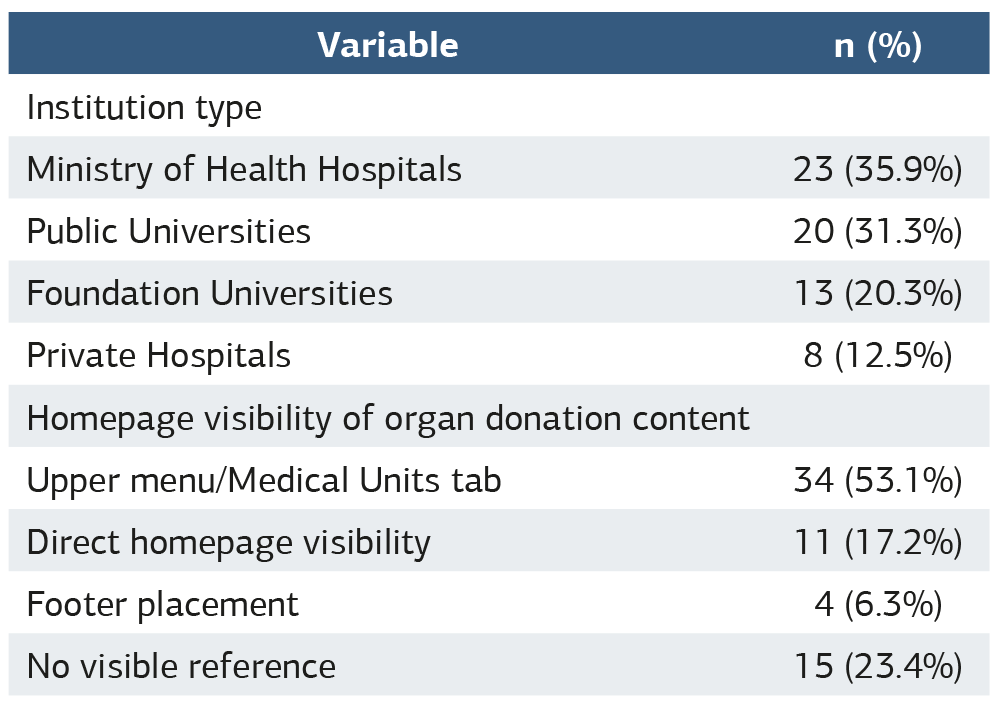
The table presents the distribution of institution types and the level of homepage visibility of organ donation or transplantation content across 64 unique corporate websites identified from the national transplant registry (ORGANKDS). Visibility was classified according to direct homepage access or placement within site navigation structures.
Additional Information
Publisher’s Note
Bayrakol MP remains neutral with regard to jurisdictional and institutional claims.
Rights and Permissions

This work is licensed under a Creative Commons Attribution-NonCommercial 4.0 International License (CC BY-NC 4.0). To view a copy of the license, visit https://creativecommons.org/licenses/by-nc/4.0/
About This Article
How to Cite This Article
Yusuf Yunus Korkmaz. Clinical transplant centers and digital organ donation communication: a national institutional analysis from Türkiye. Ann Clin Anal Med 2026;17(Suppl 2). doi:10.4328/ACAM.50092
Publication History
- Received:
- 19.02.2026
- Accepted:
- 17.03.2026
- Published Online:
- 17.03.2026
- Printed:
- 20.03.2026