
Abstract
AimEmergence delirium (ED) is a frequent and challenging complication in children after general anesthesia. The Pediatric Anesthesia Emergence Delirium (PAED) scale is widely used for its assessment, yet cultural adaptation is necessary. This study aimed to translate, adapt, and evaluate the Türkiye version of the PAED scale.MethodsA methodological study was conducted at Selçuk University between March and May 2025, including 373 pediatric patients aged 2–16 years (American Society of Anesthesiologists [ASA] I–III) undergoing elective surgery under general anesthesia. Exclusion criteria were neurological, psychiatric, or developmental disorders, emergency surgery, or major complications. The PAED scale was adapted according to Beaton’s six-step framework and WHO/consensus-based standards for the selection of health measurement instruments (COSMIN) guidelines. Two independent raters (an anesthesiologist and a post-anesthesia care unit [PACU] nurse) assessed each patient at recovery (T0) and 10 minutes later (T1). Internal consistency was measured with Cronbach’s α, inter-rater reliability with the intraclass correlation coefficient (ICC), and the concordance correlation coefficient (CCC). Deming regression and Bland–Altman analyses were used to evaluate bias and agreement.ResultsThe mean age was 7.46 ± 3.89 years; 68% were male. Median surgery and anesthesia times were 30 and 40 minutes, respectively. Cronbach’s α at T0 was 0.857 (Rater 1) and 0.817 (Rater 2), slightly decreasing at T1 (0.745 and 0.688). Inter-rater reliability remained excellent (ICC > 0.90; CCC > 0.90). Regression and Bland–Altman analyses confirmed minimal bias and strong agreement.ConclusionThe Türkiye PAED scale showed reliability and validity, with excellent inter-rater agreement and acceptable measurement error. It provides a tool for assessing ED in Türkiye populations.
Keywords
Introduction
Emergence delirium (ED) is defined as an acute condition occurring during recovery from general anesthesia in pediatric patients, characterized by confusion, agitation, hallucinations, restlessness, and inconsolable crying.1,2 It typically manifests within the first 30 minutes after anesthesia, often resolving spontaneously; however, in some cases, symptoms may persist for up to 45 minutes, and rarely even longer.3 The reported incidence of ED in children ranges between 2% and 80%, a variability largely attributed to differences in diagnostic criteria, patient age groups, surgical types, and anesthetic agents used.4 Beyond posing safety risks for the child, ED represents a challenging experience for both post-anesthesia care unit (PACU) staff and family members.5 Clinical intervention may be necessary to ensure airway security, protect intravenous lines, and prevent surgical site complications.1,4
Several risk factors have been identified in the development of ED. Rapid-acting inhalational agents, particularly sevoflurane, are strongly associated with this phenomenon.3 Additionally, high preoperative anxiety, age between 2 and 5 years, male sex, insufficient analgesia, rapid induction, and abrupt emergence have all been linked to an increased likelihood of ED.2,5 Other contributing elements may include a child’s temperament, the type and duration of surgery, and even cultural influences.5,6
Accurate recognition and assessment of ED are crucial for both clinical practice and research purposes. One of the most widely applied instruments is the Pediatric Anesthesia Emergence Delirium (PAED) scale, developed by Sikich and Lerman, which evaluates five behavioral indicators. By quantifying symptom presence and severity, the PAED scale supports clinical decision-making.5 Nevertheless, certain items of the tool have been criticized for limited specificity in distinguishing pain from delirium, highlighting the need for repeated evaluations of its validity and reliability across different populations.6
To date, the PAED scale has only been translated and culturally adapted into a limited number of languages.7,8 The present study aimed to translate the PAED scale into Türkiye and to adapt it for cultural relevance and practical applicability.
Materials and Methods
Study Design and ParticipantsThis methodological study was designed to evaluate the validity and reliability of the Türkiye version of the PAED scale. The study, with written parental consent, was conducted in the Operating Room Unit of the Anesthesiology and Reanimation Clinic at Selçuk University between March and May 2025. A total of 385 pediatric patients aged 2-16 years, classified as American Society of Anesthesiologists (ASA) Class I-III, cognitively sound, and undergoing elective surgery, were included in the study. Exclusion criteria included developmental delay, neurological disorders, severe psychiatric conditions, emergency procedures under general anesthesia, occurrence of major postoperative complications, need for postoperative mechanical ventilation, and preoperative sedative administration.PAED Scale and Assessment ProcedureThe PAED scale is a five-item behavioral tool assessing delirium after anesthesia in children: eye contact, purposeful actions, awareness of surroundings, restlessness, and inability to be consoled (5). Each item is rated from 0 to 4, yielding a total score between 0 and 20, with scores ≥10 indicative of delirium. The original version demonstrated an internal consistency of 0.89 and reliability of 0.84 (95% CI, 0.76–0.90).
Each child was assessed twice: once upon full recovery of consciousness in the PACU (T0) and again at the 10th minute (T1). Evaluations were conducted independently by two blinded raters (an anesthesiologist and a PACU nurse).Translation and Cross-Cultural AdaptationThe Türkiye adaptation of the PAED scale followed the six-step cross-cultural adaptation framework proposed by Beaton et al. 9
-Forward translation: Three anesthesiologists fluent in English independently translated the scale into Türkiye.
-Synthesis: The three versions were consolidated into a single draft, with disagreements resolved by consensus under expert supervision.
-Back translation: A bilingual English specialist, blinded to the study purpose, back-translated the scale into English.
-Expert committee review: All versions were reviewed to address ambiguities and ensure semantic and conceptual equivalence.
-Pre-testing: The draft version was reviewed by three anesthesiologists from different hospitals to assess clarity, clinical relevance, and comprehensibility.
- Finalization: Feedback from the pre-test phase was summarized, integrated, and approved by all authors.
The adaptation process adhered to the World Health Organization (WHO) guidelines on “Instrument Translation and Adaptation” and the consensus-based standards for the selection of health measurement instruments (COSMIN) checklist for cross-cultural validation.10 Linguistic, semantic, and conceptual equivalence were taken into account to ensure cultural appropriateness. Minor linguistic adjustments were introduced after pilot testing (n = 20), and an application guide was added to minimize scoring inconsistencies.Observer TrainingObservers, consisting of anesthesiologists and PACU anesthesia technicians with at least three years of experience, underwent a one-week standardized training program on the PAED scale. The training included theoretical sessions, video-based scoring exercises, and independent evaluation of 20 non-study patients. Interactive case discussions and practical scoring workshops were held at the end of the training to enhance inter-rater consistency.Data CollectionSociodemographic characteristics (age, sex, height, weight) were collected from parents, while surgical type, duration, anesthetic technique, and anesthesia time were recorded by the attending anesthesiologist in the PACU. The sample size was calculated to be 385, assuming a 5% margin of error, a 95% confidence level, and a 50% anticipated response rate.Ethical ApprovalThis study was approved by the Ethics Committee of Selçuk University (Date: 11.03.2025, Decision No: 05). The trial was registered before patient enrollment at ClinicalTrials.gov (Document Number: NCT06931249).Statistical AnalysisData were analyzed using R software (version 4.2.1; R Foundation for Statistical Computing, Vienna, Austria; www.r-project.org). A two-sided P value <0.05 was considered statistically significant. Continuous variables were presented as mean ± standard deviation (SD) or median (min–max), while categorical data were summarized as frequencies (n) and percentages (%).
Internal consistency of the PAED scale was examined for each rater using Cronbach’s alpha coefficients. A Cronbach α ≥0.70 was considered acceptable, and ≥0.80 indicated good reliability.11 Inter-rater reliability was assessed using both the intraclass correlation coefficient (ICC) and the concordance correlation coefficient (CCC). ICC values were calculated using a two-way random-effects model with an absolute agreement definition, following the recommendations of Shrout & Fleiss and Koo & Li.12,13 CCC, which evaluates both accuracy and precision, was computed as described by Ohyama.14 Reliability coefficients ≥ 0.90 were interpreted as excellent agreement.
To further explore measurement error between raters, Deming regression was applied, reporting slope and intercept with 95% confidence intervals to detect systematic or proportional bias. Bland–Altman analysis was also conducted to assess agreement at the individual level, with mean bias and 95% limits of agreement (LoA) calculated and visually inspected.
Reporting GuidelinesThis study was conducted and reported in accordance with the STROBE guidelines.
Results
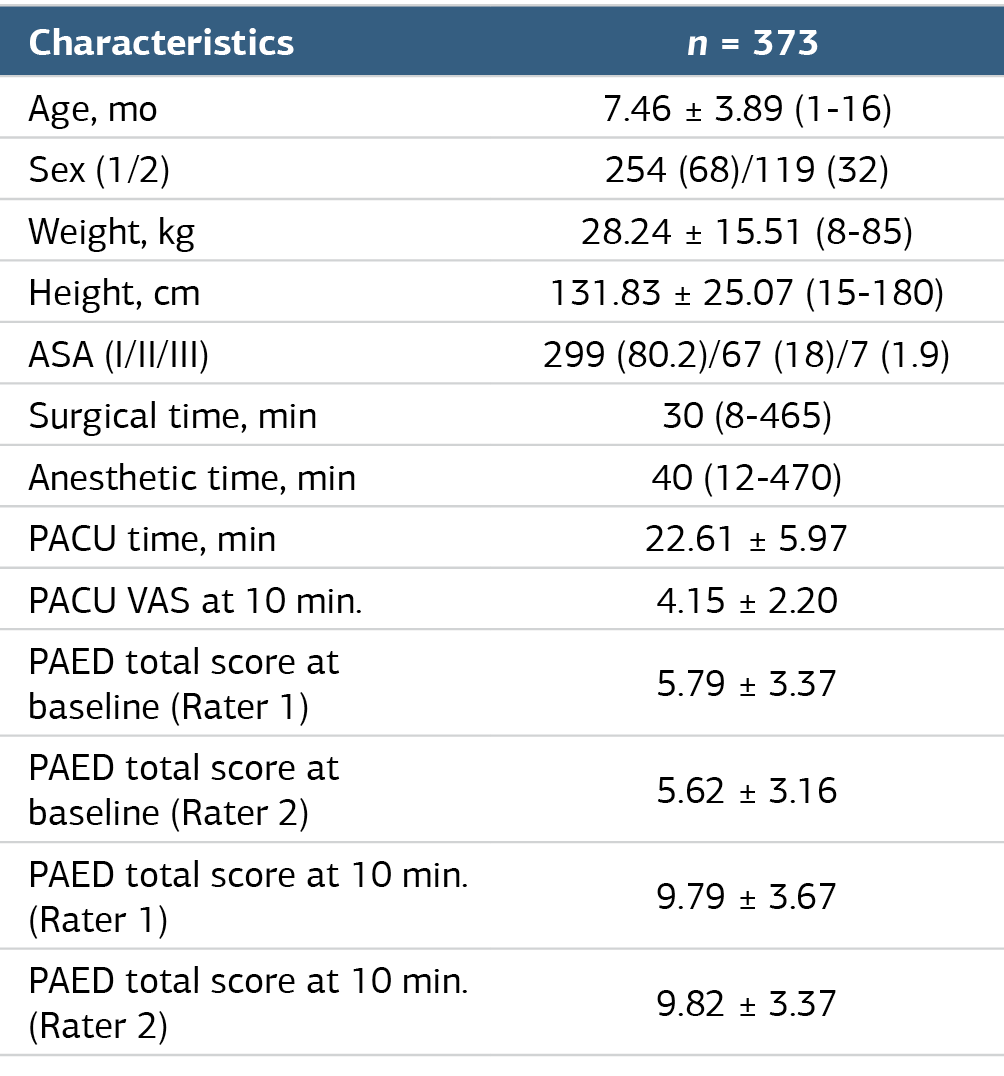
A total of 373 children with a mean age of 7.46 ± 3.89 years (range: 2–16 years) were included in the study, and 12 patients were excluded. The cohort comprised 68% boys and 32% girls. The majority of participants were classified as ASA I (80.2%), with fewer cases in ASA II (18%) and ASA III (1.9%). The median duration of surgery was 30 minutes (range: 8–465), and the median anesthesia duration was 40 minutes (range: 12–470). The mean PACU stay was 22.61 ± 5.97 minutes. PAED total scores increased from the T0 values of 5.79 ± 3.37 (Rater 1) and 5.62 ± 3.16 (Rater 2) to 9.79 ± 3.67 (Rater 1) and 9.82 ± 3.37 (Rater 2) at T1 (Table 1).
At T0, internal consistency of the PAED scale was good for both raters (Cronbach’s α = 0.857 [95% CI: 0.811–0.890, bootstrap] for Rater 1 and 0.817 [95% CI: 0.770–0.855, bootstrap] for Rater 2). At the 10-minute assessment, internal consistency showed a slight decline (α = 0.745 [95% CI: 0.682–0.793] for Rater 1 and 0.688 [95% CI: 0.610–0.744] for Rater 2). Except for Rater 2 at 10 minutes, confidence intervals suggested reliability levels ranging from acceptable to good.
Inter-rater agreement at T0 was excellent (CCC = 0.905, 95% CI: 0.854–0.946; ICC = 0.906, 95% CI: 0.883–0.926). Deming regression yielded the equation y = 0.23 + 0.93•x with a 95% CI for the slope of 0.87–0.98, indicating the absence of systematic bias (Supplementary Figure 1).
At T1, agreement remained high (CCC = 0.914, 95% CI: 0.845–0.962; ICC = 0.916, 95% CI: 0.894–0.934). The Deming regression line was y = 0.89 + 0.91•x (slope 95% CI: 0.86–0.95), demonstrating proportional consistency between raters. Both CCC and ICC values exceeding 0.90 confirmed very strong inter-rater reliability, and regression analysis supported the absence of clinically relevant systematic differences (Supplementary Figure 1). Bland–Altman analysis showed minimal bias and mean differences close to zero. At T0, mean bias was 0.169 (95% CI: 0.032–0.303) with LoA ranging from –2.600 to 2.938. At T1, bias was –0.035 (95% CI: –0.185 to 0.107) with LoA between –2.874 and 2.804. Most differences fell within the 95% LoA, and plots indicated no proportional bias. These results confirmed consistent and clinically acceptable ratings by the two observers across both time points (Supplementary Figure 2).
Discussion
This study represents the first Türkiye translation and cross-cultural adaptation of the Pediatric Anesthesia Emergence Delirium (PAED) scale, providing evidence of its validity and reliability in a pediatric population. The high ICC and CCC values, strong T0 Cronbach’s α, and absence of systematic error in Deming regression and Bland–Altman analyses align with findings from Spanish and Danish validation studies. Collectively, these outcomes suggest that the Türkiye PAED scale can be applied consistently by different clinicians, supporting its role in clinical decision-making.
The incidence of ED in our cohort was 19.03%, closer to the lower end of the 5–50% range commonly reported in the literature.15-17 The Spanish adaptation reported an incidence of 9.1%, the Danish version 13.2%, and a Saudi Arabian study 38.5%.7,8 Such variability may be explained by differences in study populations, surgical procedures, anesthetic practices, and cutoff thresholds. The relatively low incidence in our study likely reflects the predominance of elective, short-duration surgeries.
The PAED scale has been established as a valid tool for assessing postoperative delirium in children, with the original validation reporting internal consistency (Cronbach’s α ≈ 0.89) and inter-rater reliability (ICC ≈ 0.84). In our study, at T0, α values (0.857 for Rater 1 and 0.817 for Rater 2) were comparable to the original, while lower values at T1 (0.745 and 0.688) suggest a reduction in temporal sensitivity. This may reflect the rapidly changing clinical states of children in the PACU. Similarly, the Danish validation also observed a “floor effect,” indicating that the PAED scale may be less sensitive at certain postoperative time points.8 Our findings support this interpretation.
In the Spanish adaptation, kappa values ranged from 0.59 to 0.79, Cronbach’s α was 0.91, and inter-rater agreement ranged from 96.9% to 97.9%.7 These results are in line with our strong CCC and ICC values (>0.90). The Danish study also demonstrated high ICC values, supported by Bland–Altman plots showing good agreement, sensitivity, and specificity in diverse clinical contexts.8 Our regression and agreement analyses similarly indicated minimal bias and robust consistency across raters, corroborating the literature.
The strengths of our work include being the first Türkiye cultural adaptation of the PAED scale, contributing novel data to international literature, and demonstrating excellent inter-rater agreement (CCC and ICC > 0.90) with no systematic bias. Moreover, the good internal consistency observed at T0 reinforces the scale’s structural soundness for clinical use.
Limitations
There are some limitations in this study. First, the single-center design restricts generalizability. Second, test–retest reliability was not assessed, leaving uncertainty about consistency when applied to the same patient at different times. Third, the sample largely consisted of ASA I–II patients undergoing elective surgery, which may not reflect incidence rates in more complex or emergency cases. The low rate of premedication use in our cohort may further limit external applicability. Finally, discrepancies in cutoff thresholds for ED across studies complicate direct comparison of incidence rates.
Conclusion
This study successfully translated and culturally adapted the PAED scale into Türkiye, demonstrating its validity and reliability for use in pediatric patients. The scale showed high inter-rater agreement and was deemed suitable for clinical application. Its validation will facilitate systematic recognition and management of emergence delirium in children, as well as standardized data collection for future research. Multicenter studies involving larger and more diverse populations, along with assessments of test–retest reliability, are warranted to strengthen the evidence base for the use of the Türkiye PAED scale in pediatric anesthesia practice.
Declarations
Animal and Human Rights Statement
All procedures performed in this study were in accordance with the ethical standards of the institutional and/or national research committee and with the 1964 Declaration of Helsinki and its later amendments, or comparable ethical standards.
Informed Consent
Written informed consent was obtained from the parents or legal guardians of all participants prior to inclusion in the study.
Data Availability
The datasets used and/or analyzed during the current study are not publicly available due to patient privacy reasons, but are available from the corresponding author on reasonable request.
Conflict of Interest
The authors declare no conflict of interest.
Funding
None.
Author Contributions (CRediT Taxonomy)
Conceptualization: F.C.
Methodology: F.C., E.A.
Formal Analysis: F.C., E.A., M.S.U., M.S.
Investigation: F.C., E.A., M.S.U., M.S.
Data Curation: F.C, E.A., M.S.U., M.S.
Writing – Original Draft Preparation: F.C., E.A.
Writing – Review & Editing: F.C., I.K.
Supervision: F.C., I.K.
AI Usage Disclosure
The authors declare that no AI-assisted technologies were used.
Abbreviations
ASA: American society of anesthesiologists
CCC: Concordance correlation coefficient
CI: Confidence interval
COSMIN: Consensus-based standards for the selection of health measurement instruments
ED: Emergence delirium
ICC: Intraclass correlation coefficient
PACU: Post-anesthesia care unit
PAED: Pediatric anesthesia emergence delirium
SD: Standard deviation
STROBE: Strengthening the reporting of observational studies in epidemiology
T0: Initial PACU assessment after recovery of consciousness
T1: 10-minute PACU assessment
WHO: World health organization
References
- Chandler JR, Myers D, Mehta D, et al. Emergence delirium in children: A randomized trial to compare total intravenous anesthesia with propofol and remifentanil to inhalational sevoflurane anesthesia. Paediatr Anaesth. 2013;23(4):309-315. doi:10.1111/pan.12090
- Menser C, Smith H. Emergence agitation and delirium: considerations for epidemiology and routine monitoring in pediatric patients. Local Reg Anesth. 2020;13:73-83. doi:10.2147/LRA.S181459
- Vlajkovic GP, Sindjelic RP. Emergence delirium in children: many questions, few answers. Anesth Analg. 2007;104(1):84-91. doi:10.1213/01.ane.0000250914.91881.a8
- Reduque LL, Verghese ST. Paediatric emergence delirium. Continuing Education Anaesthesia, Critical Care & Pain. 2013;13(2):39-41. doi:10.1093/bjaceaccp/mks051
- Sikich N, Lerman J. Development and psychometric evaluation of the Pediatric Anesthesia Emergence Delirium scale. Anesthesiology. 2004;100(5):1138-1145. doi:10.1097/00000542-200405000-00015
- Ringblom J, Wåhlin I, Proczkowska M, Korhonen L, Årestedt K. Measurement properties of the pediatric anesthesia emergence delirium scale: a confirmatory factor analysis-based study. Pediatric Anesthesia. 2025;35(2):155-162. doi:10.1111/pan.15046
- Epulef V, Muñoz S, Alarcón AM, Vial M. Spanish version of the Pediatric Anesthesia Emergence Delirium scale: translation and cross‐cultural adaptation. BMC Anesthesiology. 2022;22(1):349. doi:10.1186/s12871-022-01893-1
- Simonsen BY, Skovby P, Lisby M. An evaluation of the Danish version of the Pediatric Anesthesia Emergence Delirium scale. Acta Anaesthesiol Scand. 2020;64(5):613-619. doi:10.1111/aas.13543
- Beaton DE, Bombardier C, Guillemin F, Ferraz MB. Guidelines for the process of cross-cultural adaptation of self-report measures. Spine. 2000;25(24):3186-3191. doi:10.1097/00007632-200012150-00014
- Mokkink LB, Terwee CB, Patrick DL, et al. The COSMIN study reached international consensus on taxonomy, terminology, and definitions of measurement properties for health-related patient-reported outcomes. J Clin Epidemiol. 2010;63(7):737-745. doi:10.1016/j.jclinepi.2010.02.006
- Nunnally JC, Bernstein IH. Psychometric Theory. 3rd ed. New York: McGraw-Hill; 1994.p.232-4.
- Shrout PE, Fleiss JL. Intraclass correlations: Uses in assessing rater reliability. Psychological Bulletin. 1979;86(2):420-428. doi:10.1037/0033-2909.86.2.420
- Koo TK, Li MY. A guideline of selecting and reporting intraclass correlation coefficients for reliability research. J Chiropr Med. 2016;15(2):155-163. doi:10.1016/j.jcm.2016.02.012
- Donner A, Wells G. A comparison of confidence interval methods for the intraclass correlation coefficient based on the one-way random effects model. Biometrics. 1986;42(2):401-412.
- Aono J, Ueda W, Mamiya K, Takimoto E, Manabe M. Greater incidence of delirium during recovery from Sevoflurane Anesthesia in Preschool Boys. Anesthesiology. 1997;87(6):1298-1300. doi:10.1097/00000542-199712000-00006
- Cole JW, Murray DJ, McAllister JD, Hirshberg GE. Emergence behaviour in children: defining the incidence of excitement and agitation following anaesthesia. Pediatr Anesth. 2002;12(5):442-447. doi:10.1046/j.1460-9592.2002.00868.x
- Banchs RJ, Lerman J. Preoperative anxiety management, emergence delirium, and postoperative behavior. Anesthesiol Clin. 2014;32(1):1-23. doi:10.1016/j.anclin.2013.10.011
Tables
Table 1. Characteristics of the Patients
Additional Information
Publisher’s Note
Bayrakol MP remains neutral with regard to jurisdictional and institutional claims.
Rights and Permissions

This work is licensed under a Creative Commons Attribution-NonCommercial 4.0 International License (CC BY-NC 4.0). To view a copy of the license, visit https://creativecommons.org/licenses/by-nc/4.0/
About This Article
How to Cite This Article
Faruk Cicekci, Emine Aslanlar, Mehmet Selcuk Uluer, Mehmet Sargin, Inci Kara. The Türkiye version of the pediatric anesthesia emergence delirium (PAED) scale: translation and cross-cultural adaptation. Ann Clin Anal Med 2026;17(9):935-938. doi:10.4328/ACAM.22869
Publication History
- Received:
- 30.08.2025
- Accepted:
- 13.10.2025
- Published Online:
- 31.03.2026
- Printed:
- 01.09.2026