
Abstract
AimLong-standing pubic-related groin pain (PRGP) is a multifactorial condition with limited evidence regarding associated clinical factors in the general population. This study aimed to evaluate the association between hip range of motion (ROM) parameters and long-standing PRGP.MethodsIn this retrospective observational study, 111 consecutive non-athletic patients presenting with groin pain were evaluated between December 2021 and December 2022. Passive hip ROM was measured at initial admission using a standard goniometer. Patients with persistent groin pain for more than three months and consistent physical examination findings underwent magnetic resonance imaging (MRI) to confirm the diagnosis. Variables significantly associated with PRGP in univariate analyses were included in a multivariate logistic regression model.ResultsThe mean age of the cohort was 42.0 ± 16.5 years, and 57.7% of the patients were male. Long-standing PRGP was diagnosed in 27 patients (24.3%). Lower age, male sex, and reduced hip internal rotation ROM on both the painful and non-painful sides were associated with PRGP (P < .05). In the multivariate model, reduced hip internal rotation ROM on the painful side (OR: 1.16, 95% CI: 1.01–1.33; P = .035) and on the non-painful side (OR: 1.16, 95% CI: 1.01–1.32; P = .031) remained independently associated with long-standing PRGP.ConclusionReduced hip internal rotation ROM was associated with long-standing PRGP in this study. These findings should be interpreted as an association rather than a causal relationship and may represent a clinically relevant finding during the evaluation of patients presenting with groin pain.
Keywords
Introduction
Groin pain is a frequently encountered and complex clinical problem due to the wide range of anatomical structures involved and the high prevalence of radiological findings in asymptomatic individuals.1 The Doha Agreement classified groin pain into adductor-related, iliopsoas-related, inguinal-related, pubic-related, and hip-related entities, providing a standardized clinical framework.2
Long-standing pubic-related groin pain (PRGP) is commonly attributed to repetitive stress at the pubic symphysis and is most frequently described in athletic populations.3,4 However, PRGP may also occur in non-athletic individuals, including those with occupational or daily activity-related loading.5 Pain in patients may arise during sports activities that involve sudden acceleration and jumping, as well as during daily activities such as getting out of bed quickly, climbing stairs, and sneezing.6
The diagnosis of long-standing PRGP is established through a combination of the patient’s history, physical examination, and radiological assessments. Local tenderness over the pubic symphysis and the immediately adjacent bone is a typical physical examination finding.7 While pelvic radiographs can be used for diagnosis, magnetic resonance imaging (MRI) is the preferred method.8 Pelvic MRI scans reveal various features, such as bone marrow edema in the pubic arms, accompanying edema in the surrounding muscles, the secondary cleft sign, increased fluid in the pubic symphysis joint, disc degeneration, and osteophytes.8,9
Anti-inflammatory drugs and rest are the initial treatment options for long-standing PRGP.4 In cases of recurrence, local steroid injections and rehabilitation can be considered.4,10 This condition typically responds well to an individual, progressive, multimodal rehabilitation program.3 Surgical intervention may become necessary if other treatment modalities fail in refractory cases.11 While the popularity of minimally invasive methods is increasing day by day, open surgical curettage, arthrodesis, and open excision of the pubic symphysis can also be applied.11,12
While several biomechanical factors have been proposed to contribute to PRGP, evidence regarding associated clinical parameters in the general population remains limited. Restricted hip range of motion, particularly internal rotation, has been suggested as a potential contributor to altered pelvic mechanics. Most existing studies have primarily evaluated male athletic populations with relatively small sample sizes, which may limit the generalizability of their findings.2,12,13
The aim of the present study was to evaluate the association between hip ROM parameters and long-standing PRGP in a non-athletic population using a retrospective observational design.
Materials and Methods
Study Design and PatientsBetween December 2021 and December 2022, consecutive non-athletic patients aged 18 to 65 with groin pain for the past month were included in this retrospective observational cohort study. Among the 146 consecutive patients initially identified, 26 patients with associated hip pathologies, including clinically symptomatic femoroacetabular impingement, and 6 patients who had previously undergone hip surgery were excluded from the study due to these conditions having the potential to affect the hip ROM of the patients. Three patients were lost to follow-up, and the remaining 111 patients were included.Diagnosis of Long-Standing PRGPInitial medical treatment was initiated, and the patients were called for a follow-up three months later for re-evaluation. Patients with persistent groin pain and consistent physical examination findings were further evaluated with MRI scans to diagnose long-standing PRGP. The diagnosis parameters for the PRGP were as follows.2,14 (i) Patients with a history of unilateral groin pain >3 months around the pubis, with local tenderness of the pubic symphysis and the immediately adjacent bone, (ii) pain had to decrease during warm-up and reappear after training, (iii) a positive adductor squeeze test, and (iv) the presence of parasymphyseal pubic bone marrow oedema observed on MRI (Figure 1).
The MRI scans were obtained using a 1.5 Tesla machine (Philips, Suzhou, China). Independent evaluations of the MRI scans were conducted by three experienced orthopedists, and any differing assessments were resolved through a collaborative consensus.Hip Range of Motion AssessmentPassive hip ROM was routinely measured at admission using a standard goniometer. The assessor (an experienced orthopedist) was blind to the final diagnosis of the patients. All ROM measurements were standardized: Flexion was measured in the supine position. Abduction and adduction were measured in the supine position, with the leg in full extension. Internal rotation and external rotation were measured with the knee and hip in 90° of flexion and in the supine position. Extension was measured in the prone position with the leg in full extension. All these measurements were applied to both hips of the patients.Ethical ApprovalThis study was approved by the Ethics Committee of Yalova University (Date: 10.03.2023, Decision No: 2023/43).Statistical AnalysisStatistical analysis was performed using the statistical package SPSS software (Version 25.0, SPSS Inc., Chicago, IL, USA). Continuous variables were described as means ± standard deviation. The Kolmogorov-Smirnov test was used for assessing the normality of the data. Comparisons between groups were performed using the Student’s t-test for normally distributed data and the Mann-Whitney U test for non-normally distributed data. Categorical variables were expressed as numbers and percentages. The categorical variables between the groups were analyzed using the chi-square or Fisher’s exact test. To determine the association with long-standing PRGP, statistically significant variables from the univariate analysis were used to create the multivariate logistic regression analysis model. Multicollinearity was assessed prior to model construction, and variance inflation factors were within acceptable limits. Values of P < .05 were considered statistically significant.
Reporting GuidelinesThis study is reported in accordance with the STROBE guidelines.
Results
One hundred and eleven patients were included in the final analysis. The mean age of the patients was 42.0 ± 16.5 (range, 18-50). Sixty-four (57.7%) of the patients were male. Long-standing PRGP was present in 27 (24.3%) patients. The mean age of the PRGP group was 35.7 ± 3.2 years, and that of the non-PRGP group was 44.0 ± 1.8 years. Lower age was significantly associated with long-standing PRGP (odds ratio [OR]: 1.10, 95% confidence interval [CI]: 1.04- 1.20, P = .023) (Table 1).
The percentages of male and female patients were 88.9% and 11.1% in the PRGP group, respectively. The percentages of male and female patients were 47.6% and 52.4% in the non-PRGP group, respectively. There was a statistically significant difference between the groups (OR: 8.80, 95% CI 2.40-31.50, P < .001) (Table 1).
Patients with PRGP demonstrated significantly lower hip internal rotation ROM on both the painful and non-painful sides compared with patients without PRGP (P < .001). Other hip ROM parameters (flexion, extension, abduction, adduction, and external rotation) did not differ significantly between the groups (P > .05). The detailed data are provided in Supplementary Table 1.
To determine the independent factors associated with long-standing PRGP, statistically significant variables from the univariate analysis were used to create the multivariate logistic regression analysis model. In the model, reduced hip internal rotation ROM on both sides remained independently associated with long-standing PRGP. Age and sex were not independently associated with PRGP in the adjusted model (P = .035 and 0.031, respectively) (Table 2). Lower hip internal rotation ROM was independently associated with increased odds of long-standing PRGP (OR per degree decrease: 1.16).
Discussion
From a clinical perspective, hip range of motion assessment is a routine component of orthopedic examination, and identifying functional limitations associated with groin pain may provide additional insight during daily practice.
The most important finding of the current study was that hip internal rotation ROM on both the painful and non-painful sides was independently associated with long-standing PRGP in a non-athletic population. Unlike previous studies focusing primarily on athletes, the present study extends these observations to a broader clinical population. The inclusion of internal rotation ROM from both hips was intended to reflect a bilateral and systemic limitation rather than a side-specific effect. The presence of bilateral hip internal rotation limitation, even in patients with unilateral symptoms, supports the concept of a generalized biomechanical predisposition rather than a purely side-specific pathology. This finding may have implications for both clinical assessment and rehabilitation strategies. From a clinical standpoint, routine assessment of hip internal rotation ROM may help identify patients at risk for long-standing PRGP, even in the absence of athletic activity. In previous studies, limited hip internal and external rotation has been found to be associated with chronic groin injuries.12,15,16 These studies did not evaluate other ROM of the patients, and included solely male athletes with small sample sizes.15,16 A more recent study found an association between hip internal rotation, external rotation, and adduction ROM limitation and a higher incidence of osteitis pubis.17 The study also included only male athletes and emphasized that its findings might not apply to other populations. Additionally, the number of patients they examined was limited.17 Although long-standing PRGP is commonly seen in athletes, this condition is not limited to young individuals or athletes. Our study evaluated the factors associated with long-standing pubic-related groin pain in the general population.
The possible mechanism by which hip internal rotation ROM limitation causes an increase in PRGP incidence has been investigated in a cadaveric study.13 The study demonstrated that limited hip internal rotation ROM causes increased rotational motion at the pubic symphysis. The study also emphasized that repetitive loading of the pubic symphysis is thought to lead to increased symphyseal motion. This hypermobility at the pubic symphysis can cause pubic bone marrow edema and degeneration in the pubic symphysis joint and has been shown to be associated with osteitis pubis,4 a term commonly used instead of the long-standing PRGP before the Doha agreement.2 Moreover, a cross-sectional MRI study demonstrated that the frequency of osteitis pubis was increased in non-athletic patients with femoroacetabular impingement syndrome, which is a disease in which the ROM of the hip are typically limited. The study concluded that further clinical studies are required to determine whether their MRI results reflect the clinical findings.18 It was also shown that treatment of femoroacetabular impingement and hip ROM limitation can resolve pubic bone marrow edema among competitive soccer players.19 In our study, we showed that hip internal rotation ROM limitation was independently associated with long-standing pubic-related groin pain.
The functional internal rotation ROM of the hip joint is crucial, especially for athletes, with a reported norm of around 30 degrees.20 In our study, among unilateral long-standing PRGP patients, the mean hip internal rotation ROM was 16.9° ± 1.2° on the painful side and 17.3° ± 1.3° on the contralateral side. On the other hand, the mean hip internal rotation ROM was not limited in the non-PRGP group. Lower hip internal rotation ROM on both sides was observed in patients with long-standing PRGP. Although this finding suggests a potential biomechanical association, the retrospective nature of the study does not allow conclusions regarding temporal sequence or preventive implications. In line with this consideration, a previous case report obtained improvement of groin pain with rehabilitation exercises in a football player with femoroacetabular impingement and limited hip ROM.21
There is a scarcity of studies evaluating the conditions associated with long-standing PRGP.22,23 Although age showed a univariate association with long-standing PRGP (P = .023), it did not remain independently associated in the multivariate analysis. Therefore, age should be interpreted as a potential confounding variable rather than an independent factor. In another study, the male sex was found to be associated with athletic pubalgia.24 In our study, we observed a higher rate of long-standing PRGP in male patients (P < .001). The loss of significance of age and sex in the multivariate model suggests that their apparent association with PRGP may be mediated through hip internal rotation ROM limitation.
Limitations
The current study has several limitations. First, physical activity level, occupational loading, body mass index, and comorbidities were not evaluated, which may have influenced hip ROM measurements. Secondly, only a single measurement was performed each time a joint was examined. It has been shown that a single measurement can be as reliable as the average of multiple measurements.25 Nevertheless, multiple measurements might be more reliable in joints with a larger range of motion, such as the hip joint.25 Third, pre-existing comorbidities and body mass index of the patients were not included in our analysis, which might affect the ROM of the patients. Additionally, hip morphology (e.g., alpha angle) was not evaluated, which may partially explain the observed limitations in hip internal rotation. Fourth, this was a retrospective evaluation, and therefore, the groups were not randomized.
Conclusion
In conclusion, reduced hip internal rotation ROM was associated with long-standing PRGP in this retrospective cohort. These findings may assist clinicians during routine functional evaluation of patients presenting with groin pain; however, prospective studies are required to clarify causality. Future studies are warranted, focusing on whether early enhancement of hip internal rotation ROM with rehabilitation is useful for preventing the development of this condition.
Declarations
Animal and Human Rights Statement
All procedures performed in this study were in accordance with the ethical standards of the institutional and/or national research committee and with the 1964 Helsinki Declaration and its later amendments or comparable ethical standards.
Informed Consent
Written informed consent was obtained from all individual participants included in the study.
Data Availability
The datasets used and/or analyzed in the current study are not publicly available due to patient privacy concerns but are available from the corresponding author upon reasonable request.
Conflict of Interest
The authors declare no conflict of interest.
Funding
None.
Author Contributions (CRediT Taxonomy)
Conceptualization: S.Ö., Z.E.Ç., İ.G.
Methodology: S.Ö., Z.E.Ç., İ.G.
Software: S.Ö., Z.E.Ç., İ.G.
Validation: S.Ö., Z.E.Ç., İ.G.
Formal analysis: S.Ö., Z.E.Ç., İ.G.
Investigation: S.Ö., Z.E.Ç., İ.G.
Resources: S.Ö., Z.E.Ç., İ.G.
Data curation: S.Ö., Z.E.Ç., İ.G.
Writing-original draft: S.Ö., Z.E.Ç., İ.G.
Writing-review & editing: S.Ö., Z.E.Ç., İ.G.
Visualization: S.Ö., Z.E.Ç., İ.G.
Supervision: S.Ö., Z.E.Ç., İ.G.
Project administration: S.Ö., Z.E.Ç., İ.G.
Funding acquisition: S.Ö., Z.E.Ç., İ.G.
AI Usage Disclosure
The authors declare that no AI-assisted technologies were used.
Abbreviations
CI: Confidence interval
MRI: Magnetic resonance imaging
OR: Odds ratio
PRGP: Pubic-related groin pain
ROM: Range of motion
SPSS: Statistical package for the social sciences
STROBE: Strengthening the reporting of observational studies in epidemiology
References
- Paajanen H, Hermunen H, Ristolainen L, Branci S. Long-standing groin pain in contact sports: a prospective case-control and MRI study. BMJ Open Sport Exerc Med. 2019;5(1):e000507. doi:10.1136/bmjsem-2018-000507
- Weir A, Brukner P, Delahunt E, et al. Doha agreement meeting on terminology and definitions in groin pain in athletes. Br J Sports Med. 2015;49(12):768-774. doi:10.1136/bjsports-2015-094869
- Schöberl M, Prantl L, Loose O, et al. Non-surgical treatment of pubic overload and groin pain in amateur football players: a prospective double-blinded randomized controlled study. Knee Surg Sports Traumatol Arthrosc. 2017;25(6):1958-1966. doi:10.1007/s00167-017-4423-z
- Angoules AG. Osteitis pubis in elite athletes: diagnostic and therapeutic approach. World J Orthop. 2015;6(9):672-679. doi:10.5312/wjo.v6.i9.672
- Choi H, McCartney M, Best TM. Treatment of osteitis pubis and osteomyelitis of the pubic symphysis in athletes: a systematic review. Br J Sports Med. 2011;45(1):57-64. doi:10.1136/bjsm.2008.050989
- Rodriguez C, Miguel A, Lima H, Heinrichs K. Osteitis pubis syndrome in the professional soccer athlete: a case report. J Athl Train. 2001;36(4):437-440.
- Verrall GM, Slavotinek JP, Barnes PG, Fon GT. Description of pain provocation tests used for the diagnosis of sports-related chronic groin pain. Scand J Med Sci Sports. 2005;15(1):36-42. doi:10.1111/j.1600-0838.2004.00380.x
- Kunduracioglu B, Yilmaz C, Yorubulut M, Kudas S. Magnetic resonance findings of osteitis pubis. J Magn Reson Imaging. 2007;25(3):535-539. doi:10.1002/jmri.20818
- Branci S, Thorborg K, Nielsen MB, Hölmich P. Radiological findings in symphyseal and adductor-related groin pain in athletes: a critical review. Br J Sports Med. 2013;47(10):611-619. doi:10.1136/bjsports-2012-091905
- Cheatham SW, Kolber MJ, Shimamura KK. Effectiveness of nonoperative rehabilitation programs for athletes diagnosed with osteitis pubis. J Sport Rehabil. 2016;25(4):399-403. doi:10.1123/jsr.2015-0016
- Mehin R, Meek R, O’Brien P, Blachut P. Surgery for osteitis pubis. Can J Surg. 2006;49(3):170-176.
- Ganal I, Çelen ZE. Midterm functional outcomes of arthroscopically treated recalcitrant osteitis pubis in competitive soccer players. Orthop J Sports Med. 2023;11(10):23259671231203677. doi:10.1177/23259671231203677
- Birmingham PM, Kelly BT, Jacobs R, McGrady L, Wang M. Effect of dynamic femoroacetabular impingement on pubic symphysis motion: a cadaveric study. Am J Sports Med. 2012;40(5):1113-1118. doi:10.1177/0363546512437723
- Via AG, Frizziero A, Finotti P, Oliva F, Randelli F, Maffuli N. Management of osteitis pubis in athletes: rehabilitation and return to training- a review of the most recent literature. Open Access J Sports Med. 2018;10:1-10.
- Verrall GM, Hamilton IA, Slavotinek JP, et al. Hip joint range of motion reduction in sports-related chronic groin injury. J Sci Med Sport. 2005;8(1):77-84. doi:10.1016/S1440-2440(05)80027-1
- Verrall GM, Slavotinek JP, Barnes PG, et al. Hip joint range of motion restriction precedes athletic chronic groin injury. J Sci Med Sport. 2007;10(6):463-466. doi:10.1016/j.jsams.2006.11.006
- Ceballos-Laita L, Hernando-Garijo I, Medrano-de-la-Fuente R, Mingo-Gomez MT, Carrasco-Uribarren A, Jimenez-Del-Barrio S. Hip range of motion and strength in male athletes with stage 1 osteitis pubis. Int J Environ Res Public Health. 2022;19(19):12824. doi:10.3390/ijerph191912824
- Akgün AS, Agirman M. Association between cam-type femoroacetabular impingement and osteitis pubis in non-athletic population. J Orthop Surg Res. 2019;14(1):329. doi:10.1186/s13018-019-1368-6
- Saito M, Utsunomiya H, Hatakeyama A, et al. Hip arthroscopic management can improve osteitis pubis and bone marrow edema. Am J Sports Med. 2019;47(2):408-419. doi:10.1177/0363546518819099
- Roach KE, Miles TP. Normal hip and knee active range of motion: relationship to age. Phys Ther. 1991;71(9):656-665. doi:10.1093/ptj/71.9.656
- Ludwig O, Schneider G, Kelm J. Improvement of groin pain in a football player with femoroacetabular impingement. J Clin Med. 2023;12(23):7443. doi:10.3390/jcm12237443
- Shimodaira H, Hatakeyama A, Suzuki H, et al. Prevalence and risk factors of pubic bone marrow edema in femoroacetabular impingement and hip dysplasia. J Hip Preserv Surg. 2021;8(4):318-324.
- Eberbach H, Fürst-Meroth D, Kloos F, et al. Long-standing pubic-related groin pain in professional academy soccer players. BMC Musculoskelet Disord. 2021;22(1):958. doi:10.1186/s12891-021-04837-x
- Varada S, Moy MP, Wu F, et al. Prevalence of athletic pubalgia imaging findings on MRI in patients with femoroacetabular impingement. Skeletal Radiol. 2020;49(8):1249-1258. doi:10.1007/s00256-020-03405-z
- Lea RD, Gerhardt JJ. Range-of-motion measurements. J Bone Joint Surg Am. 1995;77(5):784-798. doi:10.2106/00004623-199505000-00017
Tables
Table 1. Demographic Features Between the Groups
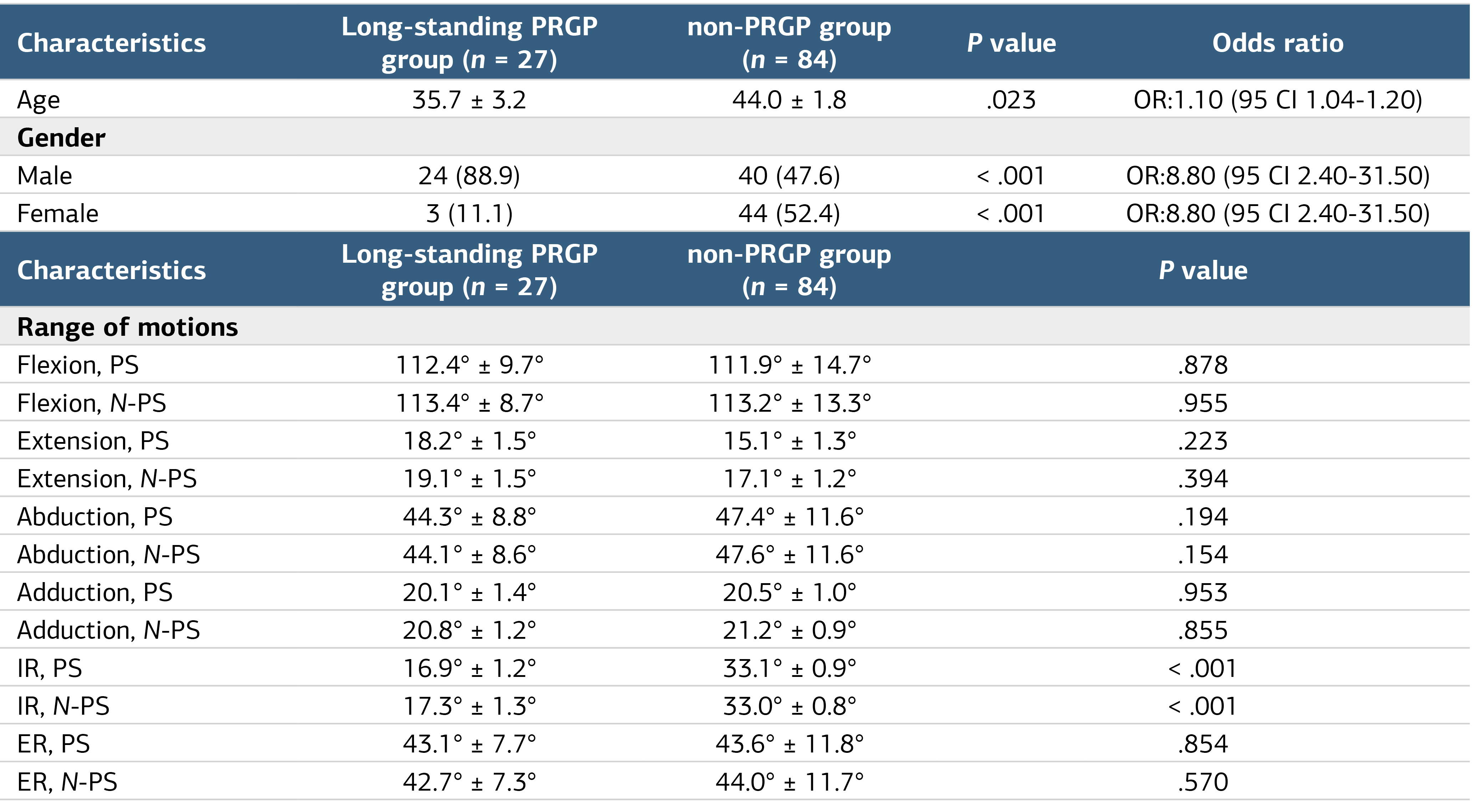
Abbreviations: PRGP, Pubic-related groin pain; OR, Odds ratio; CI, confidence interval.
Table 2. Multivariate Analysis Results of the Conditions Associated with Long-Standing Pubic-Related Groin Pain

Abbreviations: CI, confidence interval; PS, painful side; N-PS, non-painful side; IR, internal rotation.
Figures
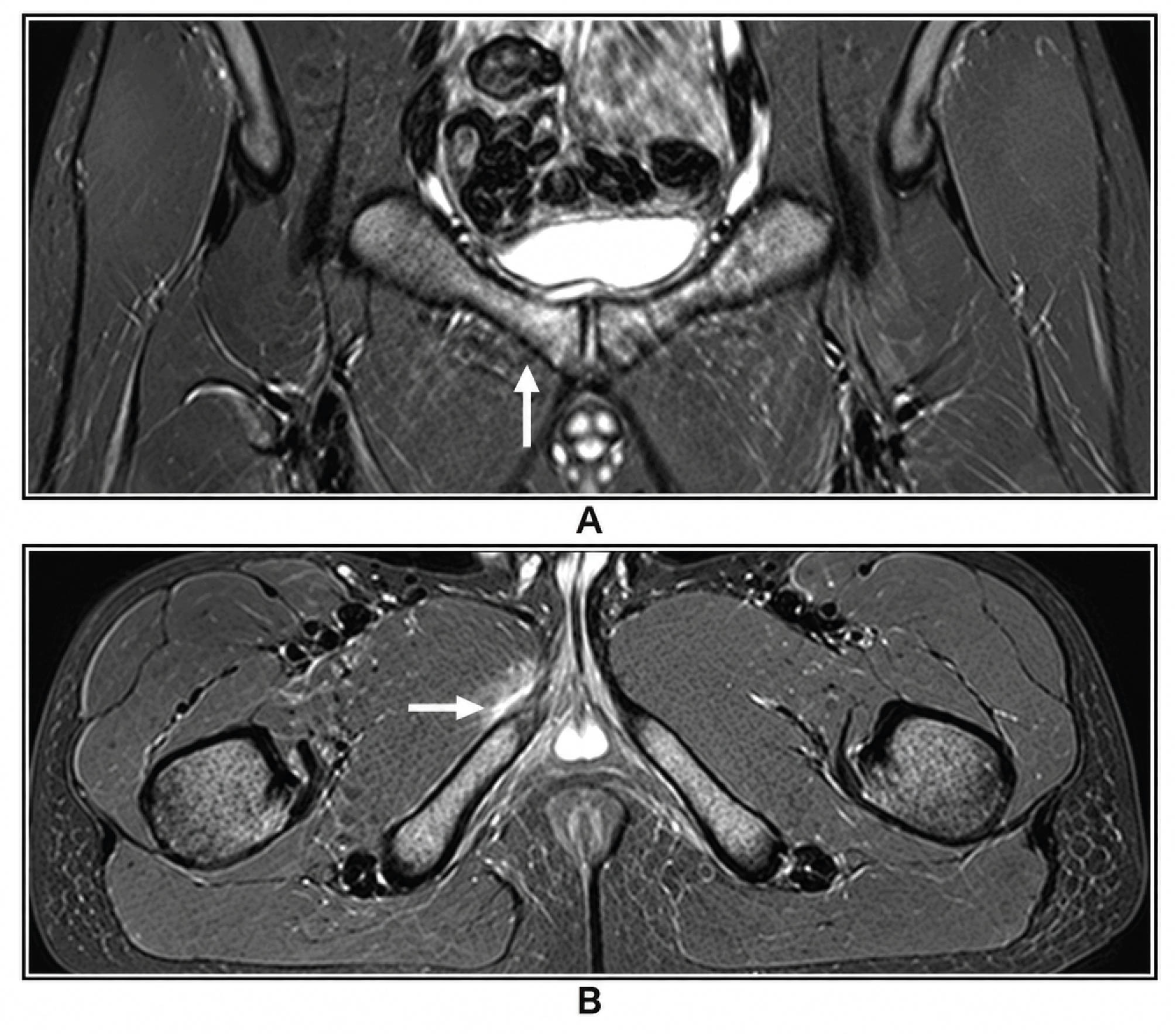
Figure 1. Coronal (A) and axial (B) magnetic resonance images demonstrate bone marrow oedema in the pubic bone (white arrow) and surrounding soft tissues (black arrow) on the right side
Additional Information
Publisher’s Note
Bayrakol MP remains neutral with regard to jurisdictional and institutional claims.
Rights and Permissions

This work is licensed under a Creative Commons Attribution-NonCommercial 4.0 International License (CC BY-NC 4.0). To view a copy of the license, visit https://creativecommons.org/licenses/by-nc/4.0/
About This Article
How to Cite This Article
İlker Ganal, Zekeriya Ersin Çelen, Seçkin Özcan. Association between hip internal rotation range of motion and long-standing pubic-related groin pain: a retrospective observational study. Ann Clin Anal Med. Articles in Press. doi:10.4328/ACAM.50054
Publication History
- Received:
- 26.01.2026
- Accepted:
- 01.04.2026
- Published Online:
- 07.04.2026
- Printed:
- 01.11.2026