
Abstract
AimIt aims to improve our knowledge about clinical care after gunshot wounds, whether surgery is required, the characteristics and origins of the injury, and the localization in which it is frequently seen on the body.MethodsThe hospital records for the five years between 2019 and 2023 were examined retrospectively, and cases with firearm injuries were identified and included in the study. The patient data, including age, sex, etiology, anatomic location of the firearm injury, treatment modality, and hospitalization duration, were obtained from the Hospital Information Management System (FONET) of xxx University Hospital.ResultsWhen the origin of gunshot wounds before hospital admission was examined, it was found that the most common admission was after assault injuries, with a rate of 51.7% (n=75). Most of the patients applying were in the young age group between 18-35 years of age, with 47.9% (n=70), and the most frequently injured internal organs were the small and large intestines (25 cases).ConclusionIn the studies conducted, the mean age was determined as 27.5, 29, 31.4, 34.5, and 36, and it was reported that 83-97.1% of the cases were male. Similarly, in our study, the mean age of all cases applying with gunshot wounds was found to be 28.9, and 83.6% of the cases were male. Similar to the studies in the literature and our analysis, most of the gunshot wounds occurred as a result of intentional injuries, that is, assaults. Very few of them resulted from suicide attempts because most of the gunshot wounds that occurred after suicide attempts resulted in death at the scene, which keeps the hospital admission rate low.
Keywords
Introduction
Gunshot wounds are complex, severe, and traumatic injuries frequently encountered in forensic medicine practice and constitute a significant portion of trauma patients admitted to hospitals. As firearms become easier to obtain, firearm-related injuries and deaths are becoming more common. Firearmrelated injuries are an important public health problem that causes premature death, disease, and disability.1-3 However, the number of nonfatal gunshot wounds and the characteristics of patients and injuries are not well known.4
Gunshot wounds are usually characterized by serious damage caused by bullets or shrapnel fragments that penetrate tissue at great speed. The severity of the injury varies depending on many factors, such as the caliber of the bullet, the angle of entry, the organs damaged, and the duration of first aid.5
The points where the bullet enters and exits the body and the path it follows in the body provide important clues in the initial assessment to help determine the prognosis, evaluation, and treatment of gunshot wounds.5-6
Following gunshot wounds, pneumothorax, hemothorax, and cardiac tamponade in the chest area; liver, spleen, small and large intestine perforations and major vascular injuries in the abdomen; bone fractures, vascular and nerve injuries in the extremity area are common medical conditions requiring emergency intervention.7
Rapid diagnosis and correct intervention are of vital importance for patients presenting after gunshot wounds.7 In the first stage, after such injuries, the patient should be stabilized, and life-threatening conditions should be quickly identified. When necessary, the condition of the internal organs should be assessed with imaging methods such as X-ray, ultrasound, and CT. Although the treatment process varies according to the severity of the injury and the damaged organs, it has been reported that cases requiring surgical intervention should be taken to emergency surgery to repair the damage.7-8
This study describes gunshot wounds treated at Harran University Hospital and aims to improve our knowledge about these injuries, clinical care, characteristics, and origins of injuries. It also provides information about the locations where gunshot wounds are frequently seen in the body and the medical conditions frequently seen after gunshot wounds.
Materials and Methods
The patient data, including age, sex, etiology, anatomic location of the firearm injury, treatment modality, and hospitalization duration, were obtained from the Hospital Information Management System (FONET) of Şanlıurfa Harran University Hospital. The hospital records for the five years between 2019 and 2023 were examined retrospectively, and cases with firearm injuries were identified and included in the study.
Cases presenting with firearm injuries, according to the application history, were divided into four groups: intentional injuries, suicide attempts, unintentional injuries, and unknown. Firearm injuries are classified as face, head and neck area, upper extremity, chest region, abdominal region, back, and lower extremity according to the body location of the bullet or shrapnel.
The study was conducted on cases admitted to Harran hospital.
The hospital is 18 km away from the city center, and since there are many hospitals in the city center. However, the study was conducted in a large city in southeastern Turkey, and the number of cases was limited because patients tend to seek emergency treatment at the nearest hospital after gunshot wounds.Ethical ApprovalThis study was approved by the Ethics Committee of Harran University (Date: 30.04.2024, Decision No: E-76244175-050.04-330802)Statistical AnalysisData were analyzed using SPSS for Windows version 21.0 software (IBM Corp., Armonk, NY, USA). Descriptive statistics were presented as mean and standard deviation (SD) values for continuous variables and as frequency (n) and percentage (%) for categorical variables. A Chi-squared test was used in the analysis of contingency tables when the sample size was > 5. Fisher’s Exact test was used to determine relationships between categorical variables in crosstabs with an expected count < 5. A value of p<0.05 was accepted as the level of statistical significance.Reporting GuidelinesThe study was reported in accordance with STROBE guideline.
Results
Over the five years between 2019 and 2023, 146 patients were admitted to our hospital due to Firearm Injury. The 146 patients comprised 122 (83.6%) males with a mean age of 28.8 ± 13.03 years (range, 5 – 75 years) and 24 (16.4%) females with a mean age of 29.1 ± 18.26 years (range, 7-64 years).
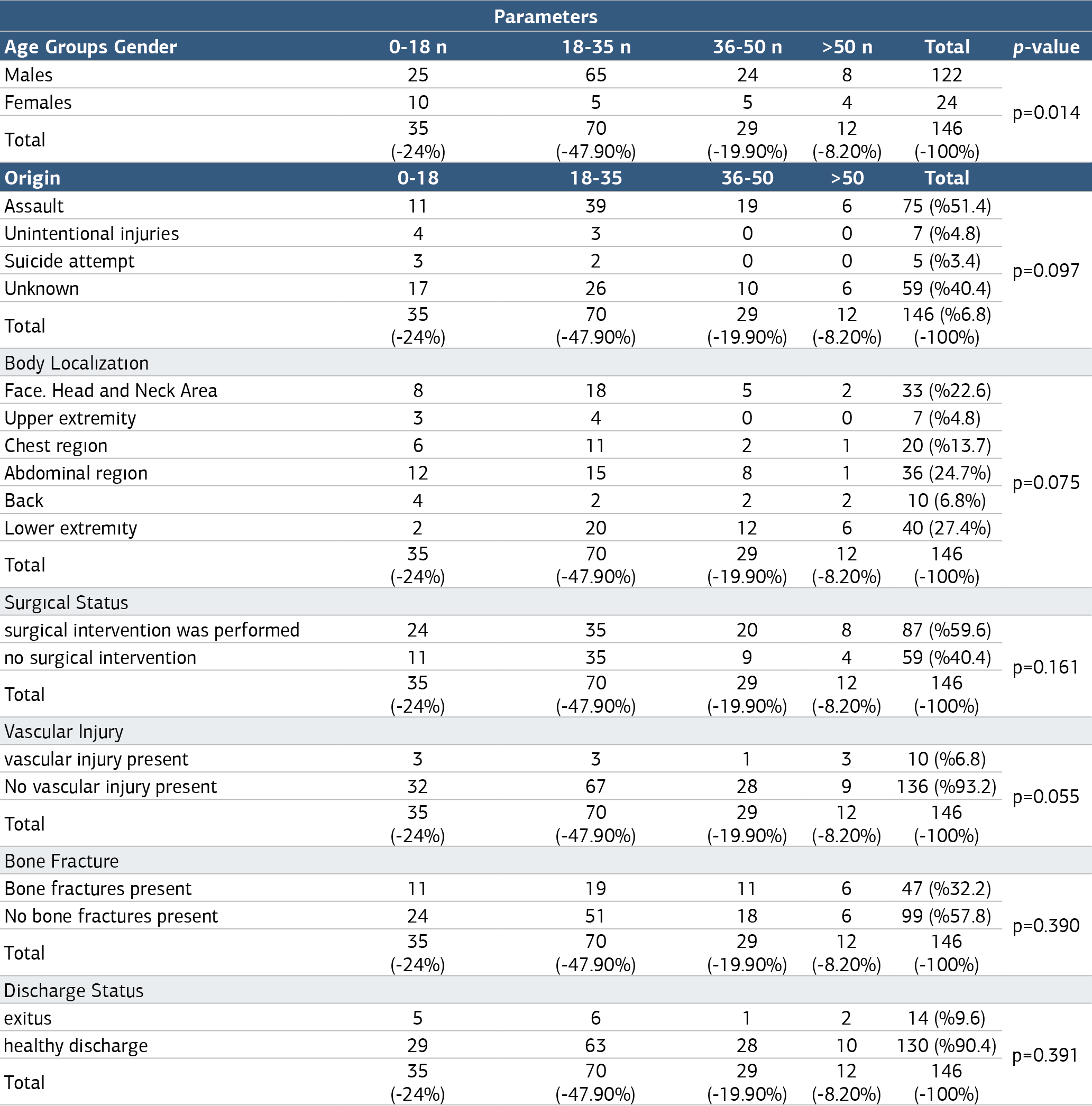
Among the patients admitted after gunshot wounds, 24% (n=35) were younger than 18 years old, 47.9% (n=70) were aged 18–35 years, 19.9% (n=29) were aged 36–50 years, and 8.2% (n=12) were older than 50 years.
Regarding the cause of gunshot wounds, 51.7% (n=75) were assault injuries, 4.8% (n=7) were unintentional injuries, 3.4% (n=5) were suicide attempts, and 40.4% (n=59) were unknown (Table 1 and 2). The localization of the gunshot wounds was determined as follows: the face, head, and neck region in 33 cases (22.6%), the upper extremity in 7 cases (4.8%), the chest region in 20 cases (13.7%), the abdomen in 36 cases (24.7%), the back in 10 cases (6.8%), and the lower extremity in 40 cases (27.4%) (p=0.000). For the treatment of gunshot wounds, 87 patients (59.6%) underwent surgery, while 59 patients (40.4%) did not. Among those who required surgery, patients with abdominal region injuries were operated on most frequently. The most frequently injured internal organs among the operated cases were the small and large intestines (25 cases), followed by the lungs (19 cases), brain (8 cases), liver (6 cases), kidneys (5 cases), stomach (4 cases), spleen (4 cases), testis (3 cases), pancreas (1 case), heart (1 case), and esophagus (1 case).
Vascular injuries were present in 10 patients (6.8%) admitted after gunshot wounds, while vascular injuries were not detected in 136 patients (93.2%). In 10 cases, injuries were detected in 12 different vessels, the most common being the inferior vena cava (3 cases), followed by the popliteal arteries (2 cases), renal arteries (2 cases), femoral artery (1 case), abdominal aorta (1 case), subclavian artery (1 case), jugular vein (1 case), and tibial artery (1 case).
The most frequently broken bones were skull bones (12 cases), followed by the femur (9 cases), vertebrae (7 cases), pelvis (6cases), scapula (4 cases), foot bones (4 cases), tibia (3 cases), fibula (1 case), and radius (1 case).
Of the cases admitted to the hospital with gunshot wounds, six patients (4.1%) died without surgery, and eight patients (5.5%) died during or after surgery. In total, 14 patients (9.6%) died. Among the deceased cases, 12 patients had internal organ injuries, three patients had vascular injuries, and five patients had bone fractures.
The mean hospitalization duration was 9.2 ± 26.0 days (range, 1-282 days).
Discussion
In our study, the average age of men presenting with gunshot wounds was 28.8, the average age of women was 29.1, the average age of all cases was 28.9, and 83.6% of the cases were male. In the study conducted by Rivara et al., the average age was found to be 29, and 83% of the cases were reported as male.4 In the study conducted by Karaca et al., the average age was found to be 36, and 90.1% of the cases were reported to be male.7 In the study conducted by Spitzer et al., the average age of individuals with gunshot wounds was 27.5, and 89.6% were male.9 The study conducted by Shah et al. found the average age of individuals with gunshot wounds to be 34.5, with 97,1% being male.10 In their Gunshot Wounds to the Head, the study conducted by Schoen et al. stated that the average age of patients applying to the hospital was 31.4, with 91,4% being male.11 Our study had an average age compatible with the literature and consisted largely of male cases.
In our study, the most common known cause was assault at 51.4%, while the least common was attempted suicide at 3.4%. Rivara et al. stated that 72.9% of gunshot injuries occurred due to assault, while 3.9% were due to suicide attempts.4 In the study conducted by Gastineau et al., approximately 65% of gunshot injuries were due to homicide, 30% to suicide, 3.5% to unintentional injuries, 2% to intent, and 0.5% to legal interventions.12 In the Spitzer study, assault injuries were the most common at 69.7%, while self-inflicted injuries were the least common at 1.7%.9 In the Simpson study, assault injuries were the most common at 58.09%, while self-inflicted injuries were the least common at 3.26%.13 In our study and line with the literature, the majority of gunshot wounds occur as a result of intentional injuries, i.e., assaults, while very few results from suicide attempts because the majority of gunshot wounds occurring after suicide attempts result in death at the scene.14 which keeps the hospitalization rate low.
In our study, in terms of distribution according to body localization, it was most frequently seen in the lower extremities, with a rate of 27.4%. This was followed by the abdominal region with a rate of 24.7%, the face, head, and neck region with a rate of 22.6%, and the least frequently seen in the upper extremities with a rate of 4.8%. In the study conducted by Karaca et al., it was reported that gunshot wounds were most frequently seen in the lower extremities (48%).7 In the Simpson study, it was reported that gunshot wounds were most frequently seen in the Extremities/pelvic bones (46.5%).13 In the study by Nyberger et al., gunshot wounds were most frequently seen in the lower extremities (29.7%).15 This situation is compatible with the literature; this is thought to be because the majority of gunshot wounds in hospital admissions are offensive, with the aim being to injure rather than kill, meaning that attackers target the lower extremities rather than lethal body parts.
In our study, 59.6% of the patients received surgical intervention, and 40.4% did not receive surgical intervention. Nguyen et al. reported that 78.5% of gunshot wounds in the study that resulted in injuries to the extremities only were in the lower extremities, and 71.8% required surgery.16 Karaca et al. reported that 49% of gunshot wounds required surgical treatment.7
In our study, among the patients admitted after gunshot wounds, 24% were younger than 18 years old, 47.9% were aged 18–35 years, 19.9% were aged 36–50 years, and 8.2% were older than 50 years. Gunshot-related deaths were reported to be increasing annually in all countries, with gunshot wounds affecting people of all ages but largely concentrated in young males in large cities.15 Rivara et al. It was stated that 81% of the gunshot injuries were between the ages of 20 and 65 in the distribution by age.4 Karaca et al. reported that gunshot wounds were seen in people between the ages of 30- 40.7 Sheffy et al. reported that 60% of gunshot victims were young people between the ages of 19 and 30.10 In our study, similar to the literature, it was observed that the most frequent application was in the young age group.
In our study, vascular injuries were detected in 12 different vessels in 10 cases (6.8%) that presented after gunshot wounds. The most common of these was the inferior vena cava, with 3 cases, followed by the popliteal and renal arteries, with 2 cases each. Among the deceased cases, 12 patients had internal organ injuries, and three patients had vascular injuries. Nguyen et al. reported that the most common anatomic vascular injury was in the lower extremity (41.7%), and the most common vascular injury was the common femoral artery (17.6%), followed by the superficial femoral (7.1%) and iliac arteries (7.1%).17 Ghorbani et al. reported that hemorrhage was the cause of death in 70% of all penetrating trauma cases.18 Gunshot-related vascular injuries, particularly those in the chest and abdomen, have been reported to cause significant morbidity and mortality.17
The mean hospitalization duration was 9.2 ± 26.0 days (range, 1-282 days). Ghorbani et al. reported that the median length of hospital stay was three days.18 Budema et al. reported that the median length of hospital stay was 34 days in their study.19 In our study, the average length of hospital stay was determined as nine days. A significant difference was found between the minimum and maximum periods in the literature and in our study, and it was thought that this difference may be because the length of hospital stay may vary depending on the location and severity of injury in hospitalized patients.
Limitations
The biggest limitation of the current study was our limited number of patients. Our insufficient sample size prevented the data distributions from reaching statistical significance. The second limitation of our study was that it was retrospective, and we were not able to extract more descriptive data. Finally, this study was conducted in a single tertiary hospital in the southeastern region of Turkey, and large multicenter series are needed for useful results that broadly reflect national data.
Conclusion
It has been found that assault is the most common cause of firearm injuries, and it continues to be a serious and costly public health problem in our country. Gunshot wounds have serious consequences, both medically and socially. By being informed about the medical disorders frequently seen in the management of such cases, the patient’s chance of survival can increase with rapid and effective intervention.
Additionally, considering the lethal nature of gunshot wounds, enacting firearm control laws to prevent such injuries and making it difficult for unauthorized individuals to access firearms will reduce the frequency of such hospital admissions in the long term.
Declarations
Animal and Human Rights Statement
All procedures performed in this study were in accordance with the ethical standards of the institutional and/or national research committee and with the 1964 Helsinki Declaration and its later amendments or comparable ethical standards.
Informed Consent
Informed consent was waived due to the retrospective design of the study.
Data Availability
The datasets used and/or analyzed during the current study are not publicly available due to patient privacy reasons but are available from the corresponding author on reasonable request.
Conflict of Interest
The authors declare that there is no conflict of interest.
Funding
None.
Abbreviations
CT: Computed tomography
SD: Standard deviation
References
- Stefanopoulos PK, Pinialidis DE, Hadjigeorgiou GF, et al. Wound ballistics 101: the mechanisms of soft tissue wounding by bullets. Eur J Trauma Emerg Surg. 2017;43(5):579-586. doi:10.1007/s00068-015-0581-1
- Vatansever G, Yılmaz H, Nalbant T, et al. Clinical characteristics of firearm-related injuries in children in Turkey. Turk J Pediatr. 2022;64(6):971-984. doi:10.24953/turkjped.2021.4564
- Fowler KA, Dahlberg LL, Haileyesus T, et al. Childhood firearm injuries in the United States. Pediatrics. 2017;140(4):2017-2298. doi:10.1542/peds.2016-3486
- Rivara FP, Hink AB, Kuhls D, et al. Firearm injuries in Missouri. PLoS One. 2023;18(11). doi:10.1371/journal.pone.0294737
- Baum GR, Baum JT, Hayward D, et al. Gunshot wounds: ballistics, pathology, and treatment recommendations, with a focus on retained bullets. Orthop Res Rev. 2022;14:293-317. doi:10.2147/orr.s378278
- Pinto A, Russo A, Reginelli A, et al. Gunshot wounds: ballistics and imaging findings. Semin Ultrasound CT MR. 2019;40(1):25-35. doi:10.1053/j.sult.2018.10.018
- Karaca MA, Kartal ND, Erbil B, et al. Evaluation of gunshot wounds in the emergency department. Turk J Trauma Emerg Surg. 2015;21(4):248-255. doi:10.5505/tjtes.2015.64495
- Reginelli A, Russo A, Maresca D, et al. Imaging assessment of gunshot wounds. Semin Ultrasound CT MR. 2015;36(1):57-67. doi:10.1053/j.sult.2014.10.005
- Spitzer SA, Pear VA, McCort CD, et al. Incidence, distribution, and lethality of firearm injuries in California from 2005 to 2015. JAMA Netw Open. 2020;3(8):2014736. doi:10.1001/jamanetworkopen.2020.14736
- Shah AA, Rehman A, Shah SJ, et al. Abdominal gunshot wounds: comparative assessment of severity measures. J Surg Res. 2015;198(2):334-339. doi:10.1016/j.jss.2015.03.061
- Schoen N, Matichak D, Armstrong V, et al. The cost of gunshot wounds to the head: an unevenly distributed burden. World Neurosurg. 2023;172:201-211. doi:10.1016/j.wneu.2022.12.130
- Gastineau KAB, McKay S. Firearm injury prevention. Pediatr Clin North Am. 2023;70(6):1125-1142. doi:10.1016/j.pcl.2023.07.003
- Simpson JT, Hussein MH, Toraih EA, et al. Trends and burden of firearm-related injuries among children and adolescents: a national perspective. J Surg Res. 2022;280:63-73. doi:10.1016/j.jss.2022.06.065
- Cai Z, Junus A, Chang Q, et al. The lethality of suicide methods: a systematic review and meta-analysis. J Affect Disord. 2022;300:121-129. doi:10.1016/j.jad.2021.12.054
- Nyberger K, Caragounis EC, Djerf P, et al. Epidemiology of firearm injuries in Sweden. Eur J Trauma Emerg Surg. 2022;48(3):2349-2357. doi:10.1007/s00068-021-01735-8
- Nguyen MP, Savakus JC, Reich MS, et al. Costs of care for low-energy extremity gunshot injuries are reduced with standardized treatment. J Orthop Trauma. 2021;35(2):61-63. doi:10.1097/bot.0000000000001870
- Nyberger K, Caragounis EC, Djerf P, et al. Management and outcomes of firearm-related vascular injuries. Scand J Trauma Resusc Emerg Med. 2023;31(1):35. doi:10.1186/s13049-023-01098-6
- Ghorbani P, Falkén M, Riddez L, et al. Clinical review is essential to evaluate 30-day mortality after trauma. Scand J Trauma Resusc Emerg Med. 2014;22(1):18. doi:10.1186/1757-7241-22-18
- Budema PM, Murhega RB, Tshimbombu TN, et al. Fatal and nonfatal firearm injuries in the eastern Democratic Republic of Congo: a hospital-based retrospective descriptive cohort study assessing correlates of adult mortality. BMC Emerg Med. 2021;21(1):116. doi:10.1186/s12873-021-00506-3
Tables
Table 1. The relationship between the origin of trauma, the body location hit by the gunshot, vascular injury, surgical status, bone fracture, and discharge status according to age groups.
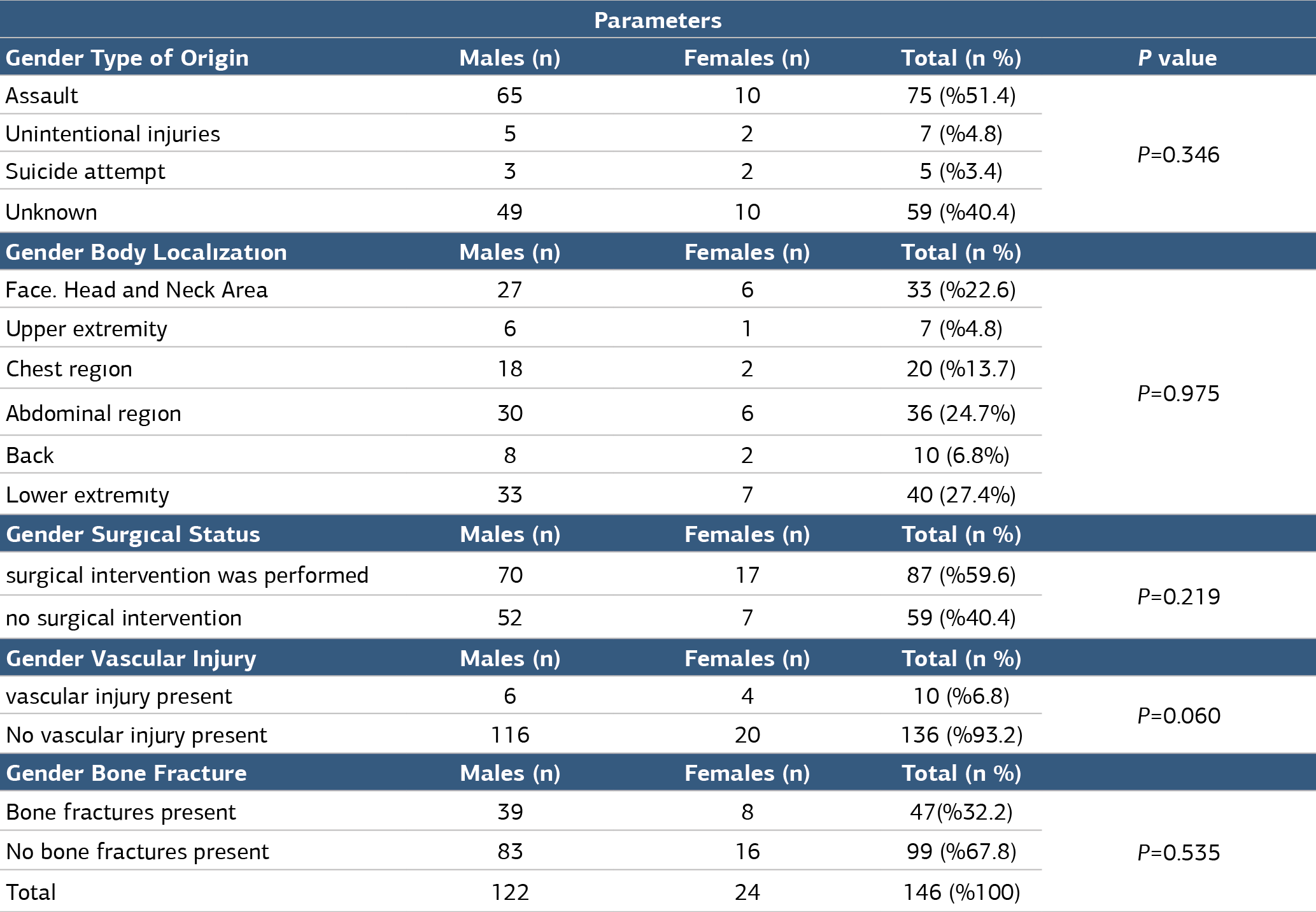
Table 2. The relationship between trauma origin, body localization hited by the gunshot, vascular injury, surgical status, bone fracture, and discharge status according to age groups
Additional Information
Publisher’s Note
Bayrakol MP remains neutral with regard to jurisdictional and institutional claims.
Rights and Permissions

This work is licensed under a Creative Commons Attribution-NonCommercial 4.0 International License (CC BY-NC 4.0). To view a copy of the license, visit https://creativecommons.org/licenses/by-nc/4.0/
About This Article
How to Cite This Article
Ugur Demir, Hüseyin Kafadar. Medicolegal evaluation of firearm injury cases admitted to a university hospital. Ann Clin Anal Med 2025;16(3):152-156. doi:10.4328/ACAM.22408
Publication History
- Received:
- 16.09.2024
- Accepted:
- 04.11.2024
- Published Online:
- 13.11.2024
- Printed:
- 01.03.2025