
Abstract
AimTo develop a literature-derived, rule-based Contrast Media Decision Support Simulator (CMDS) that operationalizes key contrast safety recommendations without using patient data.MethodsCurrent American College of Radiology (ACR) and European Society of Urogenital Radiology (ESUR) guidelines were converted into auditable condition–action rules across five modules addressing allergy prophylaxis, renal risk, metformin management, gadolinium-based contrast agent (GBCA) use, and acute reactions. The simulator presents traffic-light triage, management action cards, and an epinephrine-centered emergency pathway. Verification was performed using 30 synthetic scenarios varying by renal function, administration route, contrast class, prior reactions, and metformin use.ResultsThe finalized ruleset included 10 top-level rules. The simulator achieved 100% concordance with guideline-derived reference decisions across all scenarios, with full traceability and near-instantaneous decision generation.ConclusionA guideline-aligned, rule-based simulator can standardize contrast-related decision-making and support education and workflow rehearsal without reliance on patient data.
Keywords
Introduction
Iodinated and gadolinium-based contrast agents are essential in contemporary radiology, with major societies emphasizing standardized risk assessment and immediate access to management algorithms. Evolving guidance distinguishes contrast-associated acute kidney injury (AKI) from the far less common contrast-induced AKI, reducing unnecessary imaging deferrals and supporting rational prophylaxis.1
Allergic-like reactions remain a key safety concern, with prior reactions to the same contrast class representing the strongest predictor of recurrence, whereas unrelated allergies do not confer increased risk.2 Similarly, metformin management has been simplified, with interruption generally unnecessary in patients with estimated glomerular filtration rate (eGFR) ≥ 30 mL/min / 1.73 m² receiving intravenous contrast, except in cases of severe renal impairment, AKI, or intra-arterial first-pass exposure.3
Prompt recognition and epinephrine-based management of acute reactions are critical, yet real-world adherence to emergency algorithms remains inconsistent.4 Despite comprehensive guidelines, variability persists across contrast-related decisions, reflecting a “last-mile” gap in translating narrative recommendations into practice. To address this gap, we developed a Contrast Media Decision Support Simulator that operationalizes American College of Radiology (ACR) and European Society of Urogenital Radiology (ESUR) guidance into auditable, rule-based pathways and evaluated its concordance using synthetic scenarios.5 This study aimed to develop and perform specification-level verification a literature- and rule-based Contrast Media Decision Support Simulator (CMDS) using synthetic scenarios.
Materials and Methods
Study DesignThis was a literature-only software development and specification-testing study conducted in two phases: guideline-based rule engineering and verification using synthetic scenarios. No patient or institutional data were used; therefore, ethics approval was not required, and the simulator was designed for educational and workflow rehearsal purposes rather than clinical automation.
The simulator operationalizes guideline-based decisions for allergy risk, renal stratification, metformin management, and acute reaction treatment. The primary objective was to assess guideline concordance across predefined scenarios, with secondary objectives including rule coverage, decision traceability, and qualitative latency assessment.
Candidate rules were derived from the most recent ACR Manual on Contrast Media and ESUR Contrast Media Guidelines, supplemented by reputable institutional resources for acute reaction and metformin management. All sources were documented with access dates, and discrepancies were resolved by prioritizing current major society guidance.6,7
Guideline statements were encoded as modular condition–action rules addressing allergy risk, renal stratification, metformin management, and acute reaction treatment. Rules were assigned explicit priorities, with anaphylaxis management overriding non-urgent logic, and each rule was annotated with source provenance to ensure auditability.
The simulator processes synthetic patient profiles incorporating key clinical variables and generates triage status, guideline-based action cards, and an acute reaction pathway, without ingesting or producing any patient data.
A 30-scenario specification set was constructed to sample key axes, including renal function, administration route, contrast class, prior same-class allergic-like reaction, and metformin use, with explicit boundary checks (e.g, eGFR 29↔30, IV vs intra-arterial first-pass). For each scenario, guideline-derived reference decisions were independently abstracted by two investigators and resolved by consensus. Simulator outputs were compared against these references to assess concordance, with secondary evaluation of traceability, rule coverage, and qualitative decision latency. Scenario definitions and rule mappings are provided in Supplementary Materials (S1–S3).
The simulator displays source citations next to each recommendation and includes a banner that states local policies and drug availability take precedence. The tool does not execute orders and does not replace clinical judgment.Sources and Evidence SynthesisStatements were curated from the most recent ACR Manual on Contrast Media and ESUR Guidelines on Contrast Agents, supplemented by reputable institutional resources for acute reaction and metformin management. Guidance was abstracted into a structured evidence table, with discrepancies resolved by prioritizing the latest major society recommendations and documenting access dates.Rule EngineeringGuideline statements were translated into condition–action rules organized across allergy prophylaxis, renal risk stratification, metformin management, and acute reaction treatment. Rules were assigned explicit priorities, with acute reaction management overriding non-urgent logic, and each rule was annotated with source provenance to support transparency, auditability, and version control.Simulator ArchitectureThe simulator consists of a rule engine that processes structured inputs and generates cited recommendations and a lightweight interface that presents triage status, management actions, and an acute reaction pathway, without integration with clinical systems.Simulator Inputs and OutputsThe simulator uses synthetic patient profiles incorporating key clinical variables such as imaging modality, administration route, renal function, medication use, and prior contrast reactions. Outputs include triage status, guideline-based management recommendations, and a stepwise acute reaction pathway, with each recommendation linked to its source for traceability.Verification (Specification Tests)Specification testing was performed using 30 synthetic scenarios designed to cover key decision axes, including renal function, administration route, contrast class, prior same-class allergic-like reaction, and metformin use, with explicit boundary checks (e.g., eGFR 29↔30, IV vs intra-arterial first-pass). Stress combinations such as intra-arterial exposure with metformin use or severe prior reactions were also included.
For each scenario, guideline-derived reference decisions were independently abstracted by two investigators from curated ACR / ESUR guidance and resolved by consensus. The primary endpoint was concordance between simulator outputs and reference decisions, with secondary endpoints including decision traceability and qualitative latency assessment. All machine-readable artifacts are provided in the Supplementary Materials (S1–S3).Outcome MeasuresThe primary outcome was exact-match concordance between simulator outputs and guideline-derived reference decisions. Secondary outcomes included guideline coverage, decision traceability, and qualitative assessment of system performance.Ethical ApprovalEthical approval was not required.
Statistical AnalysisAll analyses were performed on the 30-scenario specification set, with concordance evaluated at the decision-link level, defined as each (ScenarioID, DecisionID) →RuleID comparison between simulator outputs and guideline-derived reference decisions. Concordance was summarized descriptively as the proportion of exact matches across key strata, including renal function, administration route, contrast class, prior same-class reaction, and metformin status. Secondary analyses included assessment of scenario coverage, traceability of recommendations to source documents, and qualitative evaluation of decision latency. Because this study represents a specification-level verification using synthetic data, no hypothesis testing or inferential statistics were performed. Boundary-condition checks around key thresholds were conducted to confirm expected rule behavior, and analyses were implemented using standard Python libraries with full reproducibility supported by the Supplementary Materials 1–3.Reporting GuidelinesNo specific reporting guideline applied to this study.
Results
Society guidelines were synthesized into a modular ruleset comprising 10 prioritized rules across five domains, with each rule linked to explicit source provenance to ensure transparency and auditability.
Table 1 provides an overview of the final ruleset, summarizing the five decision modules, their top-level rules, and key clinical triggers, with safety priorities and full rule documentation detailed in the Supplementary Materials (S1–S3) and Figure 1.
Thirty synthetic scenarios were constructed to span key axes of renal function, administration route, contrast class, prior same-class reaction, and metformin use, providing balanced coverage across clinically relevant strata. All scenario-to-rule decision mappings and rationales are documented in the traceability map (Supplementary Materials (S1–S3) ).
Table 2 summarizes the 30 synthetic scenarios used for specification testing, covering key axes including renal function, administration route, contrast class, prior same-class reactions, and metformin use, with full scenario definitions and rule mappings provided in Supplementary Materials (S1–S3).
Across 30 synthetic scenarios, the simulator achieved 100% concordance with guideline-derived reference decisions, with complete traceability and no priority conflicts. Safety overrides consistently activated the Acute Reaction pathway when indicated, and boundary checks showed predictable behavior. As this was a specification-level evaluation, further expert review and usability studies are needed.
Decision computation was effectively instantaneous across all scenarios, reflecting the deterministic, rule-based design with single-pass evaluation, priority short-circuiting, and no external input/output operations.
Representative synthetic cases illustrate simulator outputs across common high-risk situations, including renal impairment with prior same-class reaction prompting renal precautions and premedication, advanced chronic kidney disease favoring Group II GBCA use, and intra-arterial first-pass exposure with AKI requiring renal risk mitigation and temporary metformin discontinuation.
Figure 1 illustrates a schematic three-panel user interface of the Contrast Media Decision Support Simulator using a synthetic case. Panel A shows traffic-light triage based on guideline-derived risk factors. Panel B presents actionable management cards for allergy prophylaxis, renal/route considerations, and metformin handling with inline provenance. Panel C displays a stepwise acute reaction pathway prioritizing early epinephrine, with safety overrides suppressing non-urgent guidance during anaphylaxis.
When anaphylaxis criteria were met, the simulator consistently activated a hard override that prioritized the Acute Reaction pathway and suppressed all non-urgent recommendations, ensuring immediate focus on airway, breathing, circulation, and early epinephrine administration.8,9Priority Logic and Conflict ResolutionThe Acute Reaction module has absolute priority, enforcing an epinephrine-first, stepwise emergency pathway that temporarily suppresses all nonurgent recommendations until stabilization is achieved.User-Interface SafeguardsDuring acute reactions, the interface enforces a single-path, stepwise emergency workflow with visual alerts, timed reassessment cues, and a post-stabilization checklist to support safe and consistent management.Ambiguity and Missing Data HandlingWhen data are incomplete, the engine defaults to the acute reaction pathway in the presence of textual danger signs; at the same time, isolated mild symptoms prompt supportive care with the option for rapid escalation.Edge Cases and ConstraintsDuring acute reactions, the simulator suppresses preventive measures, limits dosing guidance to adult protocols with pediatric pathways explicitly flagged as not implemented, and surfaces medication-related cautions while maintaining epinephrine as first-line therapy.Audit and TraceabilityAll override events are logged with timestamped actions and citation trails, and once the emergency resolves, the simulator restores routine decision support with a concise, auditable post-event summary.
Discussion
This study demonstrates that a literature-derived, rule-based simulator can translate contrast media guidelines into transparent, auditable decision pathways that standardize clinical reasoning without reliance on patient data or clinical system integration.
We translated contemporary guideline recommendations into a ruleset of 10 top-level, prioritized condition–action rules across five modules. We verified their performance using 30 synthetic scenarios that varied across renal function, administration route, contrast class, prior same-class reactions, and metformin use. The simulator achieved exact-match concordance with all guideline-derived reference decisions, with each recommendation linked to explicit provenance metadata, ensuring end-to-end traceability.7 Boundary-condition testing demonstrated predictable transitions at key thresholds, and safety overrides consistently prioritized acute reaction management. These findings show that narrative contrast media guidance can be operationalized into transparent, verifiable decision logic suitable for standardized reasoning and further usability-focused evaluation.
Previous efforts to improve contrast media safety have focused on local protocols, checklists, staff education, order-entry alerts, and risk calculators, which are useful but often rely on manual recall, static guidance, or isolated risk estimates and may be prone to alert fatigue or implementation drift.10,11 In contrast, the present simulator operationalizes guideline text into a machine-readable, rule-based framework with explicit priority handling, traceable recommendations, and deterministic outputs. By providing stepwise, citable action cards that integrate allergy history, renal risk, administration route, metformin management, and acute reaction pathways, this approach complements existing protocols by translating narrative guidance into transparent and reproducible decision logic suitable for both clinical rehearsal and education.12
The simulator’s triage–management acute pathway structure mirrors clinical decision-making and supports both education and workflow rehearsal. Scenario-based use enables training in boundary conditions, rare but critical events such as anaphylaxis, and nuanced guideline distinctions, while traceable recommendations facilitate structured feedback and guideline literacy.13,14 In practice, the tool may support simulation-based onboarding, policy alignment, and quality review by allowing reproducible case replay and adaptation to local protocols through configurable, data-driven rules.
The simulator is designed to ensure explainability, safety, and auditability. Each recommendation is accompanied by a brief rationale and explicit provenance metadata, enabling transparent and inspectable decision support. Rules are maintained as versioned, machine-readable artifacts with regression testing to ensure consistency as guidance evolves. Safety-critical pathways, particularly acute reaction management, override non-urgent recommendations to prioritize life-saving actions.15,16 A traceability map links each decision to its originating rule and source, supporting quality review, reproducibility, and adaptation to site-specific policies through configurable parameters rather than code changes.
Future efforts will include expert review against institutional policies, usability testing with trainees, and simulation-based drills focusing on acute reactions. Non-interruptive prospective deployment may be used to analyze recommendations and clinician overrides. Expansion to additional domains, pediatric pathways, multilingual interfaces, and technical enhancements such as rule editors and guideline-diff alerts is planned.
Limitations
This study represents a specification-level evaluation using synthetic scenarios and does not assess clinical outcomes, usability, or workflow impact. Local adaptation may be required due to heterogeneity in evidence and site-specific practices, including formulary constraints and pediatric dosing variations. Certain subpopulations, such as pregnant patients and detailed pediatric weight-based pathways, were not comprehensively addressed but can be incorporated as modular extensions. Ongoing updates will be necessary to maintain alignment with evolving guidelines.
Conclusion
A rule-based, guideline-aligned contrast media simulator can operationalize safety recommendations into transparent, teachable, and auditable decision pathways without patient data. By addressing the “last-mile” gap between written guidance and clinical action, such tools may enhance education, consistency, and preparedness in radiology practice. Future work will focus on usability testing and simulation-based educational outcomes.16
Declarations
Animal and Human Rights Statement
This study did not involve any human participants or animal subjects.
Informed Consent
Not applicable.
Data Availability
All data are synthetic and are provided within the article.
Conflict of Interest
The authors declare no conflict of interest.
Funding
None.
Author Contributions (CRediT Taxonomy)
Conceptualization: B.T.B.
Methodology: B.T.B.
Software: B.T.B.
Validation: B.A.
Formal analysis: B.A.
Investigation: B.A.
Resources: B.A.
Data curation: B.T.B.
Writing – original draft: B.T.B.
Writing – review & editing: B.T.B.
Visualization: B.T.B.
Supervision: B.T.B.
Project administration: B.T.B.
AI Usage Disclosure
The authors declare that no AI-assisted technologies were used.
Abbreviations
ACR: American college of radiology
AKI: Acute kidney injury
CMDS: Contrast media decision support simulator
ESUR: European society of urogenital radiology
GBCA: Gadolinium-based contrast agent
IV: Intravenous
NSF: Nephrogenic systemic fibrosis
PC-AKI: Post-contrast acute kidney injury
References
- van der Molen AJ, Reimer P, Dekkers IA, et al. Post-contrast acute kidney injury part 1: definition, clinical features, incidence, role of contrast medium and risk factors: recommendations for updated ESUR Contrast Medium Safety Committee guidelines. Eur Radiol. 2018;28(7):2845-2855.
- van der Molen AJ, Reimer P, Dekkers IA, et al. Post-contrast acute kidney injury part 2: risk stratification, role of hydration and other prophylactic measures. Eur Radiol. 2018;28(7):2856-2869.
- Qiao H, Li Y, Xu B, et al. Metformin can be safely used in patients exposed to contrast media: a systematic review and meta-analysis. Cardiology. 2022;147(5-6):469-478. doi:10.1159/000527384
- Baerlocher MO, Asch M, Myers A. Metformin and intravenous contrast. CMAJ. 2013;185(1):E78. doi:10.1503/cmaj.090550
- Güneş YC, Cesur T. Accuracy of large language models in answering ESUR guidelines on contrast media-related questions. Acad Radiol. 2024;31(7):3070-3072. doi:10.1016/j.acra.2024.02.043
- Davenport MS, Perazella MA, Yee J, et al. Use of intravenous iodinated contrast media in patients with kidney disease: consensus statements from the ACR and NKF. Radiology. 2020;294(3):660-668. doi:10.1148/radiol.2019192094
- van der Molen AJ, van de Ven AAJM, Vega F, et al. Hypersensitivity reactions to contrast media: part 1. Management of immediate and non-immediate hypersensitivity reactions in adults. Updated guidelines by the ESUR Contrast Media Safety Committee. Eur Radiol. 2025;35(11):6798-6810.
- Shaker MS. Anaphylaxis: definition and criteria. J Food Allergy. 2024;6(1):26-31. doi:10.2500/jfa.2024.6.240002
- Weinreb JC, Rodby RA, Yee J, et al. Use of intravenous gadolinium-based contrast media in patients with kidney disease: consensus statements by the ACR and NKF. Radiology. 2021;298(1):28-35. doi:10.1148/radiol.2020202903
- Ko HC, Turner TJ, Finnigan MA. Systematic review of safety checklists for use by medical care teams in acute hospital settings—limited evidence of effectiveness. BMC Health Serv Res. 2011;11:211. doi:10.1186/1472-6963-11-211
- Schabelman E, Witting M. The relationship of radiocontrast, iodine, and seafood allergies: a medical myth exposed. J Emerg Med. 2010;39(5):701-707. doi:10.1016/j.jemermed.2009.10.014
- Gong L, Goswami S, Giacomini KM, Altman RB, Klein TE. Metformin pathways: pharmacokinetics and pharmacodynamics. Pharmacogenet Genomics. 2012;22(11):820-827. doi:10.1097/fpc.0b013e3283559b22
- Pandit K, Healy E, Todman R, et al. Disaster triage skills training: an introductory virtual simulation for medical students. Cureus. 2023;15(5):e39417. doi:10.7759/cureus.39417
- van der Molen AJ, van de Ven AAJM, Vega F, et al. Hypersensitivity reactions to contrast media: part 2. Prevention of recurrent hypersensitivity reactions in adults. Updated guidelines by the ESUR Contrast Media Safety Committee. Eur Radiol. 2025;35(11):6811-6825.
- Shaker MS, Wallace DV, Golden DBK, et al. Anaphylaxis: a 2020 practice parameter update, systematic review, and grading of recommendations, assessment, development and evaluation (GRADE) analysis. J Allergy Clin Immunol. 2020;145(4):1082-1123. doi:10.1016/j.jaci.2020.01.017
- Alu FF, Oluwadare S. An auditable and source-verified framework for clinical AI decision support: integrating retrieval-augmented generation with data provenance. Front Artif Intell. 2026;9:1737532. doi:10.3389/frai.2026.1737532
Tables
Table 1. Ruleset Summary by Module
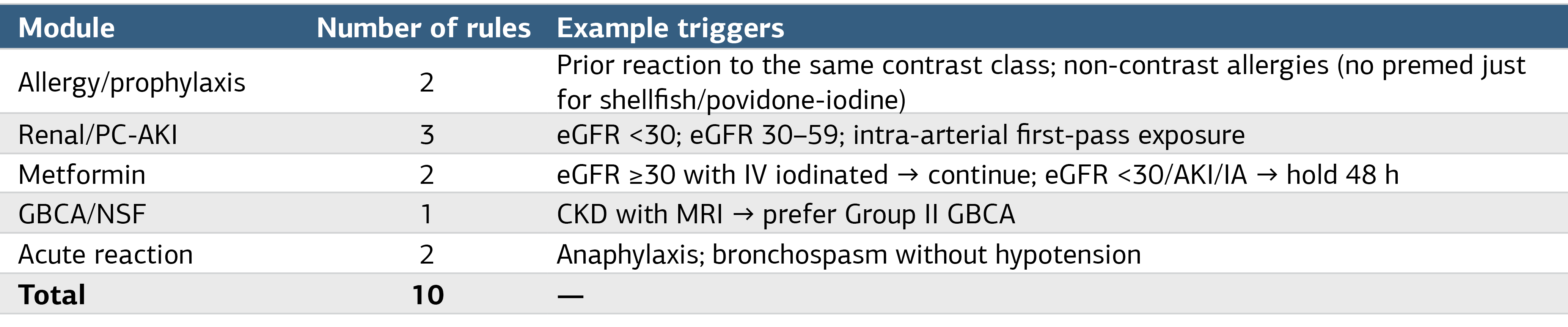
Counts refer to top-level rules. Ten top-level rules grouped into five modules Allergy/Prophylaxis (2), Renal/PC-AKI (3), Metformin (2), GBCA/NSF (1), and Acute Reaction (2) with exemplar triggers.
Table 2. Scenario Coverage (n = 30)
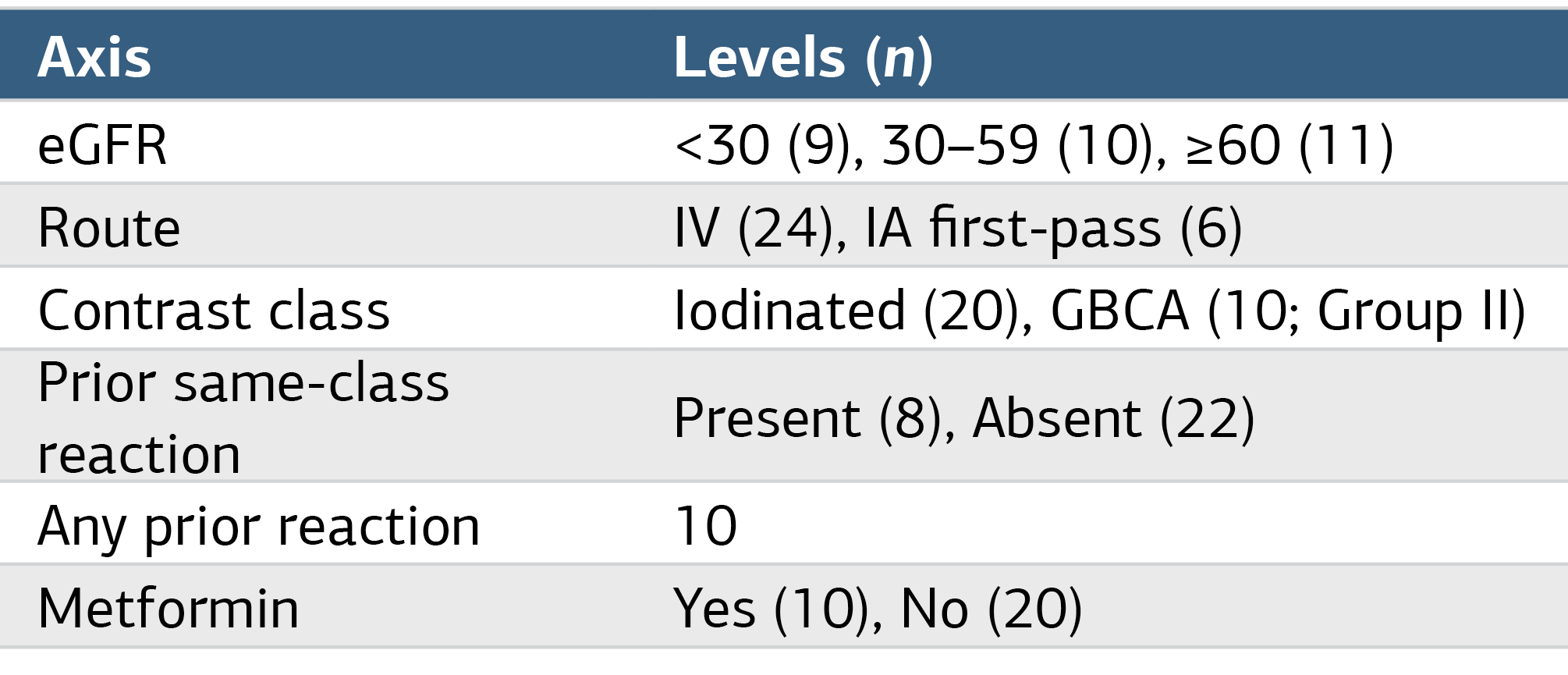
IA, intraarterial; IV, intravenous; GBCA, gadolinium based contrast agent; eGFR, estimated glomerular filtration rate.
Figures
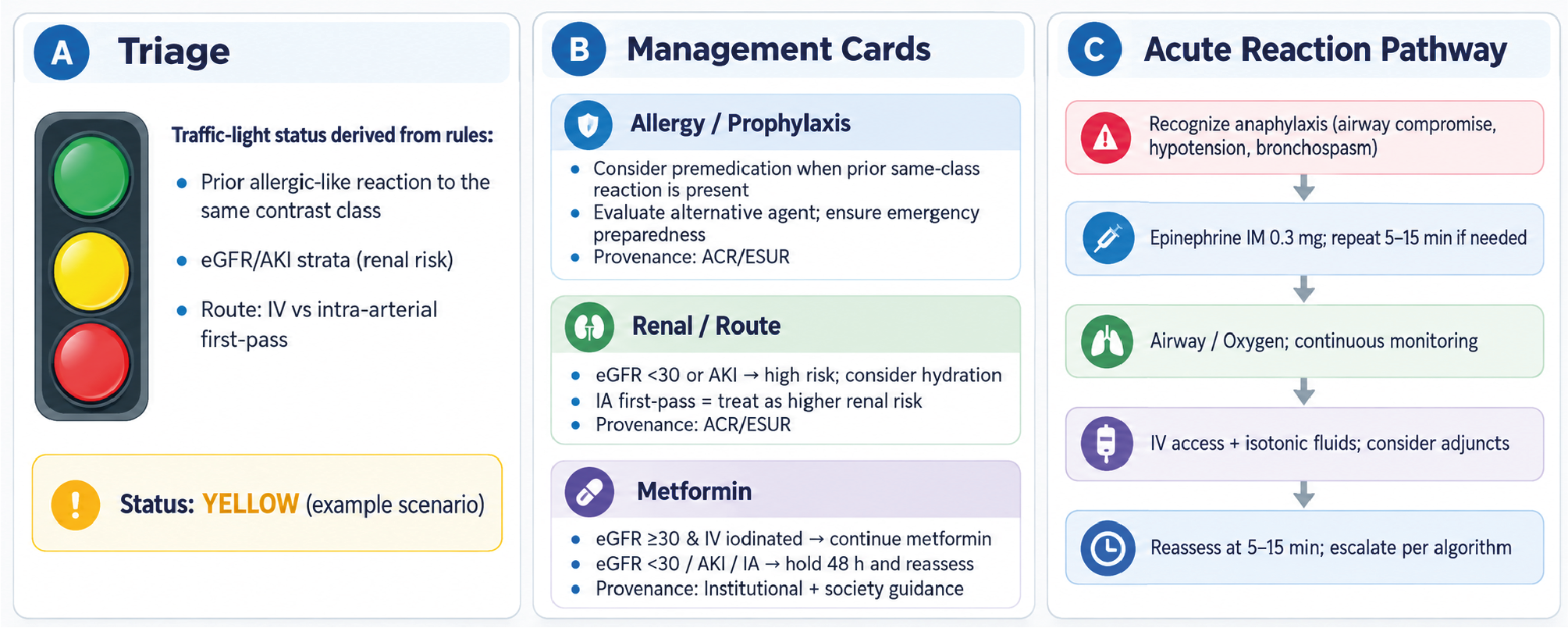
Figure 1. Representative Decision Cards
A three-panel UI mock-up illustrating triage (green/yellow/red), management cards (prophylaxis, renal/route, metformin), and the acute reaction pathway. (Schematic; not connected to clinical systems.)
Additional Information
Publisher’s Note
Bayrakol MP remains neutral with regard to jurisdictional and institutional claims.
Rights and Permissions

This work is licensed under a Creative Commons Attribution-NonCommercial 4.0 International License (CC BY-NC 4.0). To view a copy of the license, visit https://creativecommons.org/licenses/by-nc/4.0/
About This Article
How to Cite This Article
Büşra Ak, Betül Tiryaki Baştuğ. Contrast media decision support simulator (CMDS) in radiology practice. Ann Clin Anal Med 2026;17(12):00-00. doi:10.4328/ACAM.23029
Publication History
- Received:
- 12.12.2025
- Accepted:
- 16.04.2026
- Published Online:
- 16.04.2026
- Printed:
- 01.12.2026