
Abstract
AimThis study aimed to focus on the differences of physical medicine and rehabilitation (PMR) than other clinical branches in terms of Dual-Energy X-Ray Absorbsiyometri (DEXA)-related data.MethodsA total of 1293 patients from the five clinical branches that most frequently requested DEXA [the PMR, Orthopedics and Traumatology (OT), Gynecology and Obstetrics (GO) Endocrinology (END), Neurology (NEU)] and their DEXA-related data were investigated retrospectively. The DEXA-related data of PMR were compared statistically with other clinical branches.ResultsConsidering age, OT was similar to PMR, while END, GO, and NEU were lower than PMR. Considering gender (F/M), OT and END were similar to PMR, while GO was higher, and NEU was lower than PMR. Considering BMD, while OT was higher, END and NEU were lower than PMR, GO was similar to PMR. Considering osteoporosis frequency at lumbar spine, while OT and GO were lower than PMR, END and NEU were similar to PMR. Considering osteoporosis frequency at femur neck, OT, END, and GO were similar to PMR, while NEU was lower than PMR.ConclusionThe differences in DEXA-related data seen between PMR and other clinical branches may be due to differences in patient profiles.
Keywords
Introduction
Osteoporosis is an important and common bone disease causing notable economic costs globally. It is characterised by decreases in quality, turnover, strength, and mass of bone resulting an increased risk of life-threating fractures.1 Traditional pathophysiology of osteoporosis is associated with deficiencies in estrogen, vitamin D, and calcium leading to osteoclastic activation and osteoblastic inhibition resulting in bone resorbtion.1-2 On the other hand, current pathophysiology of osteoporosis includes multifactorial mechanisms such as osteoimmunological, gut microbiome or gastrointestinal factors, cellular senescence or age-related bone loss, and genetically tendency.1-4 Osteoporosis necessitates early diagnostic and therapeutic management to protect bone health.5
Dual-energy X-ray absorptiometry (DEXA), which measures and compares bone mineral density (BMD) to age-based standards, is the gold standard tool used to diagnose osteoporosis.5 It has been reported that using DEXA to screen individuals ≥50 years old for osteoporosis reduces osteoporosis-related fracture, mortality, and costs.6 According to the WHO diagnostic classification including DEXA results, osteoporosis is defined by T-score, which is an indicator of BMD, at the hip or lumbar spine equal to or less than -2.5 standard deviations relative to the mean T-score of the young adult reference population. Normal BMD is defined as a T-score of -1.0 or higher. If BMD is a T-score between -1.0 and -2.5, it is defined as osteopenia or low bone mass.7
Although the patient profiles encountered by different clinical branches are also different, osteoporosis may be found in patients applying to any clinical department. For example, the Orthopedics and Traumatology (OT) department encounters more patients with fractures and can investigate the relation between fracture and osteoporosis. The Department of Gynecology and Obstetrics (GO) often evaluates postmenopausal women and can also investigate these patients for osteoporosis. The Endocrinology (END) department can evaluate patients in terms of the risk of osteoporosis caused by hormonal disorders. The Neurology (NEU) department may take into account the increased risk of osteoporosis due to the elderly population and the immobile patient group it encounters. Therefore, in addition to physical medicine and rehabilitation (PMR), which is the clinical branch primarily related to the musculoskeletal system, other clinical branches may also request DEXA to evaluate the patient for osteoporosis. However, it is not known that the differences between PMR and other clinical branches in terms of DEXA-related data. Therefore, the present study aimed to focus on the differences of PMR than other clinical branches in terms of DEXA-related data.
Materials and Methods
This was a retrospective comparative study focused on the differences between PMR and other clinical branches in terms of DEXA-related data. The data were obtained from the Hospital’s information systems between January 1, 2022 and January 1, 2023. In accordance with the comments of the Declaration of Helsinki, the study was planned, performed and completed.
The BMD measurement was performed using the Hologic QDR 4500 DXA scanner device (Hologic, Bedford, MA, USA). Measurements included the lumbar spine and femoral neck. The inclusion and exclusion criteria were as follows: During the determined one-year period, all DEXA requested from all clinical branches were included in the study. Patients aged 18-65 years were selected to collect a study population. On the other hand, patients with inadequate data, aged <18 or >64 years were excluded.
A total of 1293 patients from the five clinical branches that most frequently requested DEXA and their DEXA-related data were investigated retrospectively. The DEXA-related data of PMR were compared statistically with other clinical branches.Ethical ApprovalThis study was approved by the Ethics Committee of Harran University (Date: 22.07.2024, Decision No: HRÜ/24.10.56).Statistical AnalysisThe statistical analyses were done by using IBM SPSS Statistics version 27.0. The Kolmogorov-Smirnov test was applied to continuous variables to test normality assumption. All of the continuous variables (age, weight, height, BMI, lumbar spine T score, and femur neck T score) in the PMR group exhibited a non-normal distribution. Therefore, the Mann-Whitney U test was used in the statistical comparisons between PMR and other groups for continuous variables. Continuous data were presented as mean ± SD (min.-max.). Categorical variables were evaluated by the Fisher’s exact test and were presented as number (percentage). Statistically significant level was considered as P < .05.
Reporting GuidelinesThis study was reported in accordance with the STROBE guideline.
Results
The branches and the DEXA numbers they requested during the specified one-year period were as follows: PMR (n = 721), OT (n = 369), END (n = 93), GO (n = 70), NEU (n = 40), Gastroenterology (n = 21), Infectious diseases (n = 21), Algology (n = 17), Internal medicine (n = 10), Family medicine (n = 2), Surgical oncology (n = 1), and Urology (n = 1).
The statistical comparisons demonstrated that the PMR group was similar to OT group (P = .820), but had higher score than END (P = .007), GO (P < .001), and NEU (P < .001) groups in terms of age (Table 1).
Considering gender differences, the Fisher’s exact test showed that the PMR group was similar to OT (P = .180) and END (P = .160) groups, but was different than GO (P < .001), and NEU (P < .001) groups (Table 1).
The Mann-Whitney U test showed that the PMR group was similar to GO group (P = .257), but was different than OT (P < .001), END (P = .011), and NEU (P < .001) groups in terms of BMI (Table 1).
Considering the osteoporosis frequency at lumbar spine, the Fisher’s exact test showed that the PMR group was similar to END (P = .647) group, but was different than OT (P = .001), GO (P = .001), and NEU (P = .041) groups (Table 2).
In terms of osteoporosis frequency at femur neck, PMR group was similar to OT (P = .076), END (P = .075) and GO (P = .259) groups, but was different than NEU group (P = .015) (Table 2).
Discussion
The current study aimed to provide a comparative view on the differences between PMR and other clinical branches considering DEXA-related data. The statistical comparisons demonstrated that PMR may be different from other clinical branches in terms of DEXA-related data. As expected, PMR, the clinical branch most related to the musculoskeletal system, was the clinic where DEXA was most frequently requested. In fact, it is likely that DEXA examinations requested by other branches were actually requested by PMR through consultation.
It is known that osteoporosis has extensive etiopathogenesis8 and is associated with various health problems and diseases such as sarcopenia.9 diabetes mellitus.10 asthma.11 depression.12 rheumatoid arthritis.13 Sjögren’s syndrome.14 and breast cancer.15 Therefore, besides PMR, many clinical branches may request DEXA for diagnosis of osteoporosis. However, it is not clear that the differences between PMR and other clinical branches in terms of DEXA-related data. In the present study, the PMR branch was compared to other clinical branches in terms of DEXA-related data including age, gender, and BMI of the patient for whom DEXA is requested, the osteoporosis frequency at lumbar spine, and the osteoporosis frequency at femur neck. To our knowledge, this study is the first to address DEXA-related data on a branch-based basis. In this respect, it could be an important contribution to the literature.
According to the results of the present study, the status of other clinical branches compared to the PMR in terms of DEXA-related data was as follows (Table 3): Considering age, OT was similar to PMR, while END, GO, and NEU were lower than PMR. Considering gender (F/M), OT and END were similar to PMR, while GO was higher, and NEU was lower than PMR. Considering BMD, while OT was higher, END and NEU were lower than PMR, GO was similar to PMR. Considering osteoporosis frequency at lumbar spine, while OT and GO were lower than PMR, END and NEU were similar to PMR. Considering osteoporosis frequency at femur neck, OT, END, and GO were similar to PMR, while NEU was lower than PMR. The differences in DEXA-related data seen between PMR and other clinical branches may be due to differences in patient profiles.
Limitations
On the other hand, possible limitations of this study should also be taken into consideration. For example, the retrospective design may result in missing data and the current study may be within this scope. In addition, it was a single-center trial and some groups had relatively small sample sizes. It was the first study on the research topic and due to no directly related literature, an in-depth comparative discussion including different results could not be performed.
Conclusion
In conclusion, osteoporosis has multifactorial nature and many clinical branches may be requested DEXA to diagnose this disease. The PMR is the most frequently clinic requesting DEXA than other clinical branches. Due to differences in patient profiles, some differences in DEXA-related data may be seen between PMR and other clinical branches.
Declarations
Animal and Human Rights Statement
All procedures performed in this study were in accordance with the ethical standards of the institutional and/or national research committee and with the 1964 Helsinki Declaration and its later amendments or comparable ethical standards.
Informed Consent
The requirement for informed consent was waived due to the retrospective design of the study.
Data Availability
The datasets used and/or analyzed during the current study are not publicly available due to patient privacy reasons but are available from the corresponding author on reasonable request.
Conflict of Interest
The authors declare that there is no conflict of interest.
Funding
None.
Abbreviations
BMD: Bone mineral density
BMI: Body mass index
DEXA: Dual-energy X-ray absorptiometry
END: Endocrinology
GO: Gynecology and obstetrics
NEU: Neurology
OT: Orthopedics and traumatology
PMR: Physical medicine and rehabilitation
References
- Adejuyigbe B, Kallini J, Chiou D, Kallini JR. Osteoporosis: molecular pathology, diagnostics, and therapeutics. Int J Mol Sci. 2023;24(19):14583. doi:10.3390/ijms241914583
- Föger-Samwald U, Dovjak P, Azizi-Semrad U, Kerschan-Schindl K, Pietschmann P. Osteoporosis: pathophysiology and therapeutic options. EXCLI J. 2020;19:1017-1037.
- Farr JN, Fraser DG, Wang H, et al. Identification of senescent cells in the bone microenvironment. J Bone Miner Res. 2016;31(11):1920-1929. doi:10.1002/jbmr.2892
- Mäkitie RE, Costantini A, Kämpe A, Alm JJ, Mäkitie O. New insights into monogenic causes of osteoporosis. Front Endocrinol (Lausanne). 2019;10:70. doi:10.3389/fendo.2019.00070
- Sangondimath G, Sen RK, F R T. DEXA and imaging in osteoporosis. Indian J Orthop. 2023;57(suppl 1):82-93. doi:10.1007/s43465-023-01059-2
- Hsu CL, Wu PC, Yin CH, et al. Clinical outcomes and cost-effectiveness of osteoporosis screening with dual-energy x-ray absorptiometry. Korean J Radiol. 2023;24(12):1249-1259. doi:10.3348/kjr.2023.0555
- Arceo-Mendoza RM, Camacho P. Prediction of fracture risk in patients with osteoporosis: a brief review. Womens Health (Lond). 2015;11(4):477-484. doi:10.2217/whe.15.14
- Valenzuela-Martínez S, Ramírez-Expósito MJ, Carrera-González MP, Martínez-Martos JM. Physiopathology of osteoporosis: nursing involvement and management. Biomedicines. 2023;11(4):1220. doi:10.3390/biomedicines11041220
- Chen S, Xu X, Gong H, et al. Global epidemiological features and impact of osteosarcopenia: a comprehensive meta-analysis and systematic review. J Cachexia Sarcopenia Muscle. 2024;15(1):8-20. doi:10.1002/jcsm.13392
- Prasad TN, Arjunan D, Pal R, Bhadada SK. Diabetes and osteoporosis. Indian J Orthop. 2023;57(suppl 1):209-217. doi:10.1007/s43465-023-01049-4
- Jha SS, Kumar M, Agrawal PK, Thakur DK. Osteoporosis in asthma and COPD. Indian J Orthop. 2023;57(suppl 1):200-208. doi:10.1007/s43465-023-01048-5
- Guo X, She Y, Liu Q, et al. Osteoporosis and depression in perimenopausal women: from clinical association to genetic causality. J Affect Disord. 2024;356:371-378. doi:10.1016/j.jad.2024.04.019
- Deng Y, Wong MCS. Association between rheumatoid arthritis and osteoporosis in Japanese populations: a mendelian randomization study. Arthritis Rheumatol. 2023;75(8):1334-1343. doi:10.1002/art.42502
- Huang W, Tian J, He J. Risk factors of primary Sjögren syndrome combined with osteoporosis. Zhong Nan Da Xue Xue Bao Yi Xue Ban. 2024;49(2):312-318.
- Zhao F, Li C, Wang W, et al. Machine learning predicts the risk of osteoporosis in patients with breast cancer and healthy women. J Cancer Res Clin Oncol. 2024;150(2):102. doi:10.1007/s00432-024-05622-8
Tables
Table 1. Comparison of PMR group with other groups in terms of age, gender, and BMI differences
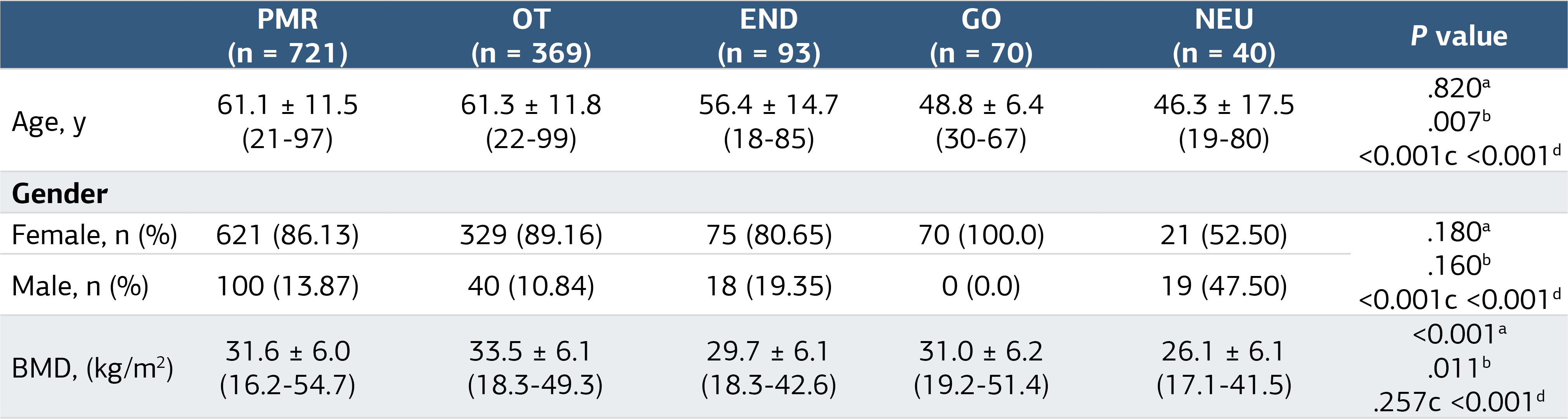
PMR: Physical Medicine and Rehabilitation; OT: Orthopedics and Traumatology; END: Endocrinology; GO: Gynecology and Obstetrics; NEU: Neurology aPMR vs OT; bPMR vs END; cPMR vs GO; dPMR vs NEU.
Table 2. Comparison of PMR group with other groups in terms of osteoporosis frequency at lumbar spine and femur neck
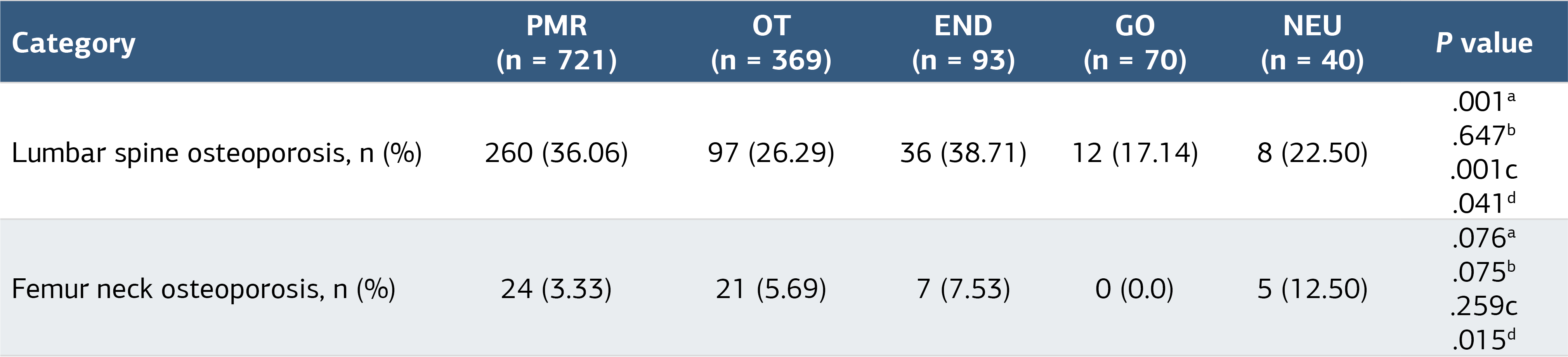
PMR: Physical Medicine and Rehabilitation; OT: Orthopedics and Traumatology; END: Endocrinology; GO: Gynecology and Obstetrics; NEU: Neurology. aPMR vs OT; bPMR vs END; cPMR vs GO; dPMR vs NEU.
Table 3. The status of other clinical branches compared to the PMR in terms of DEXA-related data

PMR: Physical Medicine and Rehabilitation; OT: Orthopedics and Traumatology; END: Endocrinology; GO: Gynecology and Obstetrics; NEU: Neurology.
Additional Information
Publisher’s Note
Bayrakol MP remains neutral with regard to jurisdictional and institutional claims.
Rights and Permissions

This work is licensed under a Creative Commons Attribution-NonCommercial 4.0 International License (CC BY-NC 4.0). To view a copy of the license, visit https://creativecommons.org/licenses/by-nc/4.0/
About This Article
How to Cite This Article
Veysel Delen, Ferit Doğan. Differences between physical medicine and rehabilitation and other clinical branches in terms of dual-energy X-ray absorptiometry (DEXA)-related data. Ann Clin Anal Med 2025;16(Suppl 2):91-94. doi:10.4328/ACAM.22362
Publication History
- Received:
- 07.08.2024
- Accepted:
- 09.09.2024
- Published Online:
- 26.11.2024
- Printed:
- 25.05.2025