
Abstract
AimWe aimed to investigate the prognostic utility of thiol disulfide levels, a novel parameter for oxidative stress, in critically ill patients who presented at the emergency room and required intensive care.MethodsThis prospective study has included 79 patients as the ‘patient group’ and 71 healty volunteers of similar age group with no complaint as the ‘control group’. We analyzed the groups based on age, gender, presenting symptoms, states of consciousness, acute physiological condition, levels of native thiol (NT), total thiol (TT), disulfide, ischemia modified albumin (IMA), and ferroxidase. The mortality status of the patients was determined after a period of 28 days.ResultsBoth the patient and control groups were divided into subgroups based on gender and age, and statistical analysis was conducted. However, no significant differences were observed between these subgroups. In terms of NT and TT values, the patient group exhibited significantly lower levels compared to the control group (P < .001). The patient group displayed a significant increase in values for index 1, index 2, and index 3 when compared to the control group. Compared to 28-day mortality, NT and TT values were lower and statistically significant in patients who died (P < .001). When the disulfide and ferroxidase values were compared the patient and the control, no statistically significant difference was found. Although the IMA value increased significantly in the patient group, no significant difference was detected in terms of mortality. ConclusionNT and TT levels as oxidative stress indicators were significantly and negatively correlated with 28 day mortality rates and it is suggested that there may be a significant parameter to determine the patient prognosis.
Keywords
Introduction
Emergency departments (ED) and intensive care units are health care units that are vital for critically ill patient care who require a multidisciplinary approach. Early detection of risk in patients who may develop cardiac arrest and mortality is important for early intervention. Many diagnostic methods are used to detect risky patients early and determine their prognosis.
Oxidative stress is the loss of balance between the production of free radicals or reactive oxygen species and the antioxidant system.1,2 Thiol is an organic compound containing a sulfhydryl group that has a critical role in preventing oxidative stress in cells. Dynamic thiol-disulfide balance has a critical role in antioxidant defense, detoxification and many other issues.1,2 According to many recent studies, it has been shown that disruption of the thiol-disulfide balance can cause many diseases.3 This double-sided balance could only be measured by one side since 1979, but with the new method developed by Erel and Neselioğlu in 2021, both variables can be evaluated separately and collectively.1,2
Albumin is one of the most abundant proteins in the body of mammals and its content in blood is approximately 60-65% of total plasma proteins. Albumin properties change under ischemic attacks associated with oxidative stress, production of reactive oxygen species and acidosis. Under these conditions, ischemia-modified albumin (IMA) is produced, which has reduced metal-binding capacity, especially for transition metals such as copper, nickel, and cobalt. Today, it has been determined that IMA increases in many diseases.4
Ferroxidase activity is a crucial component in maintaining the balance of iron within the body and is involved in defense mechanisms against oxidative stress. It serves as an essential antioxidant, safeguarding biomolecules from harm caused by free oxygen radicals.5,6
In our study, we aimed to investigate the relation of oxidative stress parameters such as native thiol (NT), total thiol (TT), disulfide (D), IMA, ferroxidase measurements with prognostic usability and mortality in critically ill patients who applied to ED.
Materials and Methods
This study was conducted between November 2017 – April 2018 in an Education and Research Hospital ED. All patients read the informed consent form and gave written informed consent for study participation. A total of 150 patients were included in the study. 79 patients with intensive care indications older than 18 years and 71 healthy volunteers were selected to be the patient and the control group, respectively. Patients were evaluated prospectively. Patients who were pregnant and who refused to participate in the study were excluded. Blood samples were taken within the first hour of ED admission, before starting any medication.
The patients were examined in terms of age, gender, presenting semptoms, states of consciousness, acute physiological condition were all evaluated. Using the new method developed by Erel and Neselioglu, the patients’ antioxidant parameters (NT, D, and TT) were also studied. Additionally, the study involved analyzing the disulfide/native thiol ratio (index 1), disulfide/total thiol ratio (index 2), and native thiol/total thiol ratio (index 3). The patients’ levels of IMA and ferroxidase were also examined. All measurements were conducted using an Autocobas 501 auto-analyzer from Roche-Hitachi in Mannheim, Germany. The decision for hospitalization was based on the patients’ Apache 2 score, and the outcome of interest was whether each patient survived or died within 28 days.Ethical ApprovalThis study was approved by the Ethics Committee of Medical School of Yıldırım Beyazıt University (Date: 25.10.2017, Decision No: 26379996).Statistical AnalysisStatistical analysis of this study was performed with SPSS Statistics 16.0 for Windows. While evaluating the study data, frequency distributions were given for categorical variables and descriptive statistics were given for continuous variables. Shapiro Wilk normality test was used for continuous variables. Mann Whitney U test, which is a nonparametric test, was used for median comparisons in pairwise independent groups, since the OSI value did not satisfy the assumption of normality (P < .05) as a result of the test. Independent Samples-t test was used to compare the mean of the data in two groups with normal distribution. Chi-Square tests were performed on 2×2 and 3×2 tables in the evaluation of independent frequency data. Multiple logistic regression analysis was performed to evaluate the factors affecting mortality. ROC analysis was performed in parameters that were found to be significant for mortality and the area under the curve was calculated. Pearson correlation analysis for data showing normal distribution in the evaluation of correlation of continuous variables, Spearman correlation analysis was used for data not showing normal distribution. p value of <0.05 was used for statistical significance.
Reporting GuidelinesThis study was reported in accordance with the STROBE guideline.
Results
A total of 150 subjects, comprising 79 patients and 71 healthy volunteers, were included in the study. In terms of distribution of gender and age, no significant difference was detected between the two groups (chi-square, P < .001,879; Mann–Whitney U test, P < .001,134) (Table 1). The critically ill patients included in the study who needed intensive care were followed up mostly in terms of lower respiratory tract infections, neurological diseases such as cerebrovascular accident and seizures, and at least in terms of oncological emergencies. NT and TT values in the patient group were significantly lower than in the control group (p: <0.001) (Table 2). In the patient group, index 1, index 2 and index 3 values increased significantly compared to the control group ( Table 2 ). The IMA value was significantly higher in the patient group than in the control group (p: <0.001) (Table 2).When the disulfide and ferroxidase values were compared the patient and the control, no statistically significant difference was found ( Table 2 ). When Erel panel parameters were compared with 28-day mortality, NT and TT values were significantly lower in the non-surviving group. When the index values, disulfide and ferroksidase were evaluated in terms of mortality, no statistically significant difference was found between the surviving and non-surviving groups. Although the IMA value increased significantly in the patient group, no significant difference was detected in terms of mortality (Table 3).
Discussion
The presence of oxidative stress in critically ill patients is known to be linked with unfavorable outcomes. Roth et al.’s study aligns with our own research, as they discovered that oxidative stress parameters were associated with conditions such as sepsis, trauma, kidney failure, and ARDS. However, their study was limited because they were unable to measure the specific oxidative stress parameters, namely thiol and disulfide levels, individually.7
Another study conducted by Alonso de Vega et al. in 2002 involving 68 patients, found that oxidative stress parameters were higher in critically ill patients with SIRS than in other patients.8
In the study of Abiles et al., it was found that the worsening of the condition of critically ill patients in the ICU was related to oxidative stress.9
In another study conducted by Bircan et al. on 45 patients, it was found that low levels of total antioxidant capacity may be significant with low levels in the diagnosis of the disease, but it was not correlated with the prognosis.10
In our study although the IMA value increased statistically in the patient group, no significant difference was found in terms of mortality. Unlike ours, in 2007 Aparci et al., found that IMA increased in the patient group and was correlated with one-year mortality in their study conducted on coronary intensive care unit patients diagnosed with acute coronary syndrome (ACS).11
According to Yıldız’s study, TT and NT levels in sepsis and septic shock patients were found to be significantly lower than the control group, consistent with our study. In our study, the disulfide level was high but not significant in the patient group, while in this study, the disulfide level was low but not significant. In our study, we observed that the levels of native thiol (NT) and total thiol (TT) were significantly higher in the group of patients who survived compared to the group of patients who did not survive. This finding was statistically significant, which differs from previous research where the difference was not statistically significant.12
While in our study, TTl and NT values were significantly low for 28-day mortality, in another study, no significant difference was observed between the surviving and non-surviving groups in terms of initial TT, NT, disulfide and IMA levels. This difference may be due to the fact that only patients diagnosed with sepsis were studied or the sample size was different.13
Similarly, in a study involving newborn patients, Aydoğan et al. showed that the natural thiol and total thiol levels of patients with sepsis were lower than healthy newborns, and the serum disulfide/total thiol ratio was higher.14
However, in another study using the same measurement technique as this study, in the patient group, NT, TT and index 3 were lower, index 1 and 2 were higher, and when patients with and without 28-day mortality were compared in terms of NT, TT, D and index 1, 2 and 3, the difference in no parameter was statistically significant.15
According to the study conducted by Prashanth and colleagues, patients diagnosed with sepsis who were admitted to the intensive care unit had significantly higher levels of IMA compared to those without sepsis. Elevated IMA levels indicate the presence of ischemic damage, which can be indicative of a poorer prognosis.16
Limitations
The limitations of our study are; Comorbid diseases that may have affected oxidative stress parameters were not excluded from the study, and post-treatment oxidative parameters were not studied. Another limitation is the small sample size.
Conclusion
Our results indicated that thiol/disulphide homeostasis could be a good biochemical risk marker in critically ill patients in the ED. Further studies are needed to reveal the prognostic value of TT, NT, IMA, disulfide and indexes for patients who need intensive care in the ED.
Declarations
Animal and Human Rights Statement
All procedures performed in this study were in accordance with the ethical standards of the institutional and/or national research committee and with the 1964 Helsinki Declaration and its later amendments or comparable ethical standards.
Informed Consent
Written informed consent was obtained from all participants.
Data Availability
The datasets used and/or analyzed during the current study are not publicly available due to patient privacy reasons but are available from the corresponding author on reasonable request.
Conflict of Interest
The authors declare that there is no conflict of interest.
Funding
None.
Abbreviations
ACS: Acute coronary syndrome
ARDS: Acute respiratory distress syndrome
D: Disulfide
ED: Emergency department
ICU: Intensive care unit
IMA: Ischemia modified albumin
NT: Native thiol
ROC: Receiver operating characteristic
SIRS: Systemic inflammatory response syndrome
SPSS: Statistical package for the social sciences
TT: Total thiol
References
- Erel O, Neselioglu S. A novel and automated assay for thiol/disulphide homeostasis. Clin Biochem. 2014;47(18):326-332. doi:10.1016/j.clinbiochem.2014.09.026
- Ateş İ, Özkayar N, Yılmaz FM, et al. Kronik böbrek hastalığı olan hastalarda oksidatif stres düzeyi. Ortadoğu Tıp Derg. 2018;10(1):45-50.
- Erel O, Erel S. Thiol-disulfide homeostasis: an integrated approach with biochemical and clinical aspects. Turk J Med Sci. 2020;50(10):1728-1738. doi:10.3906/sag-2003-64
- Shevtsova A, Gordiienko I, Tkachenko V, Ushakova G. Ischemia-modified albumin: origins and clinical implications. Dis Markers. 2021;2021:1-18. doi:10.1155/2021/9945424
- Gwozdzinski K, Pieniazek A, Gwozdzinski L. Reactive oxygen species and their involvement in red blood cell damage in chronic kidney disease. Oxid Med Cell Longev. 2021;2021:1-19. doi:10.1155/2021/6639199
- Gutteridge JM, Mitchell J. Redox imbalance in the critically ill. Br Med Bull. 1999;55(1):49-75. doi:10.1258/0007142991902295
- Roth E, Manhart N, Wessner B. Assessing the antioxidative status in critically ill patients. Curr Opin Clin Nutr Metab Care. 2004;7(2):161-168. doi:10.1097/00075197-200403000-00010
- Alonso de Vega JMA, Díaz J, Serrano E, Carbonell LF. Oxidative stress in critically ill patients with systemic inflammatory response syndrome. Crit Care Med. 2002;30(8):1782-1786. doi:10.1097/00003246-200208000-00018
- Abilés J, de la Cruz AP, Castaño J, et al. Oxidative stress is increased in critically ill patients according to antioxidant vitamins intake, independent of severity: a cohort study. Crit Care. 2006;10(5):146.
- Bircan A, Suetcue R, Goekirmak M, Hicyilmaz H, Akkaya A, Ozturk O. Total antioxidant capacity and C-reactive protein levels in patients with community-acquired pneumonia. Turk J Med Sci. 2008;38(6):537-544. doi:10.1159/000117793
- Aparci M, Kardesoglu E, Ozmen N, et al. Prognostic significance of ischemia-modified albumin in patients with acute coronary syndrome. Coron Artery Dis. 2007;18(5):367-373. doi:10.1097/mca.0b013e3281689a50
- Yıldız H. Thiol/disulphide homeostasis in intensive care unit patients with sepsis and septic shock. Turk J Med Sci. 2020;50(4):811-816.
- Başgöz BB, Acar R, Aykan MB, et al. Predictive value of thiol-disulfide homeostasis and ischemia-modified albumin on survival in patients with sepsis. Erciyes Med J. 2021;43(1):83-89.
- Aydogan S, Akduman H, Dilli D, et al. The role of thiol-disulfide homeostasis in neonatal sepsis. J Matern Fetal Neonatal Med. 2021;34(10):1522-1528. doi:10.1080/14767058.2019.1638904
- Şener A, Kurtoğlu Çelik G, Özhasenekler A, et al. Evaluation of dynamic thiol/disulfide homeostasis in adult patients with community-acquired pneumonia. Hong Kong J Emerg Med. 2018;26(6):343-350.
- Prashanth AK, Anand U. Clinical significance of ischemia-modified albumin in critically ill patients with sepsis. Indian J Clin Biochem. 2015;30(2):194-197. doi:10.1007/s12291-014-0434-4
Tables
Table 1. Gender Distribution and the Mean and Median of Age in All Patients

*Chi-square test; 0,879 ** mann-whitney-U test; IQR; P < .001,24.
Table 2. Erel Panel According to Patient and Control Groups Distribution
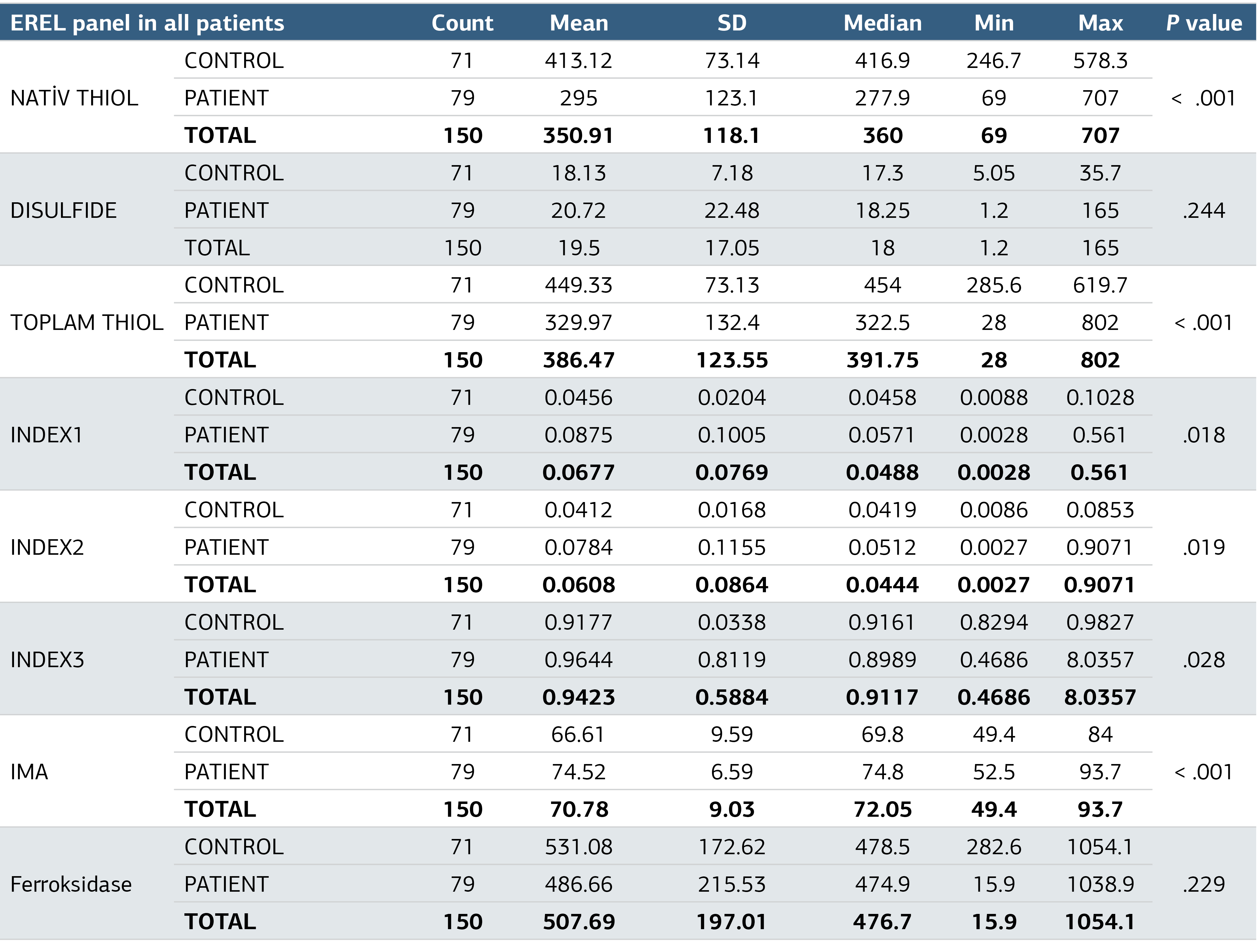
Mann whitney-U testi NT, Native Thiol; TT, Total Thiol; D, Disulfide; Index 1, D/NT; Index 2, D/TT; Index 3 , NT/TT; IMA, Ischemia Modified Albumin.
Table 3. The Relationship Between Erel Panel and 1 Month Mortality
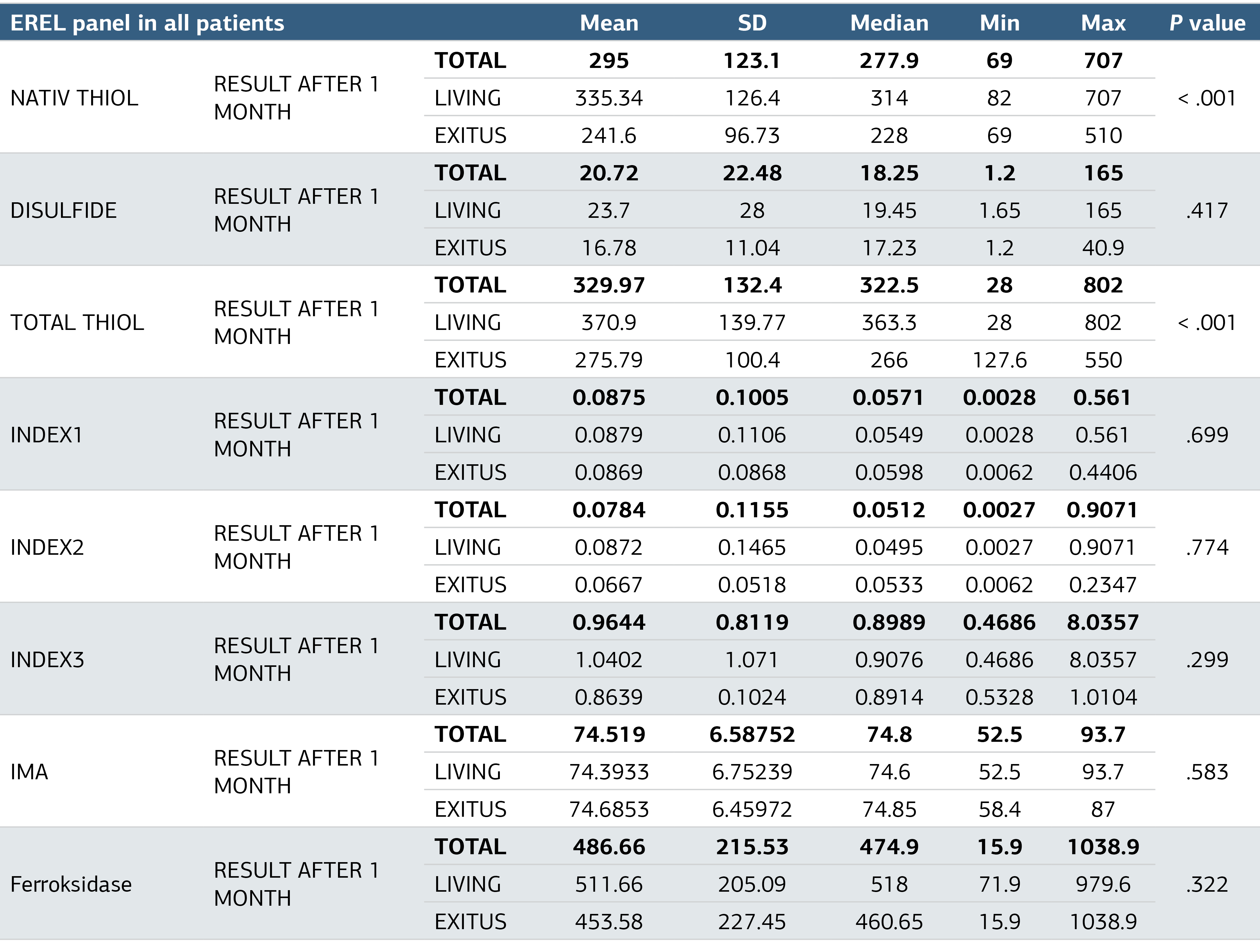
NT, Native thiol; TT, Total thiol; D, Disulfide; Index 1, D/NT; Index 2, D/TT; Index 3 , NT/TT; IMA, Ischemia Modified Albumin
Additional Information
Publisher’s Note
Bayrakol MP remains neutral with regard to jurisdictional and institutional claims.
Rights and Permissions

This work is licensed under a Creative Commons Attribution-NonCommercial 4.0 International License (CC BY-NC 4.0). To view a copy of the license, visit https://creativecommons.org/licenses/by-nc/4.0/
About This Article
How to Cite This Article
Nihal Ertürk, Fatih Tanriverdi, Servan Gökhan, Gülhan Kurtoğlu Çelik, Alp Şener, Ayhan Özhaşenekler, Özcan Erel, Salim Neşelioğlu. Correlation of thiol-disulfide levels with mortality rates in patients who need intensive care in emergency department. Ann Clin Anal Med 2024;15(4):245-249. doi:10.4328/ACAM.22048
Publication History
- Received:
- 20.11.2023
- Accepted:
- 12.02.2024
- Published Online:
- 21.02.2024
- Printed:
- 01.04.2024