
Abstract
AimPost-dural puncture headache (PDPH) remains an important complication after spinal anesthesia for cesarean delivery. Although cerebrospinal fluid leakage is central to its pathophysiology, systemic hemodynamic changes may also contribute. This prospective observational cohort study evaluated the association between early post-spinal hypotension and PDPH.MethodsPregnant women undergoing elective or semi-elective cesarean delivery under spinal anesthesia were prospectively followed. Systolic blood pressure (SBP), mean arterial pressure, heart rate, ephedrine requirement, and perioperative variables were recorded. The primary exposure was the percentage decrease in SBP at 5 minutes after intrathecal injection. PDPH was assessed during the first 5 postoperative days according to International Classification of Headache Disorders-3 criteria. Logistic regression and receiver operating characteristic (ROC) analyses were performed.ResultsA total of 353 patients were included, and PDPH occurred in 10 patients (2.83%). Baseline hemodynamic variables were similar between patients with and without PDPH. Patients who developed PDPH had lower 5-minute SBP and a greater percentage decrease in SBP from baseline. Severe hypotension (SBP decrease ≥20%) was associated with higher odds of PDPH (Firth OR 7.62, 95% CI 2.21–32.01; P = .002). The percentage decrease in SBP showed good discrimination for PDPH (AUC 0.880, 95% CI 0.807–0.937); an exploratory Youden-derived threshold of an 18.85% decrease was identified but requires external validation. In Firth penalized multivariable logistic regression, percentage SBP decrease remained independently associated with PDPH.ConclusionIn parturients undergoing cesarean delivery under spinal anesthesia, greater early post-spinal systolic hypotension was independently associated with subsequent PDPH. These findings support further investigation of hemodynamic stability as a potentially relevant factor in PDPH prevention.
Keywords
Introduction
Spinal anesthesia is a safe and effective neuraxial anesthetic technique widely used in obstetric surgery. However, post-dural puncture headache (PDPH) remains an important complication that may adversely affect patient comfort and postpartum recovery. Despite the use of atraumatic and small-gauge needles, the incidence of PDPH varies according to needle type and size, patient-related characteristics, technical factors, and the surgical context.1,2
Nevertheless, the classic CSF leakage theory does not fully explain all clinical observations. Despite spinal anesthesia performed with similar needles and techniques, PDPH develops only in a subset of patients, and the amount of CSF leakage does not always parallel headache severity. These observations suggest that mechanisms other than CSF dynamics may also contribute to PDPH pathogenesis. Impaired cerebral autoregulation is one such potential mechanism: systemic hypotension related to spinal anesthesia may be associated with reduced cerebral perfusion pressure and compensatory cerebral vasodilatation, while subsequent blood pressure fluctuations may challenge autoregulatory capacity and contribute to headache development.3
Systemic hypotension induced by spinal anesthesia is one of the most common complications in obstetric patients, with reported incidences reaching 70-80%.
However, prospective studies directly evaluating the relationship between systemic hypotension and PDPH development remain limited. Most available risk factor studies have focused on structural or procedural variables such as needle gauge, needle type, number of puncture attempts, age, sex, and body mass index.2 The aim of this study was to prospectively evaluate the association between early intraoperative systemic hypotension and PDPH occurring within the first five postoperative days in pregnant patients undergoing cesarean delivery under spinal anesthesia. We hypothesized that early post-spinal hypotension might be associated with the development of PDPH.
Materials and Methods
Study DesignThis study was conducted as a prospective observational cohort study. The study was conducted at the Department of Anesthesiology and Reanimation, Bursa City Hospital, between 1 June 2024 and 1 August 2024. The study was prospectively registered with the Australian New Zealand Clinical Trials Registry on 26 April 2024 (ACTRN12624000523505).Study PopulationInclusion CriteriaPregnant patients aged 18 years or older, in the third trimester of pregnancy, with singleton pregnancies, and scheduled for elective or semi-elective cesarean delivery under spinal anesthesia were included. Eligible patients had an American Society of Anesthesiologists (ASA) physical status classification of II-IV, had baseline hemodynamic measurements recorded before spinal anesthesia, had intraoperative blood pressure and heart rate data monitored regularly, and were available for PDPH assessment within the first five postoperative days.Exclusion CriteriaPatients who were converted to general anesthesia, received combined spinal-epidural or epidural anesthesia, had failed spinal anesthesia, or required repeated spinal puncture were excluded. Patients with active preoperative headache, a history of chronic headache or migraine, previous PDPH, known intracranial pathology, epilepsy, cerebrovascular disease, or neurological deficit were not included.
Patients with preeclampsia, eclampsia, HELLP syndrome, severe gestational hypertension, or suspected postpartum hypertension were also excluded.
Patients with coagulopathy, thrombocytopenia, anticoagulant use, severe cardiac disease, severe hepatic or renal insufficiency, multiple pregnancy, placenta previa, placenta accreta spectrum, severe obstetric bleeding, or need for massive transfusion were excluded.Anesthesia ProtocolAfter admission to the operating room, all patients underwent standard monitoring, including non-invasive arterial blood pressure at 2-min intervals, electrocardiography (lead II), and peripheral oxygen saturation. Baseline hemodynamic values, including systolic, diastolic, and mean arterial pressure (MAP) and heart rate, were recorded as the mean of three consecutive measurements.
Before spinal anesthesia, all patients received co-loading with 10 mL/kg of balanced crystalloid solution (lactated Ringer's solution). Spinal anesthesia was performed in the sitting position at the L3-L4 or L4-L5 intervertebral space using a midline approach and a 26-gauge atraumatic pencil-point needle. All patients received 10 mg of 0.5% hyperbaric bupivacaine intrathecally; the local anesthetic dose was kept constant according to the study protocol. Sensory block level was assessed with the pin-prick test, and motor block was evaluated using the Bromage scale.Hemodynamic Management and Definition of HypotensionHypotension after spinal anesthesia was assessed relative to the baseline systolic blood pressure measured before intrathecal local anesthetic administration. The baseline value was defined as the stable systolic blood pressure obtained before spinal anesthesia. Hypotension was defined as a decrease in systolic blood pressure to below 90% of baseline, whereas a decrease to below 80% of baseline was considered clinically significant/severe hypotension. The aim of blood pressure management was to maintain systolic blood pressure at least 90% of baseline and to prevent decreases below 80%.4 When severe hypotension occurred, a 250-mL rapid crystalloid bolus was administered first, followed, when required, by intravenous ephedrine in 5-mg boluses.Collected VariablesDemographic and preoperative data:
Age, sex, height, weight, body mass index, ASA physical status, comorbidities, smoking, history of headache, and history of previous spinal anesthesia.
Exposure and hemodynamic variables:
Primary exposure: The primary exposure was defined as the percentage decrease in systolic arterial pressure from baseline at 5 min after intrathecal injection. Prespecified categorical thresholds of >=10% and >=20% decreases in SBP were evaluated; a >=20% decrease was considered severe hypotension.
Secondary hemodynamic indicators: absolute MAP at 5 min, percentage change from baseline MAP, presence of MAP <65 mmHg, and total ephedrine dose.
Prophylactic ondansetron administration: recorded as administered/not administered and not interpreted as a randomized treatment arm.
Postoperative Follow-up and Definition of PDPHPatients were assessed by the same investigator at postoperative 6, 12, 24, 48, and 72 h and on day 5, either face-to-face or by telephone. PDPH was diagnosed according to the International Classification of Headache Disorders, 3rd edition (ICHD-3), criteria:4 (1) headache developing within five days after dural puncture; (2) a postural component with marked worsening within 15 min of standing and marked improvement within 15 min of lying down; (3) accompanying at least one of neck stiffness, tinnitus, hypoacusis, photophobia, or nausea; and (4) not being better accounted for by another diagnosis.
In patients who developed PDPH, conservative treatment (bed rest, hydration, oral analgesics, and caffeine) was initially administered; epidural blood patch was performed when needed on the basis of multidisciplinary international consensus guidelines.2Outcome VariableThe primary outcome variable was the development of PDPH, defined as present or absent, meeting ICHD-3 criteria within the first five postoperative days.Sample SizeSample size was calculated using G*Power 3.1. The primary endpoint was the development of post-dural puncture headache. A two-independent-proportions test was used to compare PDPH rates between patients with and without intraoperative hypotension. A two-sided alpha level of 0.05 and 80% power were accepted. Assuming that the incidence of hypotension after obstetric spinal anesthesia would be approximately 75%, the group distribution was estimated to be approximately 266/88. Based on the assumption that the incidence of PDPH would be 5% in patients without hypotension and 15% in patients with hypotension, the calculated effect size was Cohen's h=0.345. Under these assumptions, a total sample size of 354 patients was considered sufficient to test the primary hypothesis.
Post-hoc (achieved) power was calculated using the realized data for the prespecified severe-hypotension threshold (SBP decrease ≥20%). With α = 0.05 (two-sided) and the realized group allocation, the achieved power was 85.8%.Ethical ApprovalThe study protocol was approved by the Local Ethics Committee of Bursa City Hospital, University of Health Sciences (Date: 12.04.2023, Decision No.: 2023-6/2).Statistical AnalysisStudy data were analyzed in Python (version 3.12) using the SciPy (1.17), StatsModels (0.14), and scikit-learn (1.8) packages. All hypothesis tests were two-sided, and P < .05 was considered statistically significant. Continuous variables were presented as mean +/- standard deviation and median (first-third quartiles, Q1-Q3), whereas categorical variables were presented as frequency and percentage (n, %). The distribution of continuous variables was assessed using the Shapiro-Wilk test; the Mann-Whitney U test was used for between-group comparisons of non-normally distributed variables.
Categorical variables were compared between groups using the Pearson chi-square test when expected frequencies were adequate. Fisher's exact test was used for 2×2 tables when any expected cell frequency was less than 5, and the Fisher-Freeman-Halton test was used for categorical variables with more than two levels under the same condition. For the categorical exposure analyses, absolute risk differences with Newcombe hybrid-score 95% confidence intervals and Firth penalized odds ratios with profile-likelihood 95% confidence intervals were reported.
The prespecified categorical representations of the primary exposure were hypotension (SBP decrease ≥10% at 5 min after spinal anesthesia) and severe hypotension (SBP decrease ≥20%). The dose-response pattern was examined using the Cochran-Armitage trend test after categorizing percentage SBP decrease as <10%, 10–20%, and ≥20%; the same analysis was repeated for percentage MAP decrease and total ephedrine dose.
Univariable logistic regression analyses were performed to evaluate candidate independent risk indicators, and ORs (95% CIs) and p values were calculated for each variable. Because the number of PDPH events was relatively low (n = 10), creating a risk of separation and biased estimates in standard maximum likelihood models, Firth's penalized logistic regression method, based on Jeffreys' prior bias correction, was used for multivariable analysis. Age, body mass index, percentage decrease in systolic arterial pressure, and total ephedrine dose were included in the multivariable model on the basis of clinical rationale and univariable findings.
The diagnostic performance of continuous predictors for PDPH was assessed using receiver operating characteristic (ROC) curve analysis. For predictors in which lower values indicated higher risk, the orientation of the classifier was reversed so that all AUC values were directionally consistent. Areas under the curve (AUCs) were reported with bias-corrected and accelerated bootstrap 95% confidence intervals based on 2000 resamples. Optimal cutoff points were determined using the Youden index (J = sensitivity + specificity − 1), and sensitivity and specificity at these thresholds were reported with exact Clopper–Pearson 95% confidence intervals. Because the thresholds and discrimination estimates were derived from the same dataset, they were considered exploratory and in need of external validation. Pairwise associations between continuous hemodynamic variables were examined using Spearman's rank correlation coefficient (rho).Reporting GuidelinesThis study was reported in accordance with the STROBE guidelines.
Results
Patient Characteristics and Study FlowDuring the study period, analysis was planned in 354 pregnant patients who met the inclusion criteria. After one patient was excluded because of missing data, 353 patients were included in the final analysis. PDPH was assessed using ICHD-3 criteria during the first five postoperative days and was identified in 10 patients; the overall incidence was 2.83%. The median age was 29 years (Q1-Q3: 26-33), and the median body mass index (BMI) was 29.7 kg/m2 (26.8-32.9). Overall, 86.7% of patients were classified as ASA II and 13.0% as ASA III. According to 5-min measurements after spinal anesthesia, hypotension (SBP decrease >=10%) occurred in 58.1% of patients, severe hypotension (SBP decrease >=20%) occurred in 23.2%, and intraoperative ephedrine was administered in 61.5%.Comparison of Patients With and Without PDPH (Table 1)Baseline characteristics were similar between groups. Baseline pre-anesthetic hemodynamic parameters - systolic arterial pressure (SBP), diastolic arterial pressure, mean arterial pressure (MAP), and heart rate - were similar between groups (all P > .05). In contrast, 5-min post-spinal hemodynamic variables differed between groups: the 5-min SBP was approximately 20 mmHg lower in the PDPH (+) group than in the PDPH (-) group [99.5 mmHg (96.0-100.0) vs. 120.0 mmHg (110.0-130.5); P < .001], and 5-min MAP was also lower [73.3 mmHg (69.9-76.8) vs. 82.3 mmHg (73.3-90.2); P = .034]. The percentage decrease in SBP from baseline was almost twice as high in the PDPH (+) group [24.15% (19.5-25.8) vs. 11.61% (6.1-18.8); P < .001]. Total intraoperative ephedrine dose was also higher in the PDPH (+) group [17.5 mg (10-20) vs. 10 mg (0-20); P = .021].Hypotension Categories and PDPH (Table 2)Both prespecified SBP thresholds were significantly associated with PDPH. PDPH occurred in 10 of 205 patients (4.88%) with an SBP decrease ≥10%, whereas no PDPH occurred among 148 unexposed patients (risk difference 4.88%, 95% CI 1.52–8.75; Firth OR 15.95, 95% CI 2.03–2057; Fisher's exact P = .006). With an SBP decrease ≥20%, PDPH occurred in 7 of 82 patients (8.54%) versus 3 of 271 patients (1.11%) without severe hypotension (risk difference 7.43%, 95% CI 2.61–15.51; Firth OR 7.62, 95% CI 2.21–32.01; Fisher's exact P = .002). All PDPH cases received intraoperative ephedrine, whereas no PDPH occurred among the 136 patients who did not receive ephedrine (risk difference 4.61%, 95% CI 1.16–8.27; Firth OR 13.81, 95% CI 1.76–1782; Fisher's exact P = .008). MAP-defined hypotension was not significantly associated with PDPH. The very wide upper confidence limits for zero-cell comparisons indicate substantial imprecision and should not be interpreted quantitatively.Dose-Response AnalysisWhen the percentage decrease in systolic arterial pressure was categorized, no PDPH occurred in the <10% decrease group (0/148, 0%), whereas PDPH occurred in 2.44% (3/123) of the 10–20% group and 8.54% (7/82) of the ≥20% group. The Cochran-Armitage trend test showed a significant linear trend across these categories (z = 3.62; P < .001). A positive trend was also observed across total ephedrine dose categories (0 mg: 0%; 1–10 mg: 3.85%; 11–20 mg: 5.71%; >20 mg: 4.65%; z = 2.31; P = .021). The linear trend for MAP decrease categories was not statistically significant (P = .273).ROC Curve Analysis and Optimal Cutoff (Table 3)In ROC analysis, percentage decrease in SBP showed good discrimination for PDPH (AUC=0.880; 95% CI 0.807–0.937). The exploratory Youden-derived cutoff was ≥18.85%, with sensitivity 100.0% (95% CI 69.2–100) and specificity 75.2% (95% CI 70.3–79.7). Five-minute SBP showed similar discrimination when the classifier orientation was reversed (AUC=0.874; 95% CI 0.743–0.931). Total ephedrine dose showed moderate discrimination (AUC=0.705; 95% CI 0.607–0.801), whereas 5-minute MAP and percentage decrease in MAP showed weaker discrimination. Because only 10 PDPH events occurred and the cutoffs were derived in the same cohort, the 100% sensitivity estimates are imprecise and require external validation.Logistic Regression (Table 4)In univariable logistic regression analysis, percentage decrease in systolic arterial pressure was identified as a strong predictor of PDPH: each additional 1-percentage-point decrease in SBP was associated with approximately 29% higher odds of PDPH (OR=1.287; 95% CI 1.118-1.480; P < .001). No statistically significant independent effect was observed in univariable analysis for age, BMI, baseline SBP and MAP, percentage decrease in MAP, comorbidity, or smoking. Because the number of PDPH events was low (n = 10), standard multivariable models led to separation and excessively wide confidence intervals for some categorical variables; therefore, Firth's penalized logistic regression was preferred. In the adjusted model including age, BMI, percentage decrease in SBP, and total ephedrine dose, percentage decrease in SBP remained an independent and statistically significant predictor of PDPH [adjusted OR per 1-percentage-point decrease, 1.24; 95% CI 1.10-1.40; P < .001]. A borderline association was observed for total ephedrine dose (adjusted OR=1.05; 95% CI 0.998-1.096; P = .059), whereas age and BMI were not independently significant in the model.
Discussion
In this prospective observational cohort study of 353 pregnant patients undergoing cesarean delivery under spinal anesthesia, the incidence of PDPH was 2.83%, and intraoperative systemic hypotension was significantly associated with PDPH development. Early post-spinal systemic hypotension showed a strong, independent, and graded association with PDPH. The observed PDPH incidence of 2.83% was consistent with recent rates reported in cesarean populations using atraumatic needles and standard preventive measures, generally ranging between 1% and 6%.1,2,5
Our findings are consistent with the growing body of evidence suggesting that PDPH pathogenesis may not be explained solely by the classic CSF leakage theory.1,3,6,7 Recent reviews emphasize that PDPH is likely a syndrome arising from a complex interaction among CSF hydrodynamics, craniospinal compliance, vascular compensation, and nociceptive sensitization.1,6,7 In the alternative model proposed by Shahriari and Sheikh, the low-flow state caused by spinal anesthesia-induced hypotension may lead to compensatory cerebral vasodilatation; subsequent increases in blood pressure may exceed autoregulatory capacity and produce a hyperperfusion-like state that could contribute to headache.3 In our study, the significantly lower 5-min SBP in the PDPH group and the strong association between an SBP decrease >=20% and PDPH provide clinical data that are compatible with this impaired cerebral autoregulation hypothesis.
Hassan et al. reported in a quality-improvement initiative that the implementation of atraumatic needles and a standardized vasopressor protocol aimed at hemodynamic stability was associated with a reduction in PDPH incidence from 16% to 1.5%.5 In a randomized controlled trial by Helmy et al., oral caffeine before cesarean delivery was associated with lower rates of both spinal anesthesia-induced hypotension and PDPH.8 Similarly, Talih et al. reported that preoperative coffee consumption might reduce intraoperative hypotension and PDPH rates during cesarean delivery.9 Our findings are in line with this pattern linking systemic hemodynamic preservation and lower PDPH rates, but they should not be interpreted as proving a causal role for hypotension. These findings suggest that the need for vasopressor intervention, as a marker of clinically relevant sympathetic blockade and hypotension, may be a useful indicator of PDPH risk rather than evidence of a direct effect of ephedrine itself.
An exploratory finding of this study was the lower observed incidence of PDPH among patients who received prophylactic ondansetron. In our observational cohort, the ondansetron-PDPH finding should be considered hypothesis-generating rather than causal, because ondansetron administration was not randomized and may have been influenced by clinician preference. A plausible explanation is an indirect hemodynamic mechanism, whereby ondansetron may reduce spinal hypotension and thereby lessen cerebral autoregulatory stress, rather than a direct antinociceptive effect.
The exploratory 18.85% SBP-decrease threshold may be useful for hypothesis generation, but it should not be used as a clinical decision threshold before external validation.
From a clinical perspective, our findings have several implications. First, intraoperative hemodynamic preservation during cesarean delivery may deserve attention not only for maternal and neonatal safety but also as a potential strategy to reduce PDPH risk. Avoidance of substantial SBP decreases from baseline may be supported by proactive vasopressor use when clinically appropriate.5,6,10
Limitations
This study has several important limitations. First, the single-center design and the inclusion of only an obstetric population limit the generalizability of the findings; in particular, the results should not be directly extrapolated to non-obstetric spinal anesthesia or other clinical settings. Second, because of the observational cohort design, no definitive causal inference can be made from the observed associations. This is particularly relevant to the ondansetron–PDPH association, because ondansetron administration depended on clinician preference and residual confounding cannot be excluded. Third, although the achieved power for the prespecified severe-hypotension threshold was 85.8%, the small absolute number of PDPH events (n = 10) limited the precision of the multivariable and subgroup analyses and widened their confidence intervals. The secondary and exploratory analyses, including the ondansetron comparison, were not powered a priori and should be interpreted as hypothesis-generating. Fourth, because the optimal threshold and the discrimination estimate were derived from the same dataset, the reported ROC results are subject to optimism: the sensitivity of 100% obtained at the Youden-derived thresholds carries substantial uncertainty (exact 95% CI for 10/10, 69.2–100%), and the cutoff itself is unstable at this event count. The proposed threshold of an 18.85% decrease in systolic blood pressure should therefore be regarded as exploratory and requires external validation in independent and larger populations before any clinical application. Fifth, intraoperative blood pressure was measured non-invasively at 2-min intervals, and continuous arterial pressure or cerebral oximetry (NIRS) monitoring was not used; therefore, brief but severe hypotensive episodes occurring between measurements may have been missed.11 Sixth, vasopressor choice and dosing were not standardized, and ephedrine was the only vasopressor used, preventing evaluation of potentially different cerebral hemodynamic effects of alternative agents such as phenylephrine or norepinephrine.10,12 Finally, PDPH assessment was sometimes performed by telephone, which may have partially affected diagnostic classification accuracy; however, all assessments were performed by the same investigator using ICHD-3 criteria, which likely minimized this limitation.4
Conclusion
In conclusion, this prospective observational cohort study showed that intraoperative systemic hypotension, particularly the percentage decrease in SBP from baseline, was independently associated with PDPH development in pregnant patients undergoing cesarean delivery under spinal anesthesia. A lower observed PDPH incidence among patients who received prophylactic ondansetron was also noted, but this finding should be considered exploratory and hypothesis-generating because ondansetron administration was not randomized. Overall, the findings support the view that systemic hemodynamics and impaired cerebral autoregulation may contribute to PDPH pathogenesis in addition to the classic CSF leakage theory. Multicenter prospective studies with larger sample sizes, standardized vasopressor protocols, continuous arterial pressure monitoring, and NIRS assessment are needed to confirm these observations and clarify the underlying mechanisms.
Declarations
Animal and Human Rights Statement
All procedures performed in this study were in accordance with the ethical standards of the institutional and/or national research committee and with the 1964 Helsinki Declaration and its later amendments or comparable ethical standards.
Informed Consent
Written informed consent was obtained from all participants before enrolment.
Data Availability
The datasets used and/or analyzed during the current study are available from the corresponding author upon reasonable request.
Conflict of Interest
The authors certify that they have no conflict of interest with any financial organization regarding the material discussed in this manuscript.
Funding
None.
Author Contributions (CRediT Taxonomy)
Conceptualization: S.T., E.U.
Methodology: S.T., H.G.
Formal Analysis: E.U.
Investigation: E.U., M.S.
Data Curation: E.U., M.S.
Writing – Original Draft Preparation: E.U.
Writing – Review & Editing: S.T., E.C.
AI Usage Disclosure
The authors declare that no AI-assisted technologies were used.
Abbreviations
ASA: American Society of Anesthesiologists
AUC: Area under the curve
BMI: Body mass index
CI: Confidence interval
CSF: Cerebrospinal fluid
ICHD-3: International Classification of Headache Disorders, 3rd edition
MAP: Mean arterial pressure
NIRS: Near-infrared spectroscopy
OR: Odds ratio
PDPH: Post-dural puncture headache
ROC: Receiver operating characteristic
SBP: Systolic blood pressure
References
- Konduru RA, Shabnam A, Yarmush J, et al. Post-dural puncture headache: pathophysiology, risk stratification, prevention, and evidence-based management for practicing anesthesiologists. Cureus. 2026;18(4):e106499. doi:10.7759/cureus.106499
- Uppal V, Russell R, Sondekoppam RV, et al. Consensus practice guidelines on postdural puncture headache from a multisociety, international working group: a summary report. JAMA Netw Open. 2023;6(8):e2325387. doi:10.1001/jamanetworkopen.2023.25387
- Shahriari A, Sheikh M. Post-spinal headache: a new possible pathophysiology. Anesth Pain Med. 2017;7(1):e42605.
- Headache Classification Committee of the International Headache Society (IHS). The International Classification of Headache Disorders, 3rd edition. Cephalalgia. 2018;38(1):1-211. doi:10.1177/0333102417738202
- Hassan FA, Alhajri AHM, Shoaib M, et al. A hospital-based quality improvement initiative to reduce postdural puncture headache in cesarean deliveries. Cureus. 2025;17(2):e79159.
- Uppal V, Russell R, Sondekoppam RV, et al. Evidence-based clinical practice guidelines on postdural puncture headache: a consensus report from a multisociety international working group. Reg Anesth Pain Med. 2024;49(7):471-501. doi:10.1136/rapm-2023-104817
- Bishop R, Chen A, Yates WD, et al. Update and advances on post-dural puncture headache. Adv Anesth. 2023;41(1):71-85. doi:10.1016/j.aan.2023.05.005
- Helmy MA, Helmy KA, Zaki RM, et al. Caffeine before cesarean delivery: a novel preventive strategy against spinal hypotension, a double blind placebo-controlled trial. J Anesth Analg Crit Care. 2026;6(1):12. doi:10.1186/s44158-025-00333-z
- Talih G, Ulgey A, Şahingöz M, et al. Does preoperative coffee consumption prevent intraoperative hypotension in cesarean section surgeries? Cureus. 2024;16(7):e63584. doi:10.7759/cureus.63584
- Bhat AD, Singh PM, Palanisamy A. Neuraxial anaesthesia-induced hypotension during caesarean section. BJA Educ. 2024;24(4):113-120. doi:10.1016/j.bjae.2024.01.003
- Velusamy K, Kumar A, Kumar S, et al. The effect of post-spinal hypotension on cerebral oxygenation using near infrared spectroscopy and neonatal outcomes in full term parturients undergoing lower segment caesarean section. Cureus. 2025;17(8):e90770. doi:10.7759/cureus.90770
- Kinsella SM, Carvalho B, Dyer RA, et al; Consensus Statement Collaborators. International consensus statement on the management of hypotension with vasopressors during caesarean section under spinal anaesthesia. Anaesthesia. 2018;73(1):71-92. doi:10.1111/anae.14080
Tables
Table 1. Comparison of Demographic, Clinical, and Hemodynamic Characteristics Between the PDPH (+) and PDPH (-) Groups
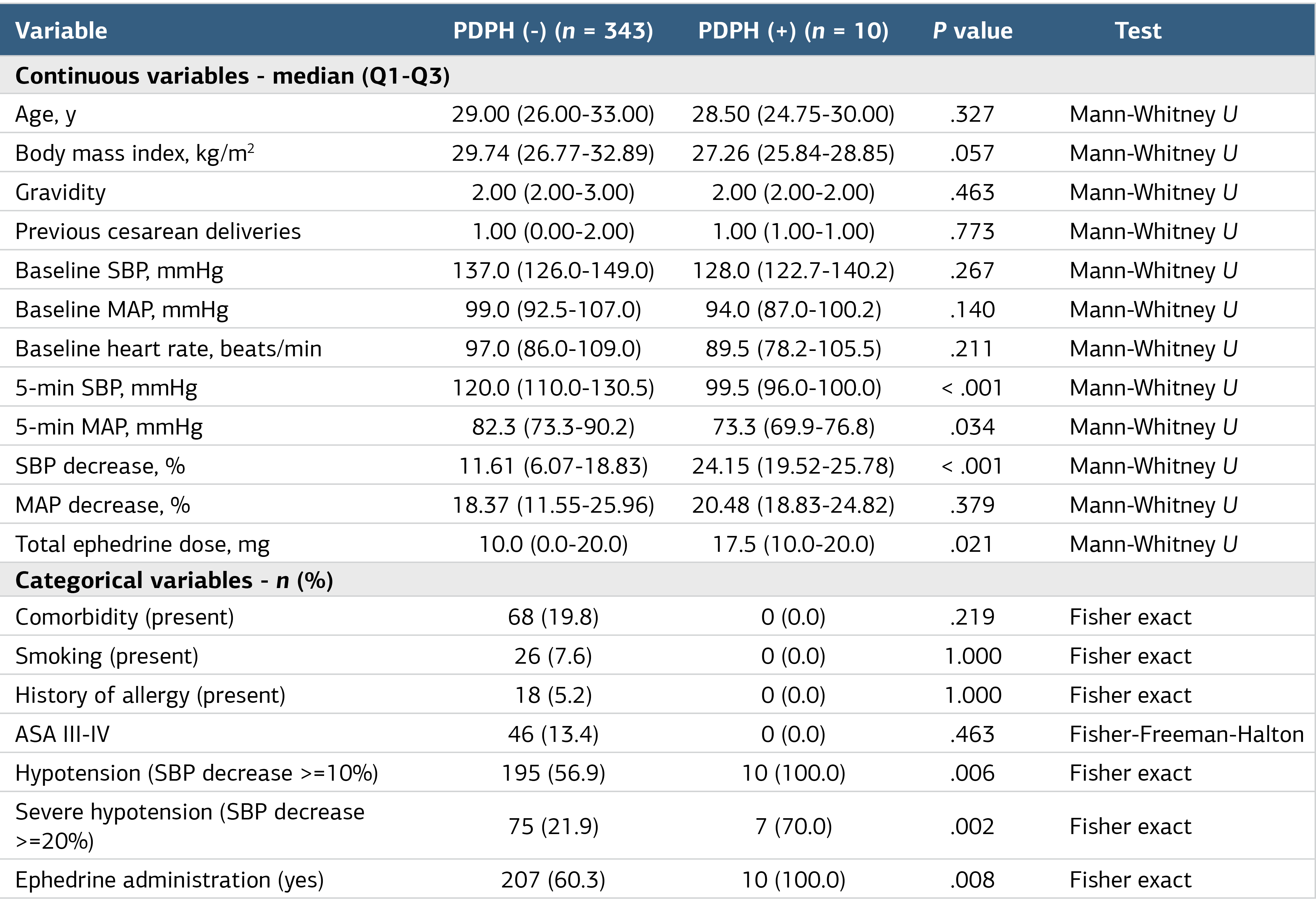
SBP, systolic blood pressure; MAP, mean arterial pressure; BMI, body mass index. Data are presented as median (Q1-Q3) for continuous variables and n (%) for categorical variables. Because the Shapiro-Wilk test yielded P < .05 for all continuous variables, between-group comparisons were performed using the Mann-Whitney U test. Fisher’s exact test (2-category variables) or the Fisher-Freeman-Halton test (3 or more categories) was used when tables contained cells with expected frequencies below 5. Rows with P < .05 indicate statistically significant differences.
Table 2. Association Between Hypotension Categories and PDPH Development
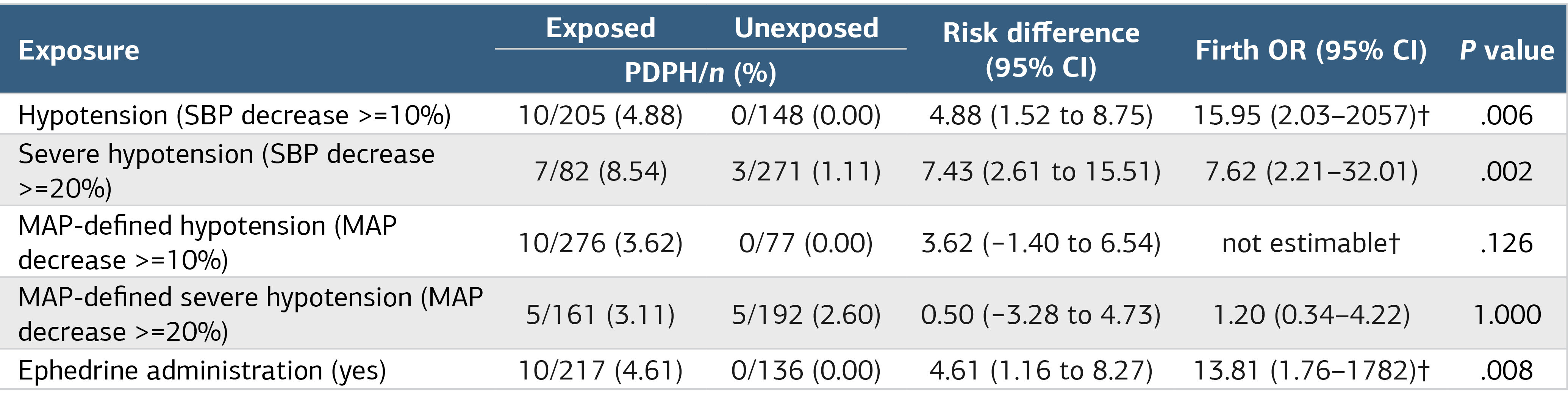
SBP, systolic blood pressure; MAP, mean arterial pressure; OR, odds ratio; RR, risk ratio; CI, confidence interval. Hypotension was defined as SBP decreasing below 90% of baseline (>=10% decrease), and severe hypotension was defined as SBP decreasing below 80% of baseline (>=20% decrease). P values were calculated using Fisher’s exact test. Rows with P < .05 indicate statistically significant associations.
Table 3. ROC Curve Analysis of Continuous Predictors for PDPH and Optimal Cutoffs Determined by the Youden Index

AUC, area under the curve; CI, confidence interval; SBP, systolic blood pressure; MAP, mean arterial pressure. The 95% confidence intervals were calculated using an unbiased bootstrap with 2000 repetitions. The optimal cutoff was determined using the Youden index (J = sensitivity + specificity - 1). Rows with AUC >=0.70 indicate at least moderate discriminatory performance.
Table 4. Univariable and Firth's Penalized Multivariable Logistic Regression Analyses for PDPH

OR, odds ratio; CI, confidence interval; BMI, body mass index; SBP, systolic blood pressure. The multivariable model simultaneously included age, BMI, percentage decrease in SBP, and total ephedrine dose. Because the number of PDPH events was low (n = 10), Firth’s penalized logistic regression was used for the multivariable model to reduce the risk of separation in standard maximum likelihood estimation.
Additional Information
Publisher’s Note
Bayrakol MP remains neutral with regard to jurisdictional and institutional claims.
Rights and Permissions

This work is licensed under a Creative Commons Attribution-NonCommercial 4.0 International License (CC BY-NC 4.0). To view a copy of the license, visit https://creativecommons.org/licenses/by-nc/4.0/
About This Article
How to Cite This Article
Serra Topal, Eralp Çevikkalp, Hande Gürbüz, Mustafa Savaş, Emre Ulusoy. Association between early systemic hypotension after spinal anesthesia and post-dural puncture headache: a prospective observational cohort study. Ann Clin Anal Med 2026;17(10):1122-1128. doi:10.4328/ACAM.50267
Publication History
- Received:
- 26.05.2026
- Accepted:
- 09.09.2026
- Published Online:
- 09.09.2026
- Printed:
- 01.10.2026