
Abstract
Aim In this article, we aimed to share our results of axillary contracture release operations and opinions on management protocols to obtain optimal postoperative results.Methods Ten patients underwent surgery between September 2004 and June 2013. All patients were male. The age range was 20-24 years, and all patients had axillary contractures for more than 10 years. In our study, split-thickness skin grafts, full-thickness skin grafts, local flaps, perforator flaps, and combinations of these techniques were used to release axillary contractures. Following the postoperative period, all patients were included in a program of both passive and assistive ROM exercises.Results In our ten-patient case series, although each patient had some degree of joint motion gains, we reached suboptimal outcomes. Only 3 of 10 patients reached 180-degree arm abduction. We also reached optimal 180-degree shoulder abduction in our 3 cases that had been operated on with pedicled flaps.Conclusion All 2nd- or 3rd-degree axillary region burns should be hospitalized in a burn unit. Particular attention should be paid to pediatric patients to avoid burn contractures in the axillary regions.
Keywords
Introduction
Axillary contractures are long-term complications of deep burn injuries in the axillary region. Shoulder abduction is limited to more than 120 degrees, and all upper extremity motions are decreased due to band formation and thickened skin.1 Daily activities are impaired with axillary contractures; moreover, the psychological status of patients is deteriorated.2 All kinds of daily activities are impaired with the existence of axillary contractures because most hand, forearm, and arm movements need regular and proper shoulder movements.3 Pediatric age group patients comprise the vast majority of burn patients,4 and children tend to adhere poorly to therapy regimens.5 Thus, children tend to develop contractures more frequently than patients in the adult age group. The frequency of axillary contractures has been reported as high as 27%–38% 6,7, and patients living in developing countries are more prone to serious contractures.8
In the English literature, there is no consensus on the classification of axillary contractures or on the selection of a perfect surgical release technique. Split-thickness skin grafts, full-thickness skin grafts, local flaps,9,10 pedicled flaps,11,12 perforator flaps,13,14 pre-expanded pedicled,2,8,13,15 and many pre-expanded,2 or non-expanded free flaps are reported to be used in axillary contracture releases. In this study, we aimed to share the outcomes of our experiences with axillary contracture release operations and ideas to reach optimal results.
Materials and Methods
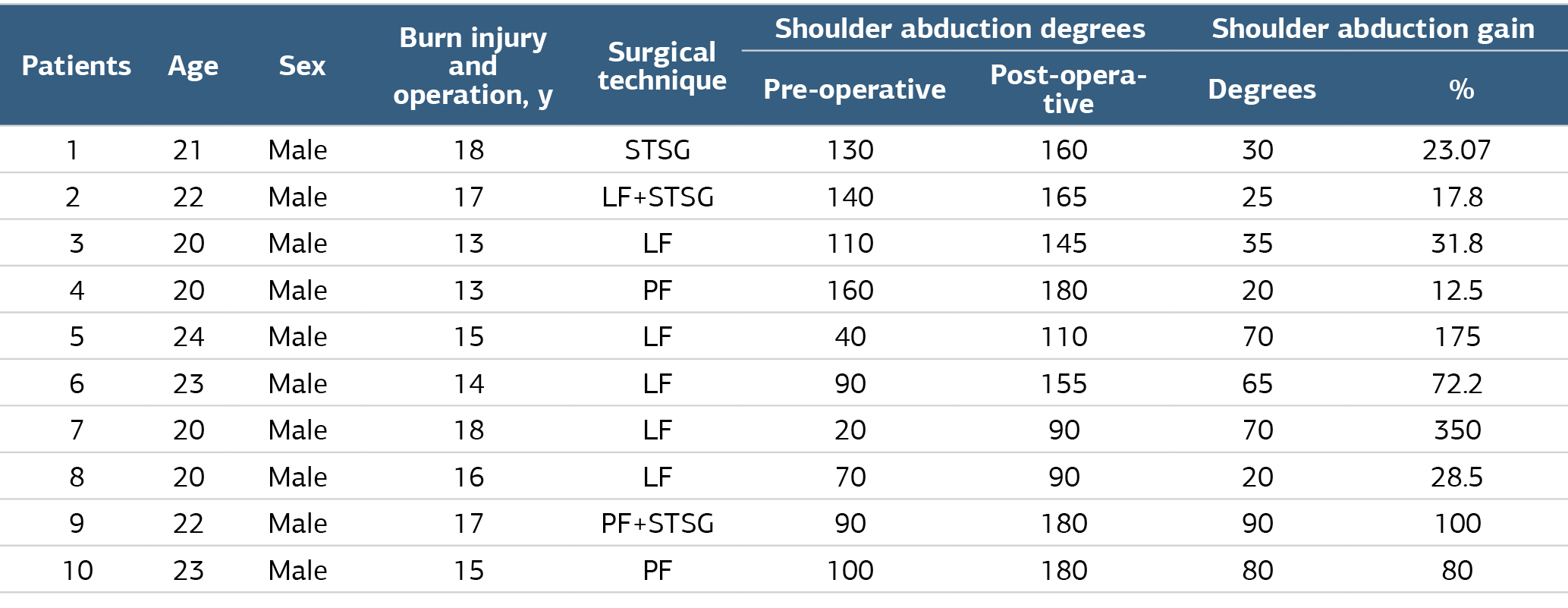
This is a multicenter retrospective case series study. All patients were male. The age range was 20 to 24 years, and all patients had axillary contractures for more than 10 years. The average age of patients was 21.5 years. The mean duration of contractures before surgery was 15.6 years. We did not use classification criteria and instead chose the surgical technique based on clinical consensus. Split-thickness skin grafts, local flaps, local flap + split-thickness skin graft, perforator flap, and perforator flap + split-thickness skin graft were used in our operations as outlined in Table 1. All patients received physiotherapy in the post-operative period, and only 2 patients had a 10% partial flap loss (Supplementary Figures S1a, S1b, S1c, and S1d).
Pre-operative and post-operative goniometric measurements were recorded. Results were considered optimal if the patient reached 180 degrees of shoulder abduction. Postoperative shoulder abductions below 180 degrees were listed as suboptimal. Shoulder abduction gain was also considered in each case.
All patients provided written informed consent before submission.Ethical ApprovalThis study did not require ethical approval in accordance with the relevant guidelines.Statistical AnalysisData were analyzed descriptively. Continuous variables were summarized using means, and categorical variables were presented as numbers. No inferential statistical analyses were performed because of the descriptive case-series design.Reporting GuidelinesThis study was reported in accordance with the STROBE guidelines.
Results
In our ten-patient case series, despite each patient having some degree of joint motion gains, we reached suboptimal outcomes. Only 3 of 10 patients reached 180-degree arm abduction. All patients sustained burn injuries during childhood, more than 10 years before contracture release surgery. Familiarity with living with such a condition at pediatric, adolescent, and adult ages led these patients to adapt to performing their daily activities in a restricted manner. Some degree of soft tissue and joint stiffness can accompany this condition. Such factors are among the causes of suboptimal results (Supplementary Figures S3a, S3b).
Discussion
Joint contractures can be avoided with proper burn care, casting, and physiotherapy. Those kinds of essential methods are best given in burn care centers. Some patients cannot access the healthcare system due to potentially low social, economic, and cultural levels in developing countries. Thus, those kinds of patients may remain untreated in case of a burn injury and even unoperated for long periods of time. In our country, every male is required to perform military service at the age of 20. Thus, patients coming from low socioeconomic and low sociocultural levels may find high-quality health care opportunities in military hospitals. This is why we can reach those patients with long-standing axillary contracture who have not undergone surgery for more than 10 years. The surgical approach to axillary contractures resulting from burn injuries is a challenging field for a reconstructive surgeon. Because there is no consensus on the classification system. As Lykoudis et al. 15 mentioned, many authors 16-19 have classified axillary contractures or modified previously defined classifications. Recently, Grishkevich published a new classification system based on a large patient series with 346 operations on axillary contracture releases.12 Due to the lack of a widely accepted and routinely used classification system, the same type of patients with axillary contractures can be operated on using a very wide range of techniques, ranging from simple skin grafts to free flaps (Supplementary Figures S2a and S2b). Every technique has its own “pros and cons”. The split-thickness skin grafts lose their popularity, in spite of technical convenience, due to cosmetically undesired appearance in the long term and a tendency to recontracture.17 Z-plasty, W-plasty-like techniques remain options for release surgery, but poor skin quality of adjacent tissues in cases of large burn sequel areas can cause complications like partial or total flap loss. In the literature, many pedicled and pre-expanded pedicled flaps have been described for axillary contracture release surgeries. Such options can be more effective than local flaps or split-thickness skin grafts. During axillary contracture release surgery, adjacent axillary neurovascular anatomic structures can be exposed perioperatively and should be covered by strong soft tissue. This kind of problem can be better addressed with pedicled flaps, such as the latissimus dorsi muscle flap or the pre-expanded latissimus dorsi flap.15 Local flaps like trapeze flap 9 and double opposing rectangular advancement flap;10 pedicled flaps like posterior arm flap,11 quadrangular local scar subcutaneous pedicled flap;12 perforator flaps like circumflex scapular perforator (CSP) propeller flap,13 thoracodorsal artery perforator (TDAP) fasciocutaneous flap;14 pre-expanded pedicled flaps like Latissimus dorsi flap,15 TDAP flap,2,8 and many pre-expanded,2 or non-expanded free flaps are reported. Our results were somewhat suboptimal when compared to Kulahci et al.’s paper8, in which adult-age-group axillary contracture cases had been operated with a pre-expanded pedicled thoracodorsal artery perforator flap, and Hocaoglu et al.’s paper2, in which pediatric-age-group patients had been operated with pre-expanded perforator flaps of the dorsolateral trunk. This may be due to the inadequacy of split-thickness skin grafts, local flaps, and their combined use in severe contractures. We also reached optimal 180-degree shoulder abduction in our 3 cases that had been operated with pedicled flaps. We, as reconstructive surgeons, know that prevention is the best solution in deformity correction surgery. Children tend to sustain more burn injuries than adults, and complication rates are higher for children. One review with 3146 patients also showed that 6 82% of follow-up patients who had contracture formation were under 5 years of age.20,21 In the same paper with 3000 patients, the author also expressed that the axillary region is very special because all axillary burn injuries cause contracture formation to any degree. The author also reported that the median time to contracture is 12.1 months and the maximum is 13 months. According to this information, all axillary burn injuries, especially in children, should be followed for a minimum of 13 months for contracture formation. Webbs et al., in their prospective case series of 25 axillary burn patients, reported that an approach to shoulder burns using a flowchart would be very useful, and that patients achieved full range of motion and had all functions preserved by 12 weeks post-discharge.1 All deep (2nd or 3rd degree) axillary region burns should be hospitalized, especially in a burn unit if available. Particular attention should be paid to avoid contracture formation after acute axillary burn injuries, if the victims are children. Axillary burn patients should be followed regularly for 13 months postdischarge to detect axillary contracture formation and intervene with simpler, more convenient methods. If a patient with AC undergoes surgery, especially if there is a long interval between the burn injury and contracture release surgery, and if the axillary contracture is severe according to any classification criterion, we strongly recommend pedicled flaps or pre-expanded pedicled flaps to achieve optimal shoulder range of motion and functional gain.
Limitations
Because this study is retrospective and single-center, its results may be limited in generalizability.
Conclusion
All second- to third-degree axillary region burns should be treated in burn units. Particular attention should be paid to pediatric patients to avoid burn contractures in the axillary and other joint regions.
Declarations
Animal and Human Rights Statement
All procedures performed in this study were in accordance with the ethical standards of the institutional and/or national research committee and with the 1964 Declaration of Helsinki and its later amendments, or comparable ethical standards.
Informed Consent
Written informed consent was obtained from all participants.
Data Availability
The datasets used and/or analyzed during the current study are not publicly available due to patient privacy reasons but are available from the corresponding author on reasonable request.
Conflict of Interest
The authors declare no conflict of interest.
Funding
None.
Author Contributions (CRediT Taxonomy)
Conceptualization: C.M., F.E.
Methodology: C.M., F.E.
Validation: F.E.
Formal Analysis: C.M.
Investigation: C.M., F.E.
Data Curation: C.M.
Writing – Original Draft: C.M.
Writing – Review & Editing: C.M., F.E.
Visualization: C.M.
Supervision: F.E.
Project Administration: C.M.
AI Usage Disclosure
The authors declare that no AI-assisted technologies were used.
Abbreviations
AC: Axillary contracture
CSP: Circumflex scapular perforator
LF: Local flap
PF: Perforator flap
ROM: Range of motion
STSG: Split-thickness skin graft
TDAP: Thoracodorsal artery perforator
References
- Webb DC, Byrne M, Kolmus A, Law HY, Holland AE, Cleland H. Outcomes of a shoulder treatment flowchart in patients with axillary burns. J Burn Care Res. 2011;32(2):224-30. doi:10.1097/BCR.0b013e31820aaeda
- Hocaoğlu E, Aydin H. Preexpanded perforator flaps of the dorsolateral trunk in pediatric patients. Plast Reconstr Surg. 2013;131(5):1077-86. doi:10.1097/ PRS.0b013e3182865dd7
- Sison-Williamson M, Bagley A, Palmieri T. Long-term postoperative outcomes after axillary contracture release in children with burns. J Burn Care Res. 2012;33(2):228-34. doi:10.1097/BCR.0b013e3182331df4
- Dissanaike S, Rahimi M. Epidemiology of burn injuries: highlighting cultural and socio-demographic aspects. Int Rev Psychiatry. 2009;21(6):505-11. doi:10.3109/09540260903340865
- Passaretti D, Billmire DA. Management of pediatric burns. J Craniofac Surg. 2003;14(5):713-8. doi:10.1097/00001665-200309000-00021
- Kraemer MD, Jones T, Deitch EA. Burn contractures: incidence, predisposing factors, and results of surgical therapy. J Burn Care Rehabil. 1988;9(3):261-5. doi:10.1097/00004630-198805000-00005
- Schneider JC, Holavanahalli R, Helm P, Goldstein R, Kowalske K. Contractures in burn injury: defining the problem. J Burn Care Res. 2006;27(4):508-14. doi:10.1097/01.BCR.0000225994.75744.9D
- Kulahci Y, Sever C, Uygur F, Oksuz S, Sahin C, Duman H. Pre-expanded pedicled thoracodorsal artery perforator flap for postburn axillary contracture reconstruction. Microsurgery. 2011;31(1):26-31. doi:10.1002/micr.20825
- Grishkevich VM. Postburn shoulder medial-adduction contracture: anatomy and treatment with trapeze-flap plasty. Burns. 2013;39(2):341-8. doi:10.1016/j.burns.2012.06.002
- Ertaş N, Borman H. Double opposing rectangular advancement flap is an alternative technique in the treatment of wide linear postburn scar contractures. Burns. 2011;37(8):1449-57. doi:10.1016/j.burns.2011.08.006
- Guha G, Agarwal AK, Gupta S, Gupta S, Murmu MB, Chumbale P, Chattopadhyaya D. Posterior arm flap in management of axillary contracture. Burns. 2013;39(5):972-7. doi:10.1016/j.burns.2012.11.010
- Grishkevich VM. Shoulder adduction contracture after burn: anatomy and treatment with quadrangular local scar subcutaneous pedicled flap. Burns. 2013;39(7):1423-9. doi:10.1016/j.burns.2013.03.014
- Kosutic D, Potter S, Gulic R. Circumflex scapular perforator propeller flap for axillary reconstruction. Microsurgery. 2012;32(3):251-2. doi:10.1002/micr.20981
- Sever C, Uygur F, Kulahci Y, Karagoz H, Sahin C. Thoracodorsal artery perforator fasciocutaneous flap: a versatile alternative for coverage of various soft tissue defects. Indian J Plast Surg. 2012;45(3):478-84. doi:10.4103/0970- 0358.105956
- Lykoudis EG, Seretis K, Ziogas DE. Tissue expansion and latissimus dorsi transfer for arm-thorax synechia reconstruction. J Burn Care Res. 2011;32(2):e15-20. doi:10.1097/BCR.0b013e31820ab117
- Hanumadass M, Kagan R, Matsuda T, Jayaram B. Classification and surgical correction of postburn axillary contractures. J Trauma. 1986;26(3):236-40. doi:10.1097/00005373-198603000-00004
- Kurtzman LC, Stern PJ. Upper extremity burn contractures. Hand Clin. 1990;6(2):261-79. doi:10.1016/S0749-0712(21)00866-0
- Teot L, Bosse JP. The use of scapular skin island flaps in the treatment of axillary postburn scar contractures. Br J Plast Surg. 1994;47(2):108-11. doi:10.1016/0007-1226(94)90168-6
- Ogawa R, Hyakusoku H, Murakami M, Koike S. Reconstruction of axillary scar contractures: retrospective study of 124 cases over 25 years. Br J Plast Surg. 2003;56(2):100-5. doi:10.1016/S0007-1226(03)00035-3
- Kidd LR, Nguyen DQ, Lyons SC, Dickson WA. Following up the follow up: long- term complications in paediatric burns. Burns. 2013;39(1):55-60. doi:10.1016/j.burns.2012.05.015
- Partain KP, Fabia R, Thakkar RK. Pediatric burn care: new techniques and outcomes. Curr Opin Pediatr. 2020;32(3):405-10. doi:10.1097/ MOP.0000000000000902
Tables
Additional Information
Publisher’s Note
Bayrakol MP remains neutral with regard to jurisdictional and institutional claims.
Rights and Permissions

This work is licensed under a Creative Commons Attribution-NonCommercial 4.0 International License (CC BY-NC 4.0). To view a copy of the license, visit https://creativecommons.org/licenses/by-nc/4.0/
About This Article
How to Cite This Article
Cenk Melikoglu, Fikret Eren. Long-lasting axillary burn contracture problem in developing countries: underlying reasons and solution suggestions. Ann Clin Anal Med 2026;17(9):979-982. doi:10.4328/ACAM.20502
Publication History
- Received:
- 26.01.2021
- Accepted:
- 06.05.2021
- Published Online:
- 13.01.2026
- Printed:
- 01.09.2026