
Abstract
IntroductionHemophagocytic syndrome is a rare syndrome of excessive inflammation and tissue destruction due to abnormal immune activation and inflammation. Brucellosis is one of the rare causes of hemophagocytosis. Several reports revealed the relationship between hemophagocytosis and brucellosis.Case PresentationIn this case, a case of brucellosis presenting with bicytopenia due to hemophagocytic syndrome is presented by blood and bone marrow culture analyses. The Rose Bengal test, Coombs’ test and the standard tube agglutination test were performed and were negative. Brucella melitensis was isolated in the blood and bone marrow cultures on the seventh day of incubation. After the diagnosis was confirmed by bone marrow biopsy and blood culture analyses, antibiotic treatment (oral doxycycline 200 mg/day and rifampicin 600 mg/day for 6 weeks) was immediately initiated. Bone marrow aspiration biopsy has shown platelets, neutrophils, and lymphocytes phagocytosed by macrophages.ConclusionPeripheral blood counts of the patient returned to normal levels after 2 weeks of antibiotic treatment of brucellosis. Antibiotic treatment was stopped after 6 weeks of therapy once patient’s complaints have resolved.
Keywords
Introduction
Hemophagocytosis is a pathological and clinical case triggered by phagocytosis of erythrocytes, leukocytes, platelets and their precursor cells, which are the main components of bone marrow cells of macrophages activated for various reasons. Hemophagocytosis is also called hemophagocytic lymphohistiocytosis (HLH). Haemophagocytic lymphohistiocytosis (HLH) is a life-threatening disorder characterized by a hyperimmune response. HLH can be classified as primary and secondary. Primary HLH is associated with mutations of syntaxin 11, perforin 1, and hMunc13-4 genes and usually presents during infancy. Secondary HLH is mainly related to viral, bacterial, fungal or parasitic infections, malignancy, and autoimmune diseases.1 Clinical diagnoses of HLH are high fever, hepatosplenomegaly (HSM), cytopenia (in 2 cell types), elevated ferritin (>500 ng/dL), high triglyceride (>265 mg/dL) or hypofibrinogenemia (<150 mg/dL), deficiency or absence of NK cell activity, elevated CD25 levels, and hemophagocytosis in the bone marrow, spleen, lymph node, or liver. Five of these eight criteria must be fulfilled for successful diagnosis.2,3 Brucellosis is one of the most common zoonotic diseases in the world and Türkiye, and can progress with various complications.4 The relationship between brucellosis and hemophagocytosis exists in the literature. In this case report, we present a secondary HLH case associated with Brucella, which is rarely reported in the literature.
Case Presentation
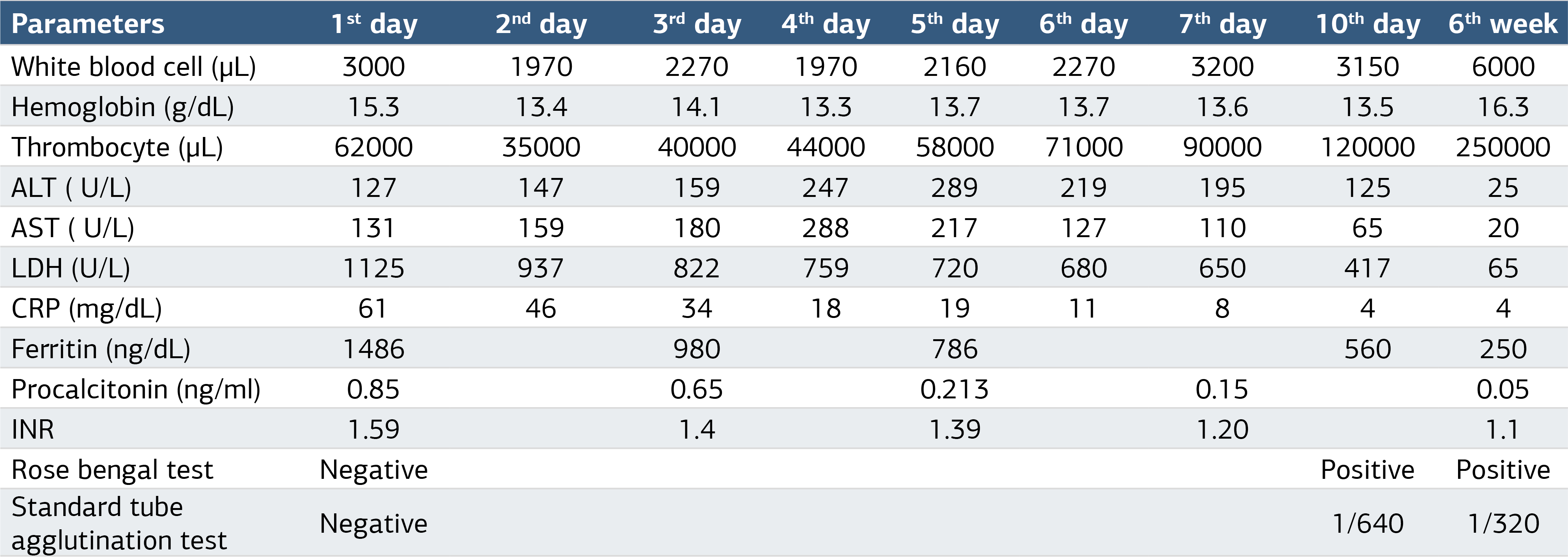
A 19-year-old male patient, who is a stock farmer, was admitted to the hospital with complaints of fever, diarrhea, decreased appetite and headache for 10 days. On the physical examination, right upper quadrant tenderness to palpation and hepatosplenomegaly were observed. The blood test results were as follows: hemoglobin: 15.3 g/dL, platelets: 60.103/μL, white blood cell: 3.000/μL (neutrophil: 980), blood urea nitrogen (BUN): 24 mg/dL, creatine: 0.7 mg/dL, AST: 131 U/L, ALT: 127 U/L, total bilirubin: 0.6 mg/dL, direct bilirubin: 0.1 mg/dL, LDH: 1125 U/L, triglyceride: 346 mg/dL, creatine kinase: 273 IU/L, CRP: 61 mg/dL, sedimentation: 3 mm/h and ferritin: 1486 ng/mL (Table 1). Hepatitis viral markers and anti-HIV test results were found to be negative. No bacterial growth was detected in urine and stool cultures. Based on the past medical history and blood test results, the patient was diagnosed with Salmonellosis, and ciprofloxacin 2x400 mg IV/day treatment was initiated. Echocardiography result of the patient revealed that no vegetation was established. Rose Bengal (RB), Brucella Coombs and standard tube agglutination (STA) tests were found to be negative. Since the fever of the patient was still high and thrombocyte (PLT) and white blood cell (WC) results were respectively 35.103/μL and 1970/μL, bone marrow aspiration biopsy was performed to diagnose fever. In addition to the existence of high fever, HSM, bicytopenia, and high ferritin levels in the patient, observation of platelets, neutrophils and lymphocytes phagocyted by macrophages in the bone marrow peripheral smear test allowed us to consider secondary hemophagocytosis syndrome due to Brucella infection. On the seventh day, the growth of Brucella Melitensis was detected in the blood and bone marrow cultures. Ciprofloxacin treatment was stopped. Doxycycline 2x100 mg/day/po and rifampicin 600 mg/day/po treatment was initiated for the patient. On the tenth day of the therapy, the Rose Bengal test result was positive and the standard tube agglutination test (STA) was detected to be 1/640. The patient was discharged after improvement of laboratory and clinical symptoms. Doxycycline 2x100 mg/day/po and rifampicin 600 mg/day/po treatment was continued after discharge. After six weeks of the therapy, laboratory test results were detected as follows: hemoglobin: 16.3 g/dL, platelets: 250.103/μL, white blood cell: 6.000/μL, AST: 20 U/L, ALT: 25 U/L, CRP: 4 mg/dL, sedimentation: 12 mm/h, ferritin: 250 ng/mL and standard tube agglutination test: 1/320. After that, the treatment was stopped due to the absence of complaints from the patient.Ethical ApprovalEthical approval was not required.
This case report was prepared in accordance with the CARE guidelines.
Discussion
Hemophagocytic lymphohistiocytosis (HLH) is a rare disorder characterized by an intense hyperimmune response and uncontrolled release of inflammatory cytokines. In addition, it involves hyperactivation of macrophages, cytotoxic T lymphocytes and natural killer (NK) cells, leading to multiorgan failure and, often, death. HLH could be primarily triggered by genetic etiology or malignancy, secondarily associated with autoimmune diseases and infections.5,6 Brucellosis infection could rarely lead to hemophagocytosis syndrome. Brucellosis is the most common zoonotic disease around the world and over 500,000 new cases of brucellosis are reported each year. Brucellosis is an endemic disease, especially in the middle east and southeast of the Anatolian region of Türkiye. The main symptoms of brucellosis are fever, myalgia, hepatosplenomegaly, diarrhea, lymphadenopathy, arthralgia and arthritis, and the most common complaint is fever. Hepatosplenomegaly, anemia, and leukopenia are frequently associated with acute brucellosis. The incidence of pancytopenia in brucellosis patients are reported between 3-21%. In the reported case, the symptoms of the patient are high fever, diarrhea, and headache. The patient had elevated levels of bicytopenia, massive HSM, ferritin, AST and ALT. Although HLH is not usually easy to diagnose, the main symptoms in the patient were fever, cytopenia, hepatosplenomegaly and hemophagocytosis.7 Hemophagocytized histiocytes should be observed in bone marrow, spleen, and lymph node. Since biopsy of the spleen and lymph nodes is an invasive procedure, the bone marrow biopsy was performed. In this case, hemophagocytosis was demonstrated in the bone marrow cellular elements.2,3 The diagnosis of Brucella species can be mostly made by serological tests and molecular methods due to the low isolation rate in blood cultures. Serological diagnosis of Brucellosis is based on screening test with Rose Bengal (RB) and detection of antibody titers measured by a standard serum tube agglutination (STA) test. In addition to that, confirmation with the Brucella Coombs gel test is necessary since false negative results may be obtained with the STA test. Bone marrow and blood cultures of Brucella cases have been reported to be positive in 82.5-92% and 45-70% of the patients, respectively. Initial results of RB, STA, and Coombs tests were negative in the reported case, but they were detected to be positive on the tenth day of the treatment. Brucella melitensis growth in the blood and bone marrow cultures was detected on the seventh day of incubation.7 Hemophagocytic syndrome could be very severe and mortal. Bleeding caused by severe thrombocytopenia or infections due to neutropenia can cause mortality. Therefore, patients with hemophagocytic syndrome must be quickly diagnosed and necessary treatments should be initiated immediately. If there is no significant clinical improvement in patients in spite of the treatment of the disease, additional supportive treatment and IVIG should be provided to the patients.1
Limitations
This case report describes a single patient; therefore, the findings should be interpreted with caution and cannot be generalized to the broader population.
Conclusion
HLH associated with brucellosis is an inflammatory disease that frequently affects children. However, it is increasingly being diagnosed in adults. Brucellosis in endemic regions should be considered as a predisposing infection in cases with HLH symptoms such as prolonged fever, splenomegaly, cytopenia and high ferritin evels, and must be appropriately treated. IVIG, steroid or immunosuppressive agents may be used in the treatment if clinical and laboratory findings of the patients do not improve due to hemophagocytosis syndrome.
Declarations
Animal and Human Rights Statement
All procedures performed in this study were in accordance with the ethical standards of the institutional and/or national research committee and with the 1964 Helsinki Declaration and its later amendments or comparable ethical standards.
Informed Consent
Written informed consent was obtained from the patient for publication of this case report and any accompanying images.
Data Availability
The datasets used and/or analyzed during the current study are not publicly available due to patient privacy reasons but are available from the corresponding author on reasonable request.
Conflict of Interest
The authors declare that there is no conflict of interest.
Funding
None.
Abbreviations
ALT: Alanine aminotransferase
AST: Aspartate aminotransferase
CRP: C-reactive protein
HLH: Hemophagocytic lymphohistiocytosis
HSM: Hepatosplenomegaly
NK: Natural killer
References
- Yildiz H, Van Den Neste E, Defour JP, Danse E, Yombi JC. Adult haemophagocytic lymphohistiocytosis: a review. QJM. 2022;115(4):205-213.
- Zhang Q, Zhu L, Zhu J, et al. Adult-onset haemophagocytic lymphohistiocytosis prognosis is affected by underlying disease: analysis of a single-institution series of 174 patients. Swiss Med Wkly. 2018;148. doi:10.4414/smw.2018.14641
- Schram AM, Comstock P, Campo M, et al. Haemophagocytic lymphohistiocytosis in adults: a multicentre case series over 7 years. Br J Haematol. 2016;172(3):412-419. doi:10.1111/bjh.13837
- Öner SZ, Türkoğlu E. Seroprevalence of brucellosis from a region where low endemicity is expected. Med J West Black Sea. 2020;4(1):18-23.
- Al-Samkari H, Berliner N. Hemophagocytic lymphohistiocytosis. Annu Rev Pathol. 2018;13:27-49. doi:10.1146/annurev-pathol-020117-043625
- Hayden A, Park S, Giustini D, Lee AY, Chen LY. Hemophagocytic syndromes, including hemophagocytic lymphohistiocytosis, in adults: a systematic scoping review. Blood Rev. 2016;30(6):411-420. doi:10.1016/j.blre.2016.05.001
- Kerget F, Kerget B, Çelik N, İba Yılmaz S. Specific tests and inflammatory biomarkers in the evaluation of brucellosis disease. Mikrobiyol Bul. 2021;55(2):113-124.
Tables
Table 1. Laboratory results of the study
Additional Information
Publisher’s Note
Bayrakol MP remains neutral with regard to jurisdictional and institutional claims.
Rights and Permissions

This work is licensed under a Creative Commons Attribution-NonCommercial 4.0 International License (CC BY-NC 4.0). To view a copy of the license, visit https://creativecommons.org/licenses/by-nc/4.0/
About This Article
How to Cite This Article
Filiz Kurklu Bozkır, Seval Sönmez Yıldırım, Rafiye Çiftçiler. Brucellosis case presenting with bicytopenia due to hemophagocytic syndrome: A Case Report. Ann Clin Anal Med 2025;16(Suppl 2):105-107. doi:10.4328/ACAM.21710
Publication History
- Received:
- 01.04.2023
- Accepted:
- 14.08.2023
- Published Online:
- 23.10.2024
- Printed:
- 25.05.2025