
Abstract
IntroductionAcute appendicitis after abdominal trauma has rarely been reported in the past on a case-by-case basis. In this article, we present a case of acute appendicitis in a motor vehicle accident driver.Case PresentationAppendicitis should be considered as a differential diagnosis in emergency department admissions with a history of trauma to the abdominal area and complaints of abdominal pain. Because post-traumatic appendicitis is rare, timely diagnosis is crucial. Clinicians and forensic report preparers should be knowledgeable and aware of the development of post-traumatic acute appendicitis.ConclusionDue to the case presented in this article, the literature was reviewed. In cases where appendicitis develops after trauma, It was emphasized that the conditions for establishing causality between the trauma and the outcome should be taken into consideration and that the requested forensic reports should be prepared within this scope.
Keywords
Introduction
Appendicitis is the most common abdominal surgical problem in emergency hospital admissions. It is seen in an average of 7-9% of individuals throughout their lives. Appendicitis often occurs due to obstruction of the appendix lumen. however, trauma has been identified as a rare cause of acute appendicitis.1,2 Cases of acute appendicitis after trauma, although rare, have been described in the past.3,4 Clinical findings of post-traumatic appendicitis have been reported to be similar to those of non-traumatic appendicitis.5 Nausea, loss of appetite, fever, and right lower quadrant abdominal tenderness were described as typical findings of appendicitis on admission to the emergency department. Early diagnosis is important in these cases, and medical history and physical examination are required in every case. Ultrasound and tomography imaging are diagnostic methods that support anamnesis and physical examination findings.6 Diagnosis and treatment of acute appendicitis are similar regardless of its relationship with trauma.4,6 Medical history is important in rare cases of post-traumatic appendicitis.5,7
In this article, a rare case of appendicitis following an in-car traffic accident, which was referred to us with the request of preparation of a forensic-medical report, is presented.
Case Presentation
A 65-year-old male patient was admitted to the hospital with a complaint of abdominal pain that started 10 hours after the traffic accident. The patient is a car driver who collided with another car 10 hours before presenting to the emergency room. He stated that he had no pain or medical complaints in his body or abdominal area before, at the time of the accident and in the first 10 hours after the accident. He applied to the hospital 10 hours after the accident with the development of widespread abdominal pain, which was gradual at first, progressively progressing and worsened with movement. In the emergency room examination, defense and rebounding were observed to be positive, and other system examinations were found to be normal. Laboratory values were: white blood cell count (WBC) 11 K/uL, hemoglobin 15.7 g/dL, platelets 321 K/uL. In upper and lower abdomen computed tomography (CT), the diameter of the appendage vermiphoris was measured as 12 mm (Figure 1). It has been stated that the appendix wall is edematous and heterogeneous density increases are observed in the appendiceal periappendicular tissue. No additional abnormalities were detected in the imaging examination. The patient was asked to be examined in consultation with the General Surgery Department. In the serial abdominal examination performed by the General Surgery, it was determined that the defense and rebound positivity continued. Therefore, the patient was taken into surgery and appendectomy surgery was performed. Histopathological examination confirmed the diagnosis of acute appendicitis.
Twenty-two months after the incident, when he applied to the forensic medicine clinic for the preparation of a forensic medical report, he was examined; He stated that his seat belt was fastened at the time of the incident and that he went to the hospital complaining of abdominal pain approximately 10 hours after the traffic accident. During the examination, he was conscious, his system examinations were normal, and a 1×1 cm scar tissue was assigned in the left lower quadrant of the abdomen and a 1×1 cm scar tissue under the umbilicus.
The person did not have any disease before the incident, and after examining all the medical records summarized above, the appendicitis that developed in the person was evaluated as being causally related to the traffic accident that occurred 10 hours ago.
The forensic report was prepared and finalized within this scope.Ethical ApprovalNot applicable.Statistical AnalysisNot applicable.
This case report was prepared in accordance with the CARE guidelines.
Discussion
Acute appendicitis after abdominal trauma has been reported rarely in the last century, and it has been stated that the frequency of acute appendicitis reported after trauma is low.3,5,8 Ciftci et al. (1996) reported appendicitis in only five (0.9%) of 554 patients following abdominal trauma.8 Salinas-Castro et al. ıt was reported that one person developed appendicitis after trauma to the abdomen with a football ball.6 Similar to the case of Sharma et al. (1995), our case is similar to seat belt appendicitis in our literature review.4 However, no cases of appendicitis with a history of acute appendicitis after a traffic accident requiring a forensic report have been encountered. This makes the article important in terms of its contribution to the literature.
There are many causes of acute inflammation of the appendix. Traumatic mechanism is also stated as one of the etiologies defined in the literature.6 Various anatomical and pathophysiological mechanisms have been proposed as to why the appendix is vulnerable to inflammation following trauma. The first mechanism is that it may be a traumatic external impact involves a process that causes a temporary increase in intra-abdominal pressure, resulting in increased intra-appendiceal membrane pressure. Alternatively, trauma can indirectly cause muscle irritation that causes adhesions or changes in the anatomical position of the appendix, resulting in mucosal edema. In addition, non-direct abdominal trauma may cause edema in the internal organs, restriction of the intra-abdominal space, and therefore increased intra-abdominal pressure.1,2,4,6
It has been suggested that it may be a direct process that causes appendiceal lumen obstruction by causing abdominal trauma, local edema, inflammation or lymphatic hyperplasia as a different mechanism.1,2,4
Diagnostic criteria for traumatic appendicitis include the patient having no previous symptoms, the presence of any trauma to the abdominal wall, the first onset of medical complaints 6 to 48 hours after the trauma, and surgical confirmation of appendicitis with persistent/progressive symptoms.6
In the case presented in this article, all diagnostic criteria for Traumatic appendicitis were met, and appendicitis was detected histopathologically after appendectomy.
Limitations
The main limitation of this case report is that the findings are based on a single patient.
Conclusion
The necessity of making a judicial notification and keeping a forensic report in hospital applications that are forensic cases, such as a traffic accident, is known by all medical doctors. The medical consequences that occur after any trauma should also be taken into account when preparing a forensic medical report.
If acute appendicitis is detected in a person after any trauma, a forensic report should be prepared, considering that trauma is a rare cause of acute appendicitis. This situation is emphasized in our case report article.
Declarations
Animal and Human Rights Statement
All procedures performed in this study were in accordance with the ethical standards of the institutional and/or national research committee and with the 1964 Helsinki Declaration and its later amendments or comparable ethical standards.
Informed Consent
Written informed consent was obtained from the patient.
Data Availability
The datasets used and/or analyzed during the current study are not publicly available due to patient privacy reasons but are available from the corresponding author on reasonable request.
Conflict of Interest
The authors declare that there is no conflict of interest.
Funding
None.
Abbreviations
CT: Computed tomography
WBC: White blood cell count
References
- Khodadadeh P, Achiam M. Trafikuheld som genvej til akut appendektomi [Traffic accident as a shortcut to acute appendectomy]. Ugeskr Laeger. 2012;174(49):3094-3095.
- Goldman S, Canastra N, Genisca A. Appendicitis following blunt abdominal trauma: an illustrative case. R I Med J. 2022;105(3):37-38.
- Amir A, Amir L, Waisman Y. Acute appendicitis after a blunt perineal trauma: an illustrative case. Pediatr Emerg Care. 2009;25(3):184-185.
- Sharma AK, Vig S, Neades GT. Seat-belt compression appendicitis. Br J Surg. 1995;82(7):999.
- Toumi Z, Chan A, Hadfield MB, Hulton NR. Systematic review of blunt abdominal trauma as a cause of acute appendicitis. Ann R Coll Surg Engl. 2010;92(6):477-482. doi:10.1308/003588410x12664192075936
- Salinas-Castro KJ, Mejía-Quiñones V, Zúñiga-Londoño NY. Acute appendicitis after closed abdominal trauma: a case report. Radiol Case Rep. 2022;18(2):631-634.
- Bangs RG. Acute appendicitis following blunt abdominal trauma. Ann Surg. 1992;216(1):100.
- Ciftci AO, Tanyel FC, Büyükpamukçu N, Hiçsönmez A. Appendicitis after blunt abdominal trauma: cause or coincidence? Eur J Pediatr Surg. 1996;6(6):350-353. doi:10.1055/s-2008-1071013
Figures
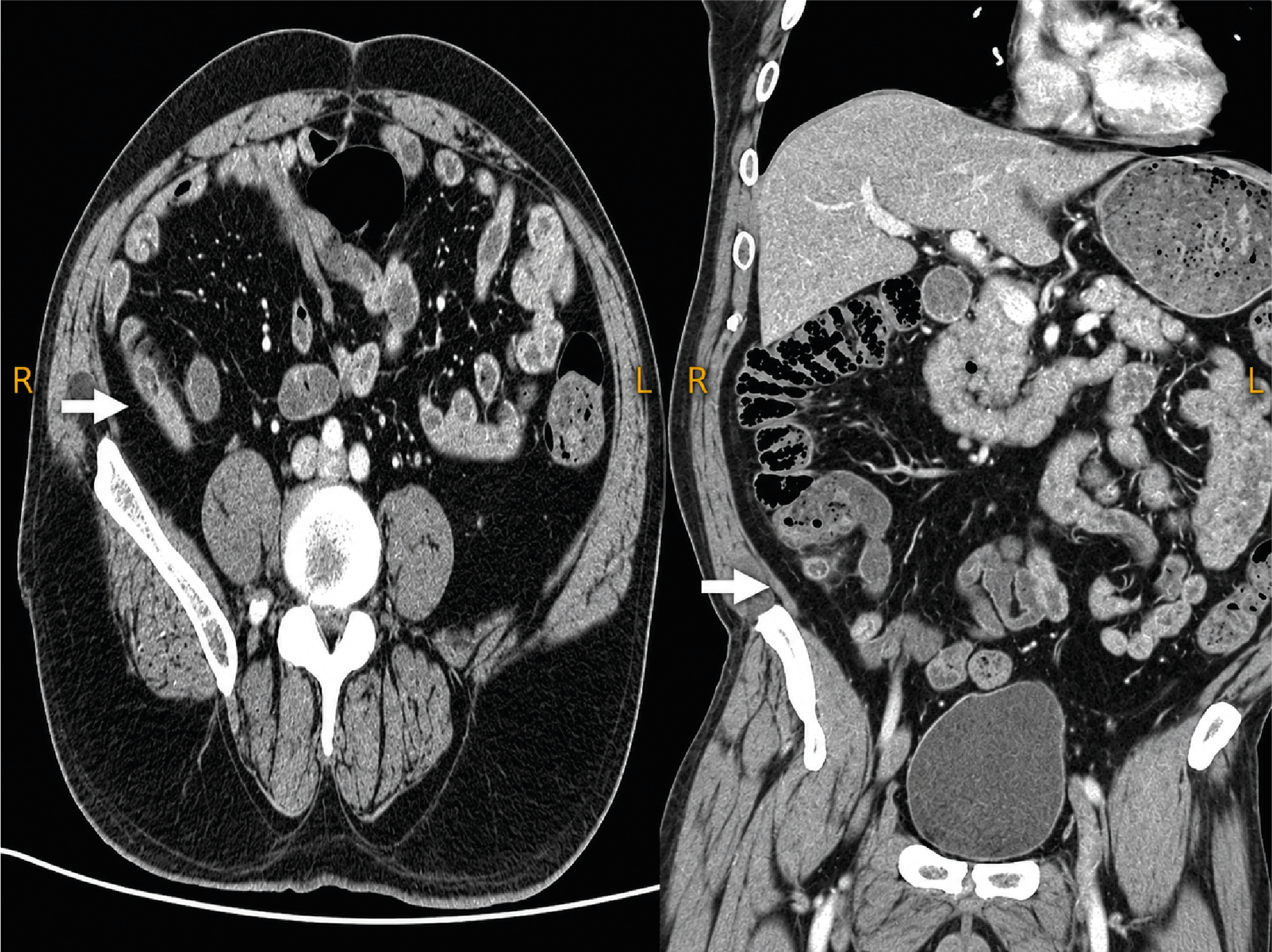
Figure 1. Appendix View in Axial Section and Coronal Section
Additional Information
Publisher’s Note
Bayrakol MP remains neutral with regard to jurisdictional and institutional claims.
Rights and Permissions

This work is licensed under a Creative Commons Attribution-NonCommercial 4.0 International License (CC BY-NC 4.0). To view a copy of the license, visit https://creativecommons.org/licenses/by-nc/4.0/
About This Article
How to Cite This Article
Uğur Demir, Hüseyin Kafadar. Acute appendicitis in a vehicle driver after a traffic accident: A Case Report. Ann Clin Anal Med 2024;15(Suppl 2):82-84. doi:10.4328/ACAM.22189
Publication History
- Received:
- 21.03.2024
- Accepted:
- 06.05.2024
- Published Online:
- 04.06.2024
- Printed:
- 20.10.2024