
Abstract
IntroductionForeign body ingestion in adults is a rare occurrence; however, intentional ingestion cases are reported among prisoners and individuals with psychiatric disorders. Here, we reported two unusual cases of foreign body ingestion in two adults with psychiatric disorders. Case PresentationA 32-year-old female presented to the emergency department with self-harm to the abdomen to extract a needle under her skin. Radiologic images showed multiple sewing needles in the gastrointestinal tract and adjacent structures. In the other case, a 23-year-old male presented with rectal bleeding after ingesting metallic screws. His previous and new scans revealed multiple metallic screws and safety pins throughout the gastrointestinal tract. Both patients had a history of chronic foreign body ingestion and had never been operated. ConclusionThe aim of this report is to raise a question whether non-operative follow-up could be a treatment of choice after the ingestion of sharp objects such as sewing needles and metallic screws.
Keywords
Introduction
Intentional or accidental ingestion of a foreign body (FB) is more common in children. However intentional digestions can occur among prisoners and adults with psychiatric disorders.1,2 Even though the majority of the ingested bodies can pass through the gastrointestinal tract and leave the body, sharp and pointy objects may cause complications like perforation that can even result in mortality.3 Controversies exist in the current literature about the management of this entity, and there are advocates on behalf of the endoscopy, immediate surgery and conservative management.4,5 Another main concern about the sharp objects is that their ability to migrate to adjacent organs and cause additional complications.4
To our knowledge, few studies have reported conservative management of sharp object digestion. In this report, we aimed to contribute to the existing literature by presenting the cases of two adults with psychiatric disorder who ingested dozens of sewing needles and metallic screws and had to be managed non-operatively.
Case Presentation
Case 1A 32-year-old female presented to the emergency department with a cut on her abdomen. She claimed that there was a needle under her skin and she cut herself with a kitchen knife to extract it. According to her medical records she had bipolar disease and had lots of emergency department admissions with the complaint of abdominal pain. In all admissions, she had left the hospital against medical advice. On physical examination, she had a 4 cm clean cut in the infraumbilical region. On wound exploration, no needle was encountered and the anterior fascia was intact. The wound was cleaned and closed primarily. Vital signs were stable and her abdomen revealed no signs of peritonitis. Her laboratory results were unremarkable. On computed tomography (CT) and plain radiography, there were multiple sewing needles in the abdominal cavity and some of them had migrated into muscles and adjacent structures (Figure 1). In her previous admissions from the last few years, the radiological images were consistent with the current images (Figure 2). After the evaluations of the scans, the patient was advised to be admitted to the surgical ward but she left the hospital against medical advice.Case 2A 23-year-old male presented to the emergency department claiming that he swallowed a bunch of metallic screws two hours prior to his presentation. He complained of rectal bleeding and bloody stool. His medical history was significant for schizoaffective disorder. One month ago, he had been admitted to the emergency department with the same complaint and left the hospital against medical advice. His abdomen was soft and no signs of peritonitis were present. On rectal examination, normal stool was detected. His laboratory results were unremarkable. According to his medical records, he had presented before to the emergency department 13 times with hematochezia and metallic screws had been extracted during rectal examination. On a plain radiograph, multiple radiopaque metallic screws were observed along with the whole gastrointestinal tract. On his previous plain radiography 6 months ago, there were additional FBs consisting of a safety pin (Figure 3). The patient was followed up in surgical ward for two days. Hemoglobin levels remained stable and he did not develop any signs of peritonitis. Psychiatric consultant did not consider an inpatient follow-up for the patient. Unfortunately, patient escaped from the surgical ward without completing the follow-up and treatment course.Ethical ApprovalThis study was approved by the Ethic Committee of İstanbul Medeniyet University Prof Dr Süleyman Yalçın Şehir Hastanesi (Date: 29.03.2023, Decision No: 2023/0214).Statistical AnalysisNot applicable.
This case report was prepared in accordance with the CARE guidelines.n
Discussion
Either intentional or accidental, FB ingestion is a frequently seen condition, especially in the pediatric population. Although the majority of FB ingestions in adults are accidental, intentional ingestion is also very common and mostly encountered in patients who have psychiatric conditions.1
Even though the spontaneous passage of the FB is commonly seen with a rate of 80-90%, ingestion of sharp objects has a high risk of complication such as abscess formation, perforation, hemorrhage, obstruction and death which are documented to be up to 35%.1,3 And, complications such as penetration of the FB through the gastrointestinal tract which requires surgical intervention is rare with a rate of less than 1%.1,3,4 Thus, in 10-20% of FB ingestion cases, endoscopic management may be required.3
Spontaneous passage or complications depend on various factors such as features of the object, duration of ingestion or age of the patient.1 Sharp or pointy objects such as needles, metallic screws, razor blades are recommended to be extracted endoscopically, especially when found in the stomach or proximal duodenum. According to The European Society of Gastrointestinal Endoscopy Guideline, if the FB cannot be removed endoscopically, daily radiographic follow-up is recommended for sharp-pointed objects and surgical removal must be considered for objects that have passed the ligament of Treitz and fail to leave the gastrointestinal tract within 3 days after ingestion.3
Along with asymptomatic cases, FB ingestion may cause a wide range of symptoms such as abdominal pain, nausea, vomiting, gastrointestinal bleeding or obstruction.6 One of our patients is a female with bipolar disorder who had a self-inflicted injury with the aim of extracting the needles she swallowed. Other than her abdominal injury, she had no signs or symptoms caused by the FB. The second patient is a male adult with schizoaffective disorder who had a complaint of rectal bleeding which started 2 hours after ingesting a bunch of metallic screws. Both of the patients had a prior history of several hospital admissions due to FB ingestion.
Plain radiography is the principal method for initial screening for radiopaque objects. However, radiolucent objects such as wood, plastic, bones and thin metal objects may not be detected in plain radiographs. Therefore, CT scan has a much higher sensitivity and specificity for such objects.3 Both of our cases were evaluated with plain radiographs and CT scans, which revealed the objects in the abdominal cavity and the gastrointestinal tract.
Penetration or migration of the FB to the abdominal viscera is infrequent. Our first case presented multiple sewing needles penetrated into the abdominal cavity and migrated into muscles and adjacent structures. Such complications occur at the sites of angulations within the digestive tract such as upper and lower esophageal sphincter, ileocecal valve and duodenum.3,6,7 In order to avoid such complications, endoscopic or surgical removal of batteries and sharp objects is recommended.3 However, there are a few conservative approaches reported in the literature for such cases which were managed successfully.6,8
Limitations
This report has some limitations. We were unable to reach the patients to investigate whether they required endoscopy or any surgical intervention after leaving our care. Therefore, the subsequent courses of the patients remain unclear.
Conclusion
We reported two uncommon cases of chronic FB ingestion by two patients with psychiatric disorders. Considering the elapsed time period from ingestion to hospital presentation of these two patients, conservative follow-up may be considered with hemodynamically stable patients with no signs of peritonitis.
Declarations
Animal and Human Rights Statement
All procedures performed in this study were in accordance with the ethical standards of the institutional and/or national research committee and with the 1964 Helsinki Declaration and its later amendments or comparable ethical standards.
Informed Consent
Written informed consent was obtained from both patients.
Data Availability
The datasets used and/or analyzed during the current study are not publicly available due to patient privacy reasons but are available from the corresponding author on reasonable request.
Conflict of Interest
The authors declare that there is no conflict of interest.
Funding
None.
Abbreviations
CT: Computed tomography
FB: Foreign body
References
- Wang X, Su S, Chen Y, et al. The removal of foreign body ingestion in the upper gastrointestinal tract: a retrospective study of 1182 adult cases. Ann Transl Med. 2021;9(6):502. doi:10.21037/atm-21-829
- Blanco-Rodríguez G, Teyssier-Morales G, Penchyna-Grub J, et al. Characteristics and outcomes of foreign body ingestion in children. Arch Argent Pediatr. 2018;116(4):256-261. doi:10.5546/aap.2018.eng.256
- Birk M, Bauerfeind P, Deprez PH, et al. Removal of foreign bodies in the upper gastrointestinal tract in adults: European Society of Gastrointestinal Endoscopy clinical guideline. Endoscopy. 2016;48(5):489-496. doi:10.1055/s-0042-100456
- Dal F, Hatipoglu E, Teksoz S, Ertem M. Foreign body: a sewing needle migrating from the gastrointestinal tract to pancreas. Turk J Surg. 2018;34(3):256-258. doi:10.5152/turkjsurg.2017.3391
- Libânio D, Garrido M, Jácome F, Dinis-Ribeiro M, Pedroto I, Marcos-Pinto R. Foreign body ingestion and food impaction in adults: better to scope than to wait. United European Gastroenterol J. 2018;6(7):974-980. doi:10.1177/2050640618765804
- Bezabih YS, Getu ME. Spontaneous passage of accidentally ingested metallic nail in an adult: a case report. Int J Surg Case Rep. 2022;92:106865. doi:10.1016/j.ijscr.2022.106865
- Boumarah DN, Binkhamis LS, AlDuhileb M. Foreign body ingestion: is intervention always a necessity? Ann Med Surg (Lond). 2022;84:104944. doi:10.1016/j.amsu.2022.104944
- Erbil B, Karaca A, Aslaner A, et al. Emergency admissions due to swallowed foreign bodies in adults. World J Gastroenterol. 2013;19(38):6447-6452. doi:10.3748/wjg.v19.i38.6447
Figures
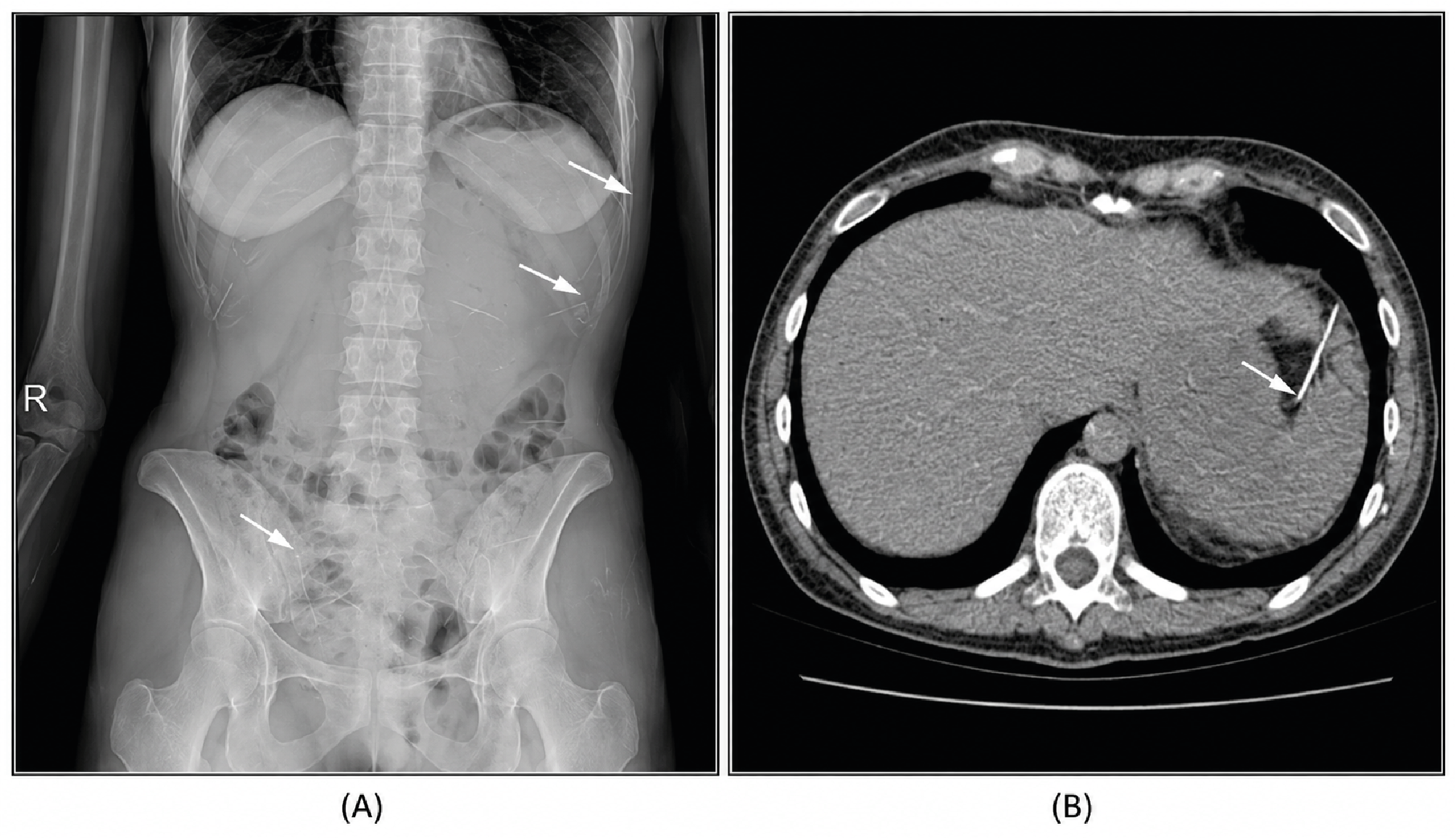
Figure 1. Case 1
Plain radiograph figure (A) and axial computed tomography figure (B) on admission day show multiple sewing needles (white arrows) both in intraabdominal cavity and adjacent structures.
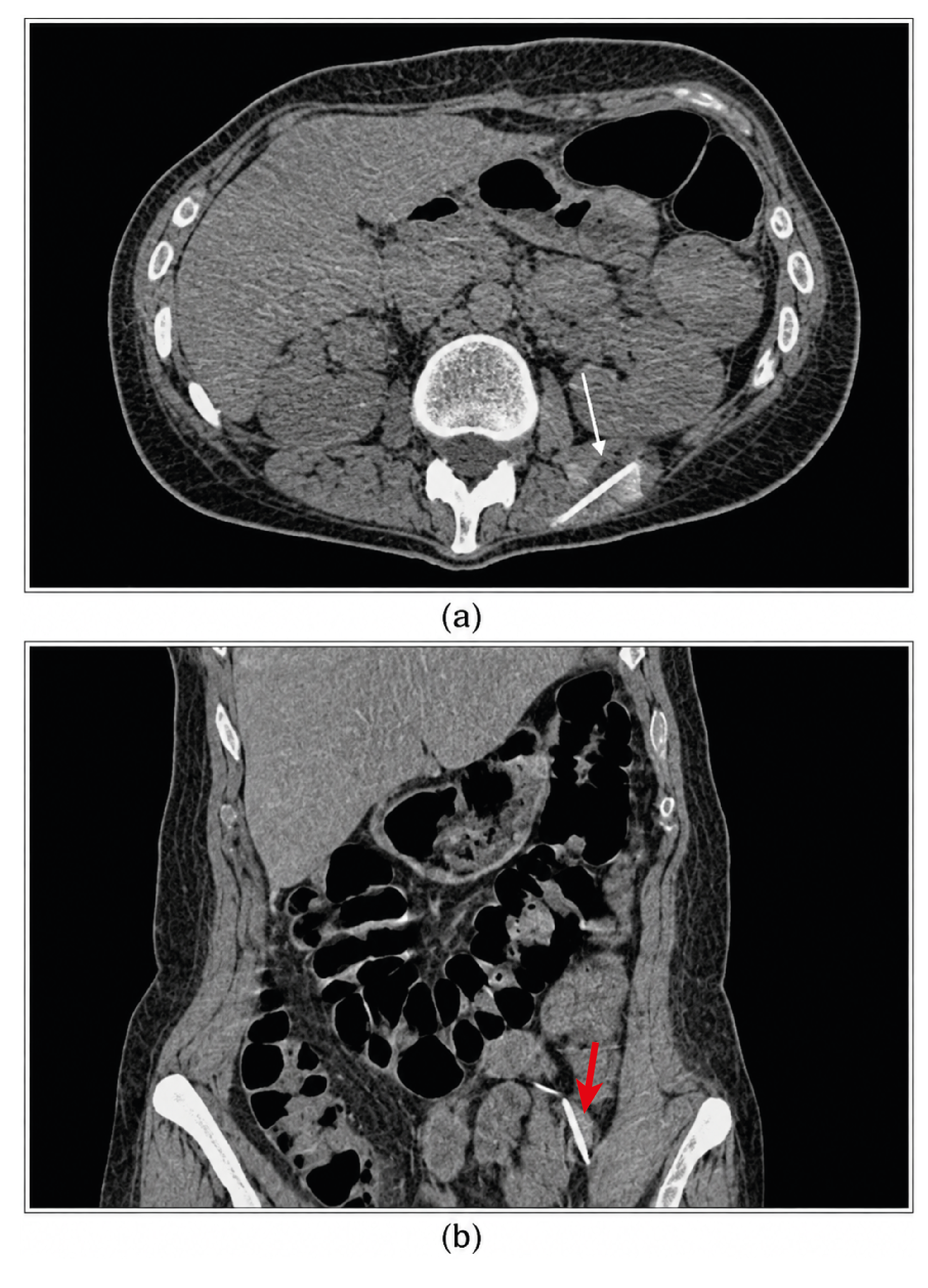
Figure 2. Case 1
On axial computed tomography (A) sewing needle (white arrow) is shown in erector spinae muscle and on coronal computed tomography (B) there are also sewing needles in left lower quadrant (white star) six months ago.
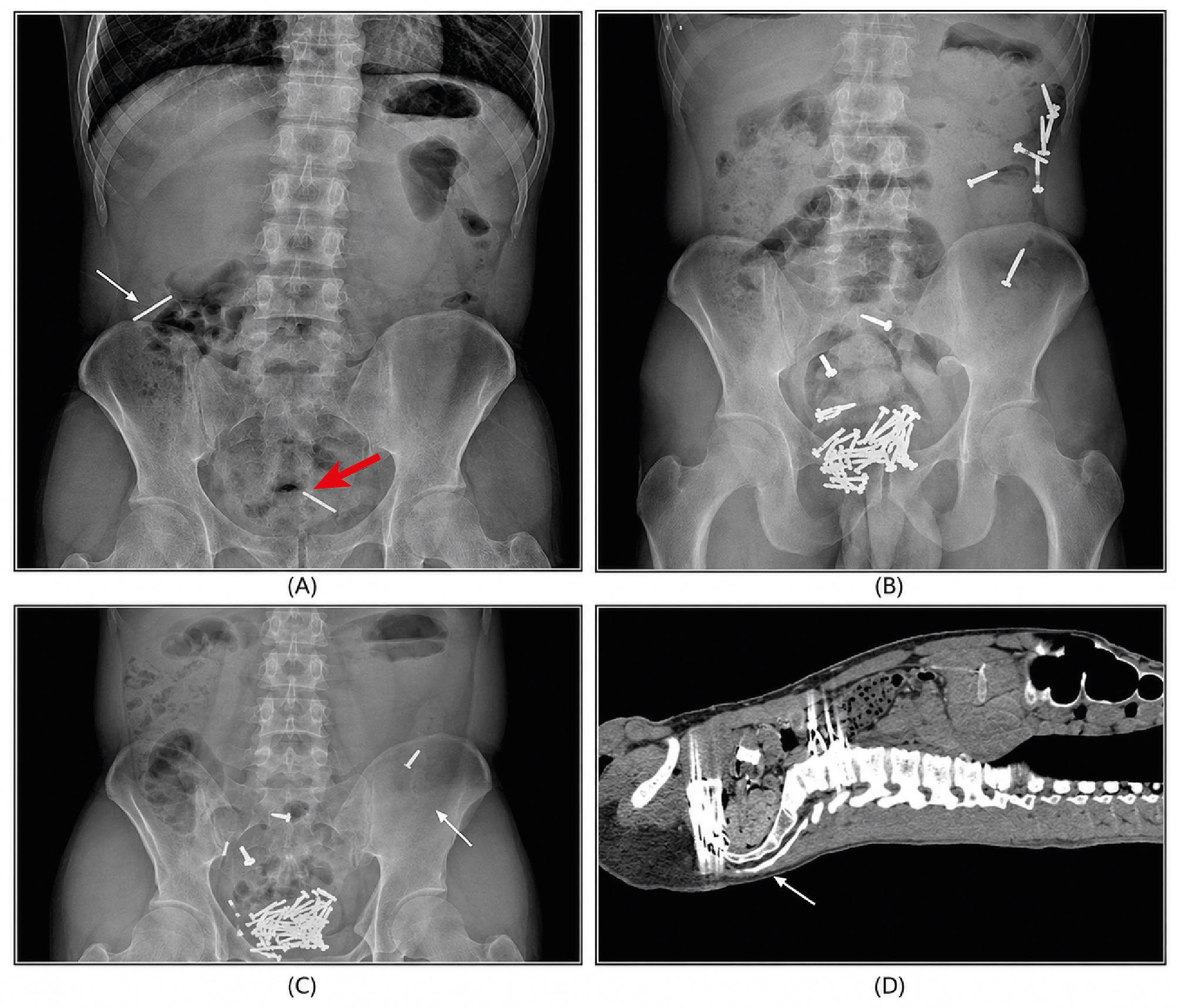
Figure 3. Case 2
On plain radiograph figure (A) there is a metallic nail (white arrow) on right upper quadrant and a safety pin (white star) in pelvis on admission day. On plain radiographs (B,C) and computed tomography (E) from previous admissions, there are multiple metallic screws and safety pins throughout the whole abdominal cavity.
Additional Information
Publisher’s Note
Bayrakol MP remains neutral with regard to jurisdictional and institutional claims.
Rights and Permissions

This work is licensed under a Creative Commons Attribution-NonCommercial 4.0 International License (CC BY-NC 4.0). To view a copy of the license, visit https://creativecommons.org/licenses/by-nc/4.0/
About This Article
How to Cite This Article
Nuray Çolapkulu Akgül, Damla Beyazadam, Mehmet Sait Özsoy, Orhan Alımoğlu. Chronic foreign body ingestion in two adults with psychiatric disorder: is it possible to wait and see? A Case Report. Ann Clin Anal Med 2024;15(Suppl 2):85-88. doi:10.4328/ACAM.22190
Publication History
- Received:
- 21.03.2024
- Accepted:
- 12.06.2024
- Published Online:
- 11.07.2024
- Printed:
- 20.10.2024