
Abstract
AimIn patients with suspected follicular or Hürtle cell neoplasia in the pre-surgery fine needle aspiration biopsy, who are found to have compatible malignancy after unilateral surgery, complementary thyroidectomy can be performed. We aimed to evaluate the malignancy rate and complications following complementary thyroid surgery in light of the current literature.MethodsComplementary thyroidectomy was performed in 85 patients with pathology compatible with differentiated thyroid cancer after lobectomy-isthmectomy. These procedures were part of a retrospective analysis of 204 patients with suspected follicular or Hürtle cell neoplasia between January 2016 and June 2021. The pathology results after completion thyroidectomy and surgical complications within 1 year postoperatively were evaluated.ResultsAfter unilateral lobectomy-isthmectomy was performed on 204 patients, 85 patients whose final pathology results were compatible with differentiated thyroid cancer were retrospectively screened. The initial pathology results were divided into three groups: microinvasive tumors, tumors with a diameter of 4 cm or less, and tumors with a diameter greater than 4 cm. Their rates were 22.3%, 57.7% and 20%, respectively. The number of patients whose pathology results were compatible with differentiated tumor after completion thyroidectomy were 5, 15 and 7, respectively. Postoperative complications were evaluated as early (within the first 6 months) and late (after 6 months). In the surgical area, hematoma was seen in 8.2% of patients, transient hypocalcemia in 2.3%, and temporary hoarseness in 2.3%. There were no patients with permanent hypocalcemia or hoarseness.ConclusionThe decision to perform complementary thyroidectomy should be based on the pathology results after lobectomy-isthmectomy to avoid the complications associated with secondary thyroidectomy.
Keywords
Introduction
Complementary thyroidectomy is a surgical procedure. It can be performed on patients who have undergone thyroid surgery due to benign pathology, if the result is compatible with malignancy or if recurrence occurs after malignancy. Moreover, if pre-surgery fine needle aspiration biopsy suggests suspected follicular or Hürtle cell neoplasia and malignancy is confirmed after unilateral surgery, complementary thyroidectomy can be performed.
In most centers, subtotal thyroidectomy is still performed for thyroid diseases caused by benign conditions or suspected malignancy. Complementary thyroidectomy has higher rates of complications compared to initially planned unilateral surgery.1 Hoarseness due to recurrent laryngeal nerve (RLN) paralysis and temporary or permanent hypocalcemia due to hypoparathyroidism are among the common complications.2 Complications are often due to adhesions developed during the first surgery and anatomical changes due to neck exploration.
Complementary thyroidectomy performed after lobectomy-isthmectomy in patients whose histopathology results are compatible with differentiated thyroid cancers reduces the rate of local recurrence. It increases survival. It makes tracking easy. It prevents the possibility of differentiated thyroid tumors transforming into undifferentiated thyroid tumors and protects the patient from the risk of a second surgical operation.3
In this study, patients with suspected follicular or Hürtle cell neoplasia on fine needle aspiration biopsy and who underwent unilateral lobectomy-isthmectomy were examined. Complementary thyroidectomy was performed on patients with malignant histopathological results. We aimed to evaluate the malignancy rate and complications following complementary thyroid surgery.
Materials and Methods
Between January 2016 and June 2021, 204 patients who underwent lobectomy-isthmectomy were analyzed retrospectively in the Department of General Surgery at Ataturk University Faculty of Medicine. Patients suspected of follicular or Hürtle cell neoplasia based on preoperative fine needle aspiration biopsy and subsequently underwent unilateral lobectomy-isthmectomy were included in the study.
Patients whose histopathology results were compatible with differentiated thyroid tumors were divided into 3 groups based on tumor diameter. The first group included microinvasive carcinoma, the second group consisted patients with a tumor diameter of 1-4 cm, and the third group consisted patients with a tumor diameter of more than 4 cm. Complementary thyroidectomy was performed on total of 85 patients with differentiated thyroid cancer.
The patients were followed up for one year postoperatively. Major complications such as hematoma in the surgical field, permanent or transient hoarseness, and permanent or transient hypocalcemia due to hypoparathyroidism (HP) were monitored in the early postoperative period. If these complications persisted for longer than six months, they were considered permanent.Ethical ApprovalThis study was approved by the Ethics Committee of Erzurum Atatürk University, Faculty of Medicine (Date: 24.02.2022, No: Decision No:2022/2-2-08).Statistical AnalysisDescriptive statistics were used to summarize the data. Categorical variables were presented as numbers and percentages, and continuous variables were presented as means.Reporting GuidelinesThis study was reported in accordance with the STROBE guideline.
Results
We retrospectively reviewed 204 patients who underwent lobectomy-isthmectomy in the past 5 years. Fine-needle aspiration biopsy results were consistent with the suspicion of follicular or Hürtle cell neoplasia, and unilateral lobectomy-isthmectomy was performed on 204 patients. Complementary thyroidectomy was performed in patients whose pathology results were compatible with differentiated thyroid cancer. The general complaints of the patients included swelling and pain in the neck. Patients were informed that unilateral thyroidectomy and isthmectomy would be performed before the first surgery, and then, depending on the final pathology result, complementary thyroidectomy migh be required.
Among the patients whose final pathology result was compatible with differentiated thyroid cancer, 19% were male (16), 81% were female (69), and the mean age was 54.5 in men and 46.8 in women. Patients were divided into 3 groups based on the pathology results. The first group was the group with microinvasive cancer and consisted of 19 patients (22.3%). The second group was the group with a tumor diameter of 1-4 cm, 49 patients (57.7%). The third group was the group with a tumor diameter of 4 cm or larger, 17 patients (20%). Complementary thyroidectomy was performed on these patients.
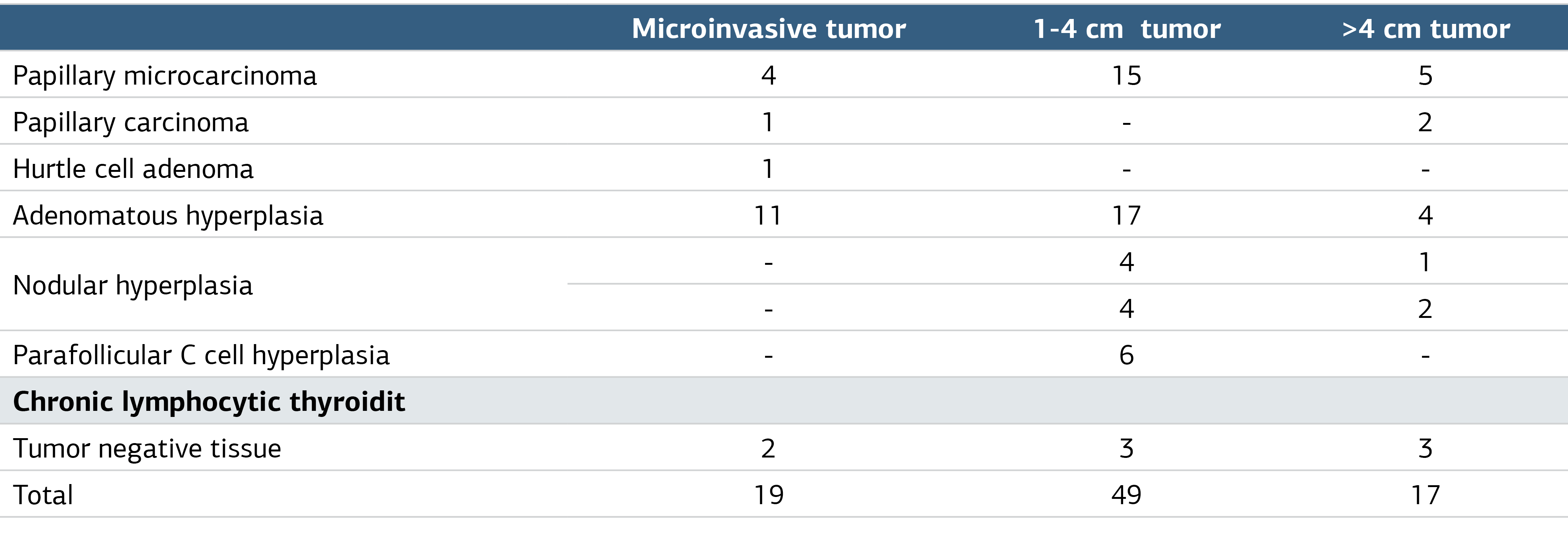
Complementary thyroidectomy pathology results of 19 patients with microinvasive tumors after completion thyroidectomy indicated that there were papillary microcarcinoma in 4 patients, papillary carcinoma in 1 patient, Hürtle cell adenoma in 1 patient, adenomatous hyperplasia in 11 patients and tumor negative tissue in 2 patients. Pathology results of 49 patients who underwent complementary thyroidectomy with tumors ranging from 1-4 cm in diameter revealed papillary microcarcinoma in 15, adenomatous hyperplasia in 17, nodular hyperplasia in 4, parafollicular (C-cell) hyperplasia in 4, chronic lymphocytic thyroiditis in 6 and consistent with tumor-negative tissue in 3 patients (Table 1).
Pathology results of 17 patients who underwent complementary thyroidectomy with tumors 4 cm or larger in diameter revealed papillary microcarcinoma in 5, papillary carcinoma in 2, parafollicular C-cell hyperplasia in 2, nodular hyperplasia in 1, adenomatous hyperplasia in 4 and consistent with tumor-negative tissue in 3 patients (Table 1).
There were 7 patients (8.2%) with hematoma in the surgical area in the early postoperative period, 2 patients (2.3%) with transient hypocalcemia, and 2 patients (2.3%) with transient hoarseness. Open hematoma evacuation was performed on 1 of the patients who developed hematoma, needle aspiration was applied to 6 of them and anti-inflammatory was started. There were no patients with persistent hypocalcemia or hoarseness.
Discussion
The most common form of thyroid tumor is follicular adenoma.4 Fine-needle aspiration biopsy is a valuable method for thyroid nodules, and the diagnostic accuracy rate in the detection of thyroid cancers before surgery was found to be %83.3.5 Capsular or vascular invasion must be demonstrated to differentiate between follicular or Hürtle cell neoplasia and carcinoma. It is not possible to show this in fine needle aspiration biopsy. The risk of malignancy in follicular neoplasia is accepted as 15-20%, and pathological examinations performed during surgery are inconclusive.6,7
Considering the possibility of benign pathology in patients with suspected follicular or Hürtle cell neoplasia, lobectomy-isthmectomy was performed on patients with suspicious fine needle aspiration biopsy results, and pathology results consistent with malignancy were reported in 85 (41%) of 204 patients.
The pathology results were categorized into three groups based on tumor diameter: microinvasive tumors, tumors with a diameter of 1-4 cm, and tumors over 4 cm in diameter. Among the 85 patients who underwent complementary thyroidectomy, pathology revealed malignancies in 5 out of 19 patients with microinvasive carcinoma, 15 out of 49 patients with tumors ranging between 1-4 cm in diameter, and 7 out of 17 patients with tumors 4 cm or larger in diameter. In total, 27 out of 85 patients (31%) were diagnosed with malignancies. The remaining 58 (69%) patients had pathology results consistent with benign disease.
The literature recommends performing a total thyroidectomy if a preoperative diagnosis of papillary carcinoma is made. If the pathological diagnosis is compatible with papillary thyroid carcinoma after partial thyroidectomy, completion thyroidectomy is recommended.8,9
Complications after completion thyroidectomy include permanent and temporary hypocalcemia, permanent and temporary vocal cord paralysis due to recurrent nerve damage, and hematoma at the wound site. In the literature, the rates of temporary and permanent hypocalcemia after reoperative thyroid surgery are reported to be between 3-15% and 0-3.5%, respectively.9
Permanent hypocalcemia was not observed in our study. Two patients (2.3%) with transient hypocalcemia were detected. Permanent and temporary vocal cord paralysis due to recurrent nerve damage has been reported in the literature at a rate of 1.4-4.4% after reoperative thyroid surgery.10,11 In our study, we did not have any patients with persistent hoarseness. Two patients (%2.3) with transient hoarseness were detected.
There is no consensus on the ideal time required for complementary thyroidectomy. In the literature, surgery is recommended within the first 7-90 days or after 90 days.12,13 In our clinic, the average interval between two surgeries is the first month. Considering that the first pathology result comes out approximately 15 days later and the patient’s anxiety in patients with malignant pathology results is taken into consideration, the appropriate time period has been determined as the first month by our clinic. Postoperative bleeding and hematoma are also possible complications in patients undergoing thyroid surgery. Although it depends on the severity of the bleeding, the need for urgent exploration is rare.14,15 In our clinic, there was no bleeding requiring urgent exploration after completion thyroidectomy, and hematoma drainage was performed in 1 patient on the postoperative second day. Needle aspiration was performed on 6 patients.
According to the literature, the reasons why our complication rates are low include the fact that all surgical operations were performed by us, the parathyroid glands were fully explored during surgery and our clinic’s experience in parathyroid surgery, the exploration and preservation of the recurrent laryngeal nerve in all thyroid surgeries, and the contralateral side in patients who underwent lobectomy-isthmectomy, avoiding entering the thyroid lodge. Additionally, performing vocal cord examination on all our patients before thyroid surgery, and the long-term acceptance of our center as a center in thyroid surgery, and its high experience in thyroid surgery.
Limitations
The main limitations of this study are its retrospective, single-center design and relatively small sample size.
Conclusion
The traditional surgical approach to patients with suspected follicular or Hürtle cell neoplasia based on fine needle aspiration biopsy is hemithyroidectomy to the side of the neoplasia. We believe that the decision for completion thyroidectomy should be based on the final pathology result, to protect patients from temporary and permanent complications of secondary thyroidectomy and due to the high rate of co-occurrence of papillary thyroid carcinoma with follicular and Hürtle cell neoplasia.
Declarations
Animal and Human Rights Statement
All procedures performed in this study were in accordance with the ethical standards of the institutional and/or national research committee and with the 1964 Helsinki Declaration and its later amendments or comparable ethical standards.
Informed Consent
Informed consent was waived due to the retrospective nature of the study.
Data Availability
The datasets used and/or analyzed during the current study are not publicly available due to patient privacy reasons but are available from the corresponding author on reasonable request.
Conflict of Interest
The authors declare that there is no conflict of interest.
Funding
None.
Abbreviations
HP: Hypoparathyroidism
RLN: Recurrent laryngeal nerve
STROBE: Strengthening the Reporting of Observational Studies in Epidemiology
References
- Sawant R, Hulse K, Sohrabi S, et al. The impact of completion thyroidectomy. Eur J Surg Oncol. 2019;45(7):1171-1174. doi:10.1016/j.ejso.2019.03.018
- Edafe O, Antakia R, Laskar N, Uttley L, Balasubramanian SP. Systematic review and meta-analysis of predictors of post-thyroidectomy hypocalcaemia. Br J Surg. 2014;101(4):307-320. doi:10.1002/bjs.9384
- Na’ara S, Amit M, Fridman E, Gil Z. Contemporary management of recurrent nodal disease in differentiated thyroid carcinoma. Rambam Maimonides Med J. 2016;7(1). doi:10.5041/rmmj.10233
- Kuo TC, Wu MH, Chen KY, Hsieh MS, Chen A, Chen CN. Ultrasonographic features for differentiating follicular thyroid carcinoma and follicular adenoma. Asian J Surg. 2020;43(1):339-346. doi:10.1016/j.asjsur.2019.04.016
- Hahn SY, Shin JH, Oh YL, Park KW, Lim Y. Comparison between fine needle aspiration and core needle biopsy for the diagnosis of thyroid nodules: effective indications according to US findings. Sci Rep. 2020;10(1):4969. doi:10.1038/s41598-020-60872-z
- Grani G, Lamartina L, Durante C, Filetti S, Cooper DS. Follicular thyroid cancer and Hürthle cell carcinoma: challenges in diagnosis, treatment, and clinical management. Lancet Diabetes Endocrinol. 2018;6(6):500-514. doi:10.1016/s2213-8587(17)30325-x
- Roman BR, Morris LG, Davies L. The thyroid cancer epidemic, 2017 perspective. Curr Opin Endocrinol Diabetes Obes. 2017;24(5):332-336. doi:10.1097/med.0000000000000359
- Giuffrida D, Giuffrida R, Puliafito I, et al. Thyroidectomy as treatment of choice for differentiated thyroid cancer. Int J Surg Oncol. 2019;2019:2715260. doi:10.1155/2019/2715260
- Vasileiadis I, Boutzios G, Karalaki M, Misiakos E, Karatzas T. Papillary thyroid carcinoma of the isthmus: total thyroidectomy or isthmusectomy? Am J Surg. 2018;216(1):135-139. doi:10.1016/j.amjsurg.2017.09.008
- Kısaoğlu A, Özoğul B, Akçay MN, et al. Completion thyroidectomy in differentiated thyroid cancer: when to perform? Ulus Cerrahi Derg. 2014;30(1):18-21.
- Varaldo E, Ansaldo GL, Assalino M, Massobrio A, Torre GC, Borgonovo G. Completion thyroidectomy for differentiated thyroid cancer: results in a consecutive series of 68 patients. Acta Chir Belg. 2012;112(1):40-43. doi:10.1080/00015458.2012.11680793
- Bin Saleem R, Bin Saleem M, Bin Saleem N. Impact of completion thyroidectomy timing on postoperative complications: a systematic review and meta-analysis. Gland Surg. 2018;7(5):458-465. doi:10.21037/gs.2018.09.03
- Dueñas JP, Duque CS, Cristancho L, Méndez M. Completion thyroidectomy: is timing important for transcervical and remote access approaches? World J Otorhinolaryngol Head Neck Surg. 2020;6(3):165-170. doi:10.1016/j.wjorl.2020.02.006
- Promberger R, Ott J, Kober F, et al. Risk factors for postoperative bleeding after thyroid surgery. Br J Surg. 2012;99(3):373-379. doi:10.1002/bjs.7824
- Materazzi G, Ambrosini CE, Fregoli L, et al. Prevention and management of bleeding in thyroid surgery. Gland Surg. 2017;6(5):510-515. doi:10.21037/gs.2017.06.14
Tables
Table 1. Table of Pathology Results after Lobectomyisthmectomy
Additional Information
Publisher’s Note
Bayrakol MP remains neutral with regard to jurisdictional and institutional claims.
Rights and Permissions

This work is licensed under a Creative Commons Attribution-NonCommercial 4.0 International License (CC BY-NC 4.0). To view a copy of the license, visit https://creativecommons.org/licenses/by-nc/4.0/
About This Article
How to Cite This Article
Ferdi Cambaztepe, Enes Ağırman, Müfide Nuran Akçay, Erdem Karadeniz, Metin Yıldız, Rıfat Peksöz, Sabri Selçuk Atamanalp. Outcomes of completion thyroidectomy in well-differentiated thyroid cancers: a retrospective clinical study. Ann Clin Anal Med 2024;15(11):759-762. doi:10.4328/ACAM.22207
Publication History
- Received:
- 30.03.2024
- Accepted:
- 03.06.2024
- Published Online:
- 07.08.2024
- Printed:
- 01.11.2024