
Knowledge, attitudes and practices of caregivers towards inhaler use in asthmatic children
Knowledge, attitudes and practices towards inhaler use
Authors
Abstract
AimThis study aimed to assess the knowledge, attitudes, and practices (KAPs) of caregivers towards asthma disease, especially in using prescribed inhalers for children with asthma at Hue Central Hospital, Vietnam.
MethodsThis was a cross sectional survey based study conducted at the Pediatric Pulmonary Department of Hue Central Hospital. A questionnaire that assessed KAPs regarding inhalers used in asthma was distributed to 278 parents of children who had asthma.
ResultsOnly 5.0% of the participants correctly answered > 75% of the questions assessing knowledge, 10.8% gave positive responses to >75% of the questions related to attitudes, whereas 48.6% correctly performed of practices of nebulizer and 8.6% correctly performed of practices of MDI (metered-dose inhaler) with chamber. There was a relationship between knowledge and attitudes toward the use of inhaler (p<0.05). The proportion of caregivers having good practices of nebulizers was higher in the group with good asthmatic knowledge than in the other groups (70.2% compared to 50.4% and 35.2%, p<0.05), in the group with good asthma practices compared to the other groups (20.8% vs 6.7% and 4.7%, p<0.05). Good practice of MDI with spacer was found to be better in the group of caregivers of children with a history of asthma than in the group without a history of asthma (13.8% vs. 3.6%, p<0.05).
ConclusionAlthough a minority of the caregivers had a good level of knowledge and attitudes, they tended to demonstrate good practices with regard to the use of an inhaler, especially using nebulizer.
Keywords
Introduction
Asthma is one of the most common chronic diseases in the world. The World Health Organization (WHO) estimates that there are currently about 300 million people with asthma worldwide, and with the current increasing trend, it is expected that this number will reach 400 million people with asthma by 2025.1 In children, asthma is the most common chronic disease, ranking among the top 20 diseases in diseaseadjusted life years in children worldwide.2 According to the International Study of Asthma and Allergy in Children (ISAAC) from phase I to phase III, the global rate of asthma symptoms in children and adolescents ranged from 11.1-11.6% and from 13.2-13.7% respectively.3 World data records showed that the death rate due to asthma in children ranged from 0 - 0.7/100.000 people.4 Many surveys still show that the current level of asthma control in many countries is still below optimal levels, especially in developing countries, increasing the burden of asthma.5,6 It is worth mentioning that the appropriate treatment of pediatric asthma patients does not solely rely on accurate evaluation and prompt intervention by healthcare professionals. It is also greatly affected by parental/caregivers’ knowledge, attitudes, and practices (KAPs) regarding the use of inhalers in asthmatic children. Only a few studies have assessed this issue among children with asthma worldwide. The aim of this study was to evaluate the factors affecting knowledge, attitudes and practices of parents/caregivers towards inhaler use in asthmatic children.
Materials and Methods
PatientsThe study subjects were the parents and direct caregivers of pediatric patients with asthma aged between 1 and 15 years admitted to the Respiratory Department, Pediatric Center, Hue Central Hospital. 285 parents/caregivers were invited to participate in this survey during the study period.
MethodA cross‐sectional non‐interventional survey-based study was conducted at the Respiratory Department, Pediatric Center, Hue Central Hospital between January 2022 and December 2023.
Data Collection MethodsWe developed a questionnaire to assess caregiver KAPS regarding the use of inhalers [Appendix 1]. Knowledge of parents/caregivers regarding reliever and controller medications consists of 22 items, and each correct answer is given a score of 1. A score of ≤ 50% total points was considered as poor, 51-75% total points as fair and > 75% total points as good. Attitudes of parents/caregivers regarding reliever and controller medications consist of 17 items. Each correct answer is given a score of 1. A score of ≤ 50% total points was considered as negative, 51-75% total points as neutral and > 75% total points as positive.7 The practice of parents/ caregivers using nebulizer consists of 8 items. Good practice would be defined if parents/caregivers performed successfully the two critical steps 3 and 4 (*), while other steps might be partially accomplished; not good practice if parents/caregivers did not perform successfully the two critical steps (*), while other steps might be partially accomplished.8 The practice of parents/caregivers using a metered-dose inhaler (MDI) with spacer consists of 5 items. Good practice would be defined if parents/caregivers correctly performed all critical steps (*); and not good practice if parents/caregivers performed incorrectly one or more critical steps (*).9,10,11
ProcedureCaregivers were notified about the purpose of the study and they were invited voluntarily. After providing written informed consent, they completed the questionnaire through a face-toface interview with medical doctors. Each child will have only one caregiver who will be interviewed. The inhaler technique was demonstrated by caregivers by face-to-face demonstration.
Ethical ApprovalThis study was approved by the Ethics Committee of Hue University (Date: 10.10.2022, Decision No: 22/NCKH-DHH).
Statistical AnalysisData were analyzed according to knowledge, attitude and practices about the asthmatic disease and towards inhaler use. All statistical analysis was performed using SPSS v.18.0 (IBM Corp, Armonk, NY).
Reporting GuidelinesThe study was reported in accordance with STROBE guideline.
Results
KnowledgeGeneral knowledge about asthma medications: most caregivers did not have good knowledge, accounting for 14 (5.0%), the percentage of having fair and poor knowledge were 11.5% and 83.5% respectively. Regarding using reliever asthma medication knowledge, the percentage of having good, fair and poor knowledge accounted for 5.0%, 11.9% and 83.1% respectively. The percentage of having good, fair and poor knowledge of using controller asthma medication were 4.7%, 8.6% and 86.7% respectively.
AttitudesThe percentage of caregivers who had a positive attitude toward the use of asthma medication was 10.8%, whereas 28.1% and 61.2% of the caregivers exhibited fair and negative attitudes, respectively. Regarding the attitude toward the use of reliever asthma medication, the percentage of caregivers who had a positive, fair and poor attitude were 9.4%, 28.1% and 62.6%. These percentages were similar for the caregivers who toward the use of controller asthma medication, with 12.6% caregivers having a positive attitude, 18.7% of them having fair attitudes and the majority of them (68.7%) having negative attitudes.
PracticesThe percentage of caregivers who have good practices in the use of nebulizer was 48.6%, whereas 51.4% had bad practices. Regarding practices in the use of MDIs with spacers, there were only 8.6% of caregivers who had good practices and 91.4% of caregivers who had bad practices.
Factors Affecting Caregivers’ Knowledge Towards Reliever and Controller MedicationsCaregivers’ knowledge about asthma medication was not significantly associated with caregivers’ gender, age, job, education, asthma history of patients and their families, severity of flare-ups, and severity of asthma (p>0.05) (Table 1).
The proportion of caregivers with good knowledge about medications was significantly lower in the group that received asthma information from relatives compared to the group that did not receive those (0.0% vs. 7.7%, p<0.05). However, this rate was not correlated with self-searching information on the internet, radio or receiving information from healthcare staff. The percentage of caregivers with good knowledge about medications was higher in the group with good asthma knowledge than in the other groups (15.8% vs 3.8% and 0.0%, p<0.05); in the group with good asthma attitudes than the other groups (12.5% vs 0.7% and 0.0%, p<0.05); in the group with good asthma practices than the other groups (9.6% vs 1.1% and 1.6%, p<0.05) (Table 1).
Factors Affecting Caregivers’ Attitudes Towards Reliever and Controller MedicationsCaregiver’s attitudes about asthma medications were not significantly associated with caregivers’ gender, job, asthma history of patients and their families, severity of flare-ups, and severity of asthma (p > 0.05); but significantly associated with caregivers’ age and education (p<0.05) (Table 2).
The proportion of caregivers with good attitudes about medications was significantly lower in the group that received asthma information from relatives compared to the group that did not receive those (8.2% vs. 12.2%, p<0.05), However, this rate was not correlated with self-searching information on the internet, radio or receiving information from healthcare staff. The proportion of caregivers with good attitudes about medications was significantly higher in the group with good asthma knowledge than in the other groups (24.6% vs 11.5% and 1.1%, p<0.05); in the group with good asthma attitudes than the other groups (20.2%% vs 6.7% and 0.0%, p<0.05); in the group with good asthma practices than the other groups (20.8% vs 3.4% and 1.6%, p<0.05) (Table 2).
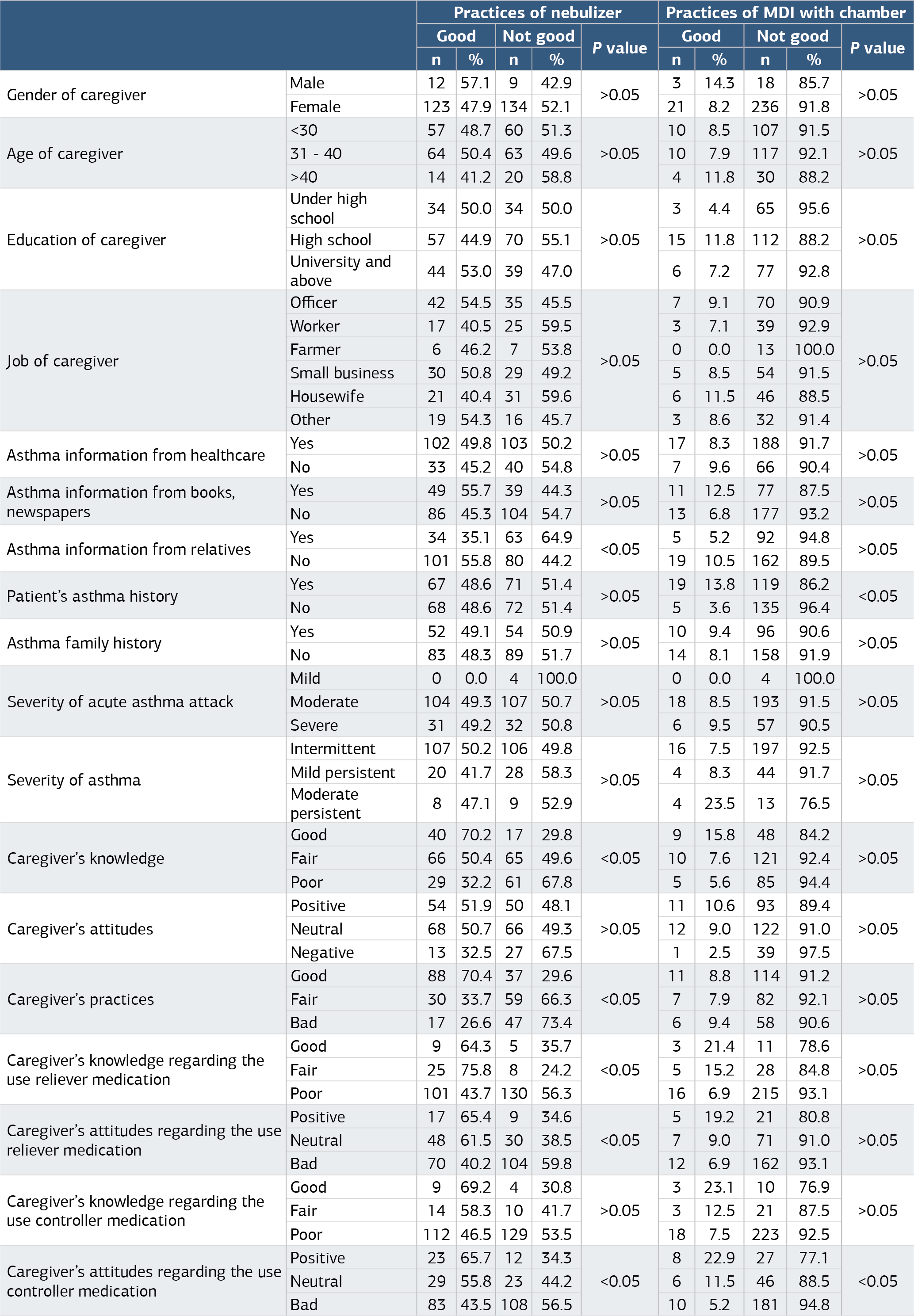
Factors Affecting Caregivers’ Practices of Using Nebulizers and MDIs With SpacersCaregivers’ practices of using nebulizers were not significantly associated with caregivers’ gender, age, job and education, asthma history of patients and their families, severity of flareups, and severity of asthma (p>0.05). However, there was a significant relationship between caregivers’ knowledge and attitudes about reliever medications, caregivers’ attitudes about controller medications and their practice of using nebulizers (p<0.05) (Table 3).
The proportion of caregivers with good practices of using nebulizer was significantly lower in the group that received asthma information from relatives compared to the group that did not receive those (35.1% vs. 55.8%, p<0.05). However, this rate was not correlated with self-searching information on the internet, radio or receiving information from healthcare staff. And the proportion of caregivers with good practices of using nebulizer was significantly higher in the group with good asthma knowledge than in the other groups (70.2% vs 50.4% and 35.2%, p<0.05); in the group with good asthma practices than the other groups (20.8% vs 6.7% and 4.7%, p<0.05) (Table 3).
Caregivers’ practices of using MDIs with spacers were not significantly associated with caregivers’ gender, age, job, education, asthma information sources, asthma history of patients and their families, severity of flare-ups, and severity of asthma (p>0.05) (Table 3).
The proportion of caregivers who had good practices of using MDIs with spacers in the group with a history of asthma was significantly higher than the group without a history of asthma (13.8% vs. 3.6%, p<0.05).
Table 3 also shows that there was a significant relationship between attitudes toward the use of controller medications and practices of MDIs with spacers: 22.9% of the caregivers who had positive attitudes towards the use of controller medications had good practices toward the use of MDIs with spacers, whereas only 5.2% of those who had negative attitudes had positive practices (p<0.05).
Discussion
This study was the first research relating knowledge, attitudes and practices of caregivers towards using inhalers in Vietnamese children. So, there was not any data to compare with. The GINA and the asthma guidelines for the prevention and treatment highlight the value of education and the optimal use of inhaler devices.12 In this study, the percentage of caregivers who had poor knowledge about general asthma medications, reliever medications and controller medications were very high: 83.5%, 83.1% and 86.7% respectively. Similar results were found in some other researches, such as in China, where results from an asthma-related KAPs survey showed that more than half the parents had a low level of knowledge.13 In United Arab Emirates, the KAPs survey demonstrated that 52.6% of patients had poor knowledge.14 In another study in Cairo, the result revealed that more than one-third of the mothers were found to have incomplete knowledge about asthma medications.15 Our study found that caregivers’ knowledge about asthma medication was not significantly related to caregivers’ gender, age, job, education (p>0.05). However, the proportion of caregivers with good knowledge about medications was significantly lower in the group that received asthma information from relatives compared to the group that did not receive those (0.0% vs. 7.7%, p<0.05). These findings had some points which were similar to other studies and had some points which differ from some other studies. According to the study of Al-Ali et al., level of knowledge was not significantly associated with relation to child, marital status, or the age of the parents; but the percentage of parents who had good knowledge was significantly highest among parents of non‑Emirati non-Arab background (16.1%), among those having educational level of university and above (16.6%) and among those being employed (13.6%).14 In the study conducted in Riyadh, Saudi Arabia, Al-Otaibi and Al-Ateeq explored that the majority of caregivers received their information about asthma from pediatricians (87%), followed by family physicians (44.3%), written materials (41.1%), and the Internet (40.7%); and suggested that for better control of asthma, more effort is needed to educate caregivers and to enhance their awareness about asthma, at both hospital and community levels.7
Regarding attitudes, in this study, the percentage of caregivers who had a positive attitude toward the using of asthma medication, reliever asthma medication and controller asthma medication were 10.8%, 9.4% and 12.6%. These findings differed from those of other studies. According to Al-Ali et al., approximately half of participants (49%) had positive attitudes.14 In the study of Zhao et al., most participants (89.95%) gave positive responses to ≥ 60% of the attitude questions.14 Our study found that caregiver’s attitudes about asthma medication were not significant associated with relation to child, caregivers’ sex, job, asthma history of patients and their families, the severity of acute asthma attacks, asthma (p> 0.05). However, caregiver’s attitudes about asthma medication were significant associated with caregivers’ age, education (p<0.05). According to Al-Ali et al., attitudes toward the use of inhalers were associated with age of the parents, whereby elderly parents (>40) had more positive attitudes than younger parents (21-30 year-old).14 With regards to inhaler practices, the percentage of caregivers who have good practices in the use of nebulizer was 48.6%, whereas 51.4% had bad practices. There were only 8.6% of caregivers who had good practices in the use of MDIs with spacers and 91.4% of caregivers who had bad practices of that. In contrast with Al-Ali et al, the percentage of parents who had good practices in the use of inhaler was 56.2%, and more than two-thirds of participants who were given asthma action plans stated that they were confident about the use of inhaler.14 According to Deis et al.’ research, parents who were given a written asthma action plan for acute attacks were more confident in managing their child’s asthma exacerbation, and they felt confident in using inhaler.16 In our study, caregivers’ practices of using nebulizers were not significant associated with relation to child, caregivers’ sex, age, job and education, asthma history of patients and their families, the severity of acute asthma attack, asthma (p>0.05). Our study differ from the result of Al-Ali et al which demonstrated that the relationship between education level and practices was significant associated.14 However, our study showed that there was a significant relationship between caregivers’ knowledge and attitudes about reliever medications, caregivers’ attitudes about controller medications and their practice of using nebulizers (p<0.05). And there was a significant relationship between attitudes toward the use of controller medications and practices of MDI with the chamber. These findings emphasize the importance of providing knowledge, explain more detail asthma disease for caregivers and guide them carefully on how to use inhalers.
Limitations
This study's cross-sectional design limits causal inferences, and its findings may not be generalizable beyond the study population.
Conclusion
Only a minority of the caregivers in this study had a good level of knowledge as well as positive attitudes regarding asthma, and the use of inhalers, and approximately half had good practices in the use of nebulizer and the minority of caregivers had good practices in the use of MDIs with spacers. Moreover, a good level of knowledge and positive attitudes were related to partial good practices. Besides, knowing patient’s asthma history and receiving asthma information from relatives also play an important role in asthma practice. Education and training for caregivers reveal outstanding steps which contribute to treat asthma successfully, especially in practices of using inhaler. It is required that healthcare staff to educate and assess their understanding and practices.
Declarations
Animal and Human Rights Statement
All procedures performed in this study were in accordance with the ethical standards of the institutional and/or national research committee and with the 1964 Helsinki Declaration and its later amendments or comparable ethical standards.
Informed Consent
Consent was obtained from all participants in this study.
Data Availability
The datasets used and/or analyzed during the current study are not publicly available due to patient privacy reasons but are available from the corresponding author on reasonable request.
Conflict of Interest
The authors declare that there is no conflict of interest.
Funding
None.
Abbreviations
KAPs: Knowledge, attitudes, practices
MDI: Metered-dose inhaler
SPSS: Statistical Package for the Social Sciences
References
-
Dharmage SC, Perret JL, Custovic A. Epidemiology of asthma in children and adults. Front Pediatr. 2019;7:246. doi:10.3389/fped.2019.00246
-
Vos T, Flaxman AD, Naghavi M, et al. Years lived with disability for 1160 sequelae of 289 diseases and injuries 1990-2010: a systematic analysis for the Global Burden of Disease Study 2010. Lancet. 2012;380(9859):2163-2196. doi:10.1016/s0140-6736(12)61729-2
-
Pearce N, Ait-Khaled N, Beasley R, et al. Worldwide trends in the prevalence of asthma symptoms: phase III of the International Study of Asthma and Allergies in Childhood. Thorax. 2007;62(9):758-766. doi:10.1136/thx.2006.070169
-
Serebrisky D, Wiznia A. Pediatric asthma: a global epidemic. Ann Glob Health. 2019;85(1):6. doi:10.5334/aogh.2416
-
Demoly P, Gueron B, Annunziata K, Adamek L, Walters RD. Update on asthma control in five European countries: results of a 2008 survey. Eur Respir Rev. 2010;19(116):150-157. doi:10.1183/09059180.00002110
-
Aschalew A, Kebed RA, Demie TG, Weldetsadik AY. Assessment of level of asthma control and related factors in children attending pediatric respiratory clinics in Addis Ababa, Ethiopia. BMC Pulm Med. 2022;22(1):70. doi:10.1186/s12890-022-01865-8
-
AlOtaibi E, AlAteeq M. Knowledge and practice of parents and guardians about childhood asthma at King Abdulaziz Medical City for National Guard, Riyadh, Saudi Arabia. Risk Manag Healthc Policy. 2018;11:67-75. doi:10.2147/rmhp.s143829
-
Petrocheilou A, Kaditis AG, Troupi E, Loukou I. Nebulizer care and inhalation technique in children with cystic fibrosis. Children (Basel). 2020;7(10):153. doi:10.3390/children7100153
-
Gardenhire DS, Burnett D, Strickland S, Myers TR. Metered-dose inhaler accessory devices. In: Gardenhire DS, Burnett D, Strickland S, Myers TR, eds. A Guide to Aerosol Delivery Devices for Respiratory Therapists. 4th ed. American Association for Respiratory Care; 2017:29-31.
-
Walia M, Paul L, Satyavani A, Lodha R, Kalaivani M, Kabra SK. Assessment of inhalation technique and determinants of incorrect performance among children with asthma. Pediatr Pulmonol. 2006;41(11):1082-1087. doi:10.1002/ppul.20498
-
Hagmolen of ten Have W, van de Berg NJ, Bindels PJ, van Aalderen WM, van der Palen J. Assessment of inhalation technique in children in general practice: increased risk of incorrect performance with new device. J Asthma. 2008;45(1):67-71.
-
Boulet LP, Reddel HK, Bateman E, Pedersen S, FitzGerald JM, O’Byrne PM. The Global Initiative for Asthma: 25 years later. Eur Respir J. 2019;54(2):1900598. doi:10.1183/13993003.00598-2019
-
Zhao J, Shen K, Xiang L, et al. The knowledge, attitudes and practices of parents of children with asthma in 29 cities of China: a multicenter study. BMC Pediatr. 2013;13:20. doi:10.1186/1471-2431-13-20
-
Al-Ali L, Al Jasmi SA, Al Yammahi S, Syeed A, Darwish E. Parental knowledge, attitudes, and practices regarding the use of prescribed inhalers in asthmatic children attending Ambulatory Healthcare Services Clinics. Ibnosina J Med Biomed Sci. 2019;11:68-76. doi:10.4103/ijmbs.ijmbs_12_19
-
Amin G, Elsamman G, Hussein H. Knowledge of mothers of children with bronchial asthma. Med J Cairo Univ. 2014;82:63-70.
-
Deis JN, Spiro DM, Jenkins CA, Buckles TL, Arnold DH. Parental knowledge and use of preventive asthma care measures in two pediatric emergency departments. J Asthma. 2010;47(5):551-556. doi:10.3109/02770900903560225
Tables
Table 1. Factors affecting caregiver’s knowledge toward reliever and controller asthma medications

Table 2. Factors affecting caregiver’s attitudes toward reliever and controller asthma medications

Table 3. Factors affecting caregiver’ practices of using nebulizers and MDIs with spacers
Additional Information
Publisher’s Note
Bayrakol MP remains neutral with regard to jurisdictional and institutional claims.
Rights and Permissions

This work is licensed under a Creative Commons Attribution-NonCommercial 4.0 International License (CC BY-NC 4.0). To view a copy of the license, visit https://creativecommons.org/licenses/by-nc/4.0/
About This Article
How to Cite This Article
Bui-Binh-Bao Son, Nguyen-Thi Kim-Hoa, Nguyen-Duy Nam-Anh, Nguyen-Manh Phu, Le-Binh Phuong-Nguyen, Ho-Ly Minh-Tien, Phan-Thi Bich-Chi. Knowledge, attitudes and practices of caregivers towards inhaler use in asthmatic children. Ann Clin Anal Med 2025;16(4):247-253. doi:10.4328/ACAM.22263
- Received:
- May 15, 2024
- Accepted:
- July 2, 2024
- Published Online:
- December 1, 2025
- Printed:
- April 1, 2025