
Declarations
Ethics Declarations
This study was approved by the Ethics Committee of Istanbul Medipol University (Date: 2023-05-13, No: E-10840098-772.02-3157)
Animal and Human Rights Statement
All procedures performed in this study were in accordance with the ethical standards of the institutional and/or national research committee and with the 1964 Helsinki Declaration and its later amendments or comparable ethical standards.
Informed Consent
Written informed consent was obtained from all participants before enrollment in the study.
Data Availability
The datasets used and/or analyzed during the current study are not publicly available due to patient privacy reasons but are available from the corresponding author on reasonable request.
Conflict of Interest
The authors declare that there is no conflict of interest.
Funding
None.
References
- Krhut J, Gärtner M, Mokris J, et al. Effect of severity of urinary incontinence on quality of life in women. Neurourol Urodyn. 2018;37(6):1925-1930. doi:10.1002/nau.23568
- Jacomo RH, Nascimento TR, Lucena da Silva M, et al. Exercise regimens other than pelvic floor muscle training cannot increase pelvic muscle strength: a systematic review. J Bodyw Mov Ther. 2020;24(4):568-574. doi:10.1016/j.jbmt.2020.08.005
- Sharma K, Gupta M, Parasher RK. The role of dynamic neuromuscular stabilization exercises in stress urinary incontinence among females aged 18-40 years. Cureus. 2024;16(5):1-19. doi:10.7759/cureus.59828
- Abrams P, Andersson KE, Birder L, et al. Fourth International Consultation on Incontinence recommendations of the International Scientific Committee: evaluation and treatment of urinary incontinence, pelvic organ prolapse, and fecal incontinence. Neurourol Urodyn. 2010;29(1):213-240. doi:10.1002/nau.20870
- Pennycuff JF, Borazjani A, Wang H, Iglesia C. Commercially available home pelvic training devices for the treatment of pelvic floor disorders: a systematic review and meta-analysis. Obstet Gynecol. 2022;140(2):275-292. doi:10.1097/aog.0000000000004860
- Araujo CC, Marques A de A, Juliato CRT. The adherence of home pelvic floor muscles training using a mobile device application for women with urinary incontinence: a randomized controlled trial. Female Pelvic Med Reconstr Surg. 2020;26(11):697-703. doi:10.1097/spv.0000000000000670
- Orhan C, Akbayrak T, Özgül S, et al. Effects of vaginal tampon training added to pelvic floor muscle training in women with stress urinary incontinence: randomized controlled trial. Int Urogynecol J. 2019;30(2):219-229. doi:10.1007/s00192-018-3585-7
- Shah Z, Rathod P. Effect of home-based pelvic floor muscle training based on the severity of incontinence on quality of life in women with stress urinary incontinence. Physiother. 2020;14(2):80. doi:10.4103/pjiap.pjiap_14_19
- Sharma JB, Kakkad V, Roy KK, Kumari R, Pandey K. Role of Incontinence Severity Index in evaluating severity and impact of treatment of stress urinary incontinence. J Midlife Health. 2022;13(2):139-144. doi:10.4103/jmh.jmh_113_20
- Ptaszkowski K, Malkiewicz B, Zdrojowy R, Paprocka-Borowicz M, Ptaszkowska L. The prognostic value of the surface electromyographic assessment of pelvic floor muscles in women with stress urinary incontinence. J Clin Med. 2020;9(6):1-10. doi:10.3390/jcm9061967
- Chmielewska D, Stania M, Kucab-Klich K, et al. Electromyographic characteristics of pelvic floor muscles in women with stress urinary incontinence following sEMG-assisted biofeedback training and Pilates exercises. PLoS One. 2019;14(12):1-22. doi:10.1371/journal.pone.0225647
- Dannecker C, Wolf V, Raab R, Hepp H, Anthuber C. EMG-biofeedback-assisted pelvic floor muscle training is an effective therapy of stress urinary or mixed incontinence: a 7-year experience with 390 patients. Arch Gynecol Obstet. 2005;273(2):93-97. doi:10.1007/s00404-005-0011-4
- Bertotto A, Schvartzman R, Uchôa S, Wender MCO. Effect of electromyographic biofeedback as an add-on to pelvic floor muscle exercises on neuromuscular outcomes and quality of life in postmenopausal women with stress urinary incontinence: a randomized controlled trial. Neurourol Urodyn. 2017;36(8):2142-2147. doi:10.1002/nau.23258
- Aukee P, Immonen P, Penttinen J, Laippala P, Airaksinen O. Increase in pelvic floor muscle activity after 12 weeks’ training: a randomized prospective pilot study. Urology. 2002;60(6):1020-1023. doi:10.1016/s0090-4295(02)02125-8
- Rett MT, Simoes JA, Herrmann V, Pinto CLB, Marques AA, Morais SS. Management of stress urinary incontinence with surface electromyography-assisted biofeedback in women of reproductive age. Phys Ther. 2007;87(2):136-142. doi:10.2522/ptj.20050318
- Yoo EH, Kim YM, Kim D. Factors predicting the response to biofeedback-assisted pelvic floor muscle training for urinary incontinence. Int J Gynaecol Obstet. 2011;112(3):179-181. doi:10.1016/j.ijgo.2010.09.016
- Ptaszkowski K, Zdrojowy R, Slupska L, et al. Assessment of bioelectrical activity of pelvic floor muscles depending on the orientation of the pelvis in menopausal women with symptoms of stress urinary incontinence: continued observational study. Eur J Phys Rehabil Med. 2017;53(4):564-574. doi:10.23736/s1973-9087.17.04475-6
Tables
Table 1. Comparison of demographic characteristics of groups

A ANOVA / X² Ki-kare test (Fischer test), Mean±sd = mean±standard deviation; BMI = body mass index; PFMT = pelvic floor muscle training; BF = biofeedback.
Table 2. Analysis of EMG parameters of participants
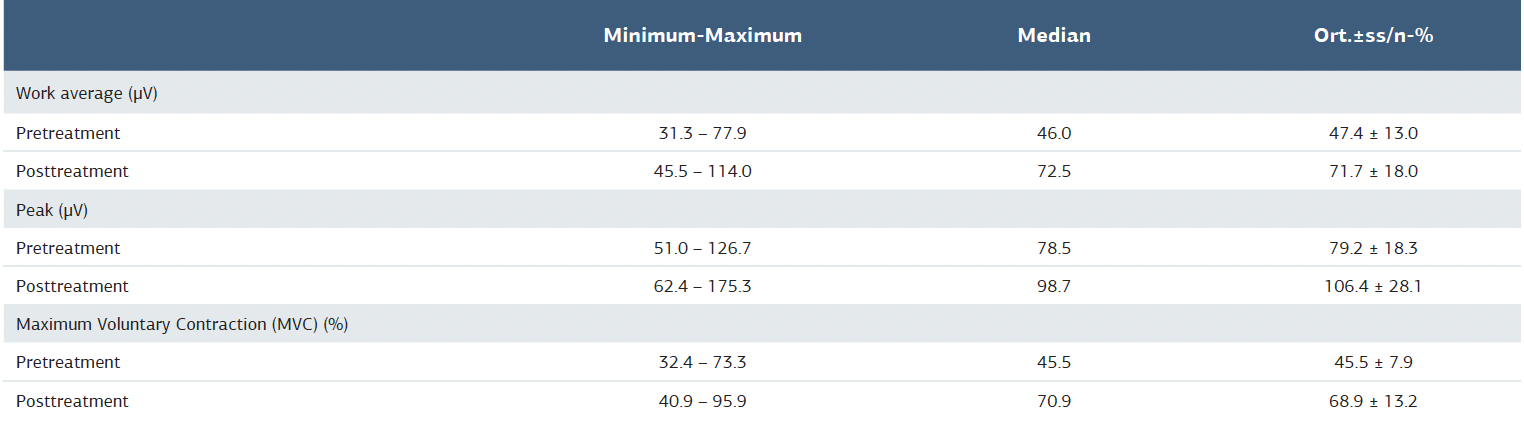
Table 3. Comparison of work average (μv), peak (μv) and MVC (%) values from EMG results of groups

K Kruskal-Wallis (Mann-Whitney u test) / w Wilcoxon test; Mean±SD = mean±standard deviation; PFMT = pelvic floor muscle training; BF = biofeedback.
About This Article
How to Cite This Article
Büşra İnce, Devrim Tarakçı, Aykut Başer. Biofeedback support in stress urinary incontinence the effect of pelvic floor muscle training on muscle activity potential. Ann Clin Anal Med 2025;16(10):683-687. doi:10.4328/ACAM.22379
Publication History
- Received:
- 21.08.2024
- Accepted:
- 21.10.2024
- Published Online:
- 05.03.2025
- Printed:
- 01.10.2025