
Negative impact of hydroxychloroquine on artificial decidualization in a rat model of pseudopregnancy
Hydroxychloroquine and decidualization
Authors
Abstract
AimThe study sought to investigate the possible effects of hydroxychloroquine intake on uterine decidualization in rats.
MethodsThree groups of adult Wistar nulliparous female rats were divided as follows, two groups were administered daily hydroxychloroquine either for 1 week or 4 weeks and one group took a vehicle to act as the negative control. Then, pseudopregnancy and artificial decidualization were induced in all groups. On day 8 of pseudopregnancy, the quantity and quality of artificial decidualization were assessed by decidual weight, decidualization biomarkers, and histologically. In addition, the decidual oxidative stress was assessed.
ResultsThe results showed that hydroxychloroquine induced oxidative stress and impacted artificial decidualization in rats with prolonged treatment (4 weeks) with hydroxychloroquine but not with short-term treatment (1 week). In the form of a significant decrease in decidual weight, decidual prolactin, and insulin-like growth factor binding protein-1 (IGFBP1), as well as the number of decidual cells under light microscopy.
ConclusionThis research suggested that the long-term use of hydroxychloroquine may impair uterine decidualization in rats and accordingly affect pregnancy which contradicts the common concept about its safety during pregnancy.
Keywords
Introduction
Endometrial decidualization is a crucial prerequisite for a successful pregnancy that lays the essential foundation for subsequent gestation by preparing the endometrium for embryo reception. It is primarily a progesterone-dependent process during which the endometrial stromal cells (ESCs) multiply and transform into large epithelioid cells, called decidual stromal cells (DSCs) along with other stromal changes.1,2 These reprogrammed DSCs have several vital roles for pregnancy success including inflammation suppression, vascular adaptation, tolerance to fetal antigens, etc.1,2 Decidualization spontaneously occurs during each menstrual cycle in the few menstruating species including humans while in rats and most other placental mammals, it only starts after embryo implantation.1 The crosstalk between a blastocyst and a receptive endometrium in the proper timing has been considered the “black box” of fertility and reproduction. This is when many pregnancies fail, and many developmental disorders are thought to arise. Any disruption in this delicate synchrony or intervention during this critical period can be causally linked to infertility and many obstetric complications.3 So, a dysfunctional endometrium and/or decidualization is highly suspected as a causal factor in pregnancy complications or even failure.2,4
Chloroquine is one of the oldest drugs still widely used in clinical practice along with its analogue hydroxychloroquine (HCQ) which was found to be more effective and less toxic. They have been used to prevent and treat malaria and also in the treatment of autoimmune disorders.5,6 Furthermore, they drew interest during the Ebola virus outbreak and again recently during the initial phase of the COVID-19 pandemic based on preliminary research exhibiting potent antiviral effects on severe acute respiratory syndrome coronavirus 2.5 Previous research recommended the use of HCQ in the prevention of obstetric complications and protection against fetal death and placental insufficiency in retrospective studies and in vivo models of autoimmune diseases which reported better outcomes with HCQ treatment.7 Additionally, based on HCQ’s probability to improve prognosis of pregnancy in females with autoimmune disorders, it was proposed that it may also lessen pregnancy complications in non-autoimmune women with risk for placental insufficiency.8 However, with the expansion of its use, variable posology, and prolonged duration with the lack of a definitive dose-response relationship that determines the minimum effective and toxic doses, its impact on pregnancy, particularly decidualization, remains unclear.5,9,10 In the current study, we aimed to assess whether HCQ intake can affect decidualization positively or negatively through its effect on oxidative stress in an experimental rat model of artificial decidualization.
Materials and Methods
Experimental AnimalsThe study was conducted on adult (8-10-week-old) nulliparous female Wistar rats of 150-180 gm body weight range in the animal house of the Medical Physiology Department Faculty of Medicine, Alexandria University. The animals were housed under standard laboratory conditions, at room temperature, and a 12-hour light-dark cycle with unrestricted access to standard chow and water. All experiments followed the Guide for the Care and Use of Laboratory Animals, Faculty of Medicine, Alexandria University (IRB NO: 00007555-FWA NO: 00018699). Additionally, the study was authorized by the Alexandria Faculty of Medicine Ethics Committee.
Experimental Design and ProceduresStudy GroupsThe rats were divided into three groups of ten rats each at random:
Group I (control decidualization) administered 1 ml of oral vehicle.
Group II (1-week HCQ + decidualization), treated with 40 mg/Kg/day HCQ for one week. HCQ solution was prepared from Hydroxychloroquine sulphate (Hydroquine 200-mg, Minapharm Company, 10th of Ramadan, Egypt).
Group III (4-weeks HCQ + decidualization), received the same daily dose of HCQ for 4 weeks that represents 5 to 6 rat estrous cycles equivalent to about 5 to 6 monthly human cycles.
Artificial Decidualization SurgeryFor artificial decidualization induction, female rats at the proestrus or early estrus phase were allowed to mate with vasectomized males by a 1:1 ratio to induce pseudo-pregnancy. Pseudopregnancy was considered to be on day 1 if sperm or a vaginal plug were found.11 On the 4th day of pseudopregnancy, the rats were anesthetized using mixture of ketamine and xylazine intraperitoneally. Then, artificial decidualization was induced in the right uterine horn by injecting 100μl of sesame oil inside it. On the 8th day of pseudo-pregnancy, the animals were sacrificed.11
Measurements and Laboratory InvestigationsSerum Estrogen and ProgesteroneAfter sacrifice, the serum was separated from a posterior vena cava blood sample by centrifugation and samples. Serum estradiol and progesterone levels were assayed by electrochemiluminescence immunoassay on the Roche Cobas e analyzer.
Decidual Weight AssessmentOn the sacrifice day, the rats’ uteri were dissected, and right and left uterine horns were weighed to determine the fold increase in stimulated horn weight which represents decidual weight.12
Tissue Sampling and ProcessingAfter weighing, stimulated horns were divided into two parts. One part was stored at -80°C till minced and homogenized to be used for biochemical analysis. While the other part was fixed in 10% formalin for histological examination.
Decidualization Biomarkers AssessmentEach prolactin and IGFBP1 protein were measured in uterine homogenate by using ELISA kits according to the manufacturer’s instructions (Wuhan Fine Biotech Co., Hubei, China, Cat. No. ER0076 and ER0081 respectively). The assay applied the quantitative sandwich enzyme immunoassay technique where the specific protein is bound by the specific monoclonal immobilized antibody and the biotin-conjugated antibody is used as the detection antibody. The results were adjusted to total tissue proteins and presented per milligram of tissue protein.
Oxidative Stress EvaluationTotal antioxidant capacity (TAC) was assessed using TAC assay kit from Biodiagnostic diagnostic and research reagents, Giza, Egypt (Cat. No. TA 2513,) to measure the reductive power of a sample representing the cumulative effect of antioxidant systems.13 According to provider instructions, H2O2 was diluted then mixed with the sample or distilled water and incubated. After that, a working reagent was added. Finally, the absorbances were read spectrophotometrically.
Lipid Peroxidation assay kit (Cat. No. MD 2529, Biodiagnostic diagnostic and research reagents, Giza, Egypt) was used to analyze the decidual Malondialdehyde (MDA) content as a measurement of the decidual oxidative-stress levels.13 In brief, either the samples or the standard was added to trichloroacetic acid and mixed well then centrifuged. The supernatant was added to thiobarbituric acid and heated then cooled. The absorbance of the resultant product was read by spectrophotometer.
Histopathological Assessment of Decidualization Using Hematoxylin & Eosin (H&E)Uterine horn samples were fixed in 4% paraformaldehyde, and specimens were placed in a 10% formalin solution, processed, and embedded in paraffin for histological examination. Tissue sections (3-5 Microns thick) were cut with microtome and stained with H&E. Finally, tissue section slides were examined using light microscopy for the histopathologic evaluation magnification.
Ethical ApprovalThis study was approved by the Ethics Committee of Alexandria Faculty of Medicine (Date: 15.14.2021, Decision No: 0201489, IRB NO: 00012098-FWA NO: 00018699).
Statistical AnalysisIBM SPSS software package version 20.0. (Armonk, NY: IBM Corp) was used for statistical data analysis. Quantitative data were expressed using the mean and Standard Error of Mean (SEM), and the results were considered of statistical significance at p values ≤0.05. Analysis of variance (ANOVA) test was used for comparison between groups, and the post-hoc test (Tukey) for pairwise comparisons.
Reporting GuidelinesThis study was reported in accordance with the ARRIVE guidelines.
Results
Effect of HCQ Intake on Serum Estradiol and ProgesteroneThere was no significant difference in the level of serum estradiol (Figure 1A) or progesterone (Figure 1B) between the three studied groups.
Effect of HCQ on Artificial DecidualizationDecidual WeightThere was no statistically significant difference in decidual weight in group II compared to control group I. Prolonged HCQ intake for 4 weeks caused a significant decrease of decidua thickness as compared to control group I and to short-term intake of HCQ in group II (Figure 1C).
Decidualization BiomarkersThere was a significant increase in prolactin and IGBP1 stimulated horn homogenate of group I and group II as compared to the unstimulated horn. On the other hand, in group III, prolactin of the stimulated horn was non-statistically higher than in the unstimulated horn while IGBP-1 in the stimulated horn in group III was significantly lower compared to group I and group II despite being statistically higher than in the unstimulated horn (Figures 1D,1E).
Decidual Oxidative Stress Evaluation After HCQ IntakeStimulated horn MDA level was significantly higher in group III as compared to control group I (Figure 2A). Prolonged intake of HCQ in group III led to a significant decrease in total antioxidant capacity in tissue homogenate of stimulated horn compared to that in groups I and II (Figure 2B).
Results of Histopathological Assessment of DecidualizationHistopathological examination of the right stimulated horn exhibited the normal decidual reaction with hyperplasia and hypertrophy of endometrial stroma in control group I (Figure 3B). In line with the previous findings, the decidual reaction in group II was apparently normal and may not be affected by short-term intake of HCQ (Figure 3C). On the other hand, long-term treatment with HCQ in group III passively affected the decidualization in the form of fewer decidual cells and glands in addition to the appearance of necrosis, indicating that hydroxychloroquine inhibited this process impaired stromal cells differentiation with a notable decrease in the endometrial thickness (Figure 3D).
Discussion
The safety of CQ and HCQ during pregnancy was reported when used for the treatment of autoimmune and rheumatologic disorders as well as malaria prevention and treatment. Nevertheless, their expanded usage for other nonmalarial disorders has led to longer intake durations and higher daily dosages, resulting in greater cumulative doses and unanticipated adverse effects. Accordingly, many studies have been conducted to assess their safety, study their possible side effects, and determine the safe maximal daily dose.14,15
Shu-Wing Ng et al.2 state that “the primary driver of pregnancy health is the quality of the soil, not the seed”. Decidualization is a sequence of changes in the endometrial stroma including cellular transformation to provide a nutrient-rich uterine suitable environment for embryo implantation and growth.2,4 Since decidualization in humans begins during the secretory phase of each monthly menstrual cycle, pregnancy health gets determined even before the blastocyst arrival.2
In the present study, the working model of artificial decidualization in one uterine horn was chosen to simulate endometrial changes in humans which start regularly each month without dependence on the implanted embryo as a trigger and to focus on the possible effects of HCQ on the quality of the endometrial soil without the seed impact on the decidualization response. The results of this study indicated that HCQ might adversely affect decidualization response in the model of artificial decidualization mostly due to local uterine factors depending on the duration of intake. It was found that HCQ intake for four weeks and throughout the days of decidualization induction impaired decidualization compared to its intake for only one week and to control. In other words, HCQ intake in group III significantly decreased decidual weight and decidualization biomarkers while there was no statistically significant difference between the studied groups as regards serum female sex hormones. In addition, only in rats administered HCQ for four weeks, histological evaluation of the decidua revealed remarkably impaired cellular differentiation and proliferation with a considerable reduction of the endometrial thickness.
The potential mechanism by which HCQ may impact decidualization is likely multifactorial. Hydroxychloroquine alkalinizes lysosomes inhibiting lysosomal enzymes and interfering with lysosomal activity. Thereby, they affect membrane stability, signaling cascades and transcriptional activity, and inhibit autophagy.16,17 Moreover, since HCQ is widely used for chronic autoimmune diseases, it has anti-inflammatory and immunomodulatory effects. However, it can indirectly reduce the anti-inflammatory cytokines and elevate some inflammatory cytokines, thereby presenting a potential risk of immune imbalance and damage in addition to endothelial cell injury and antiangiogenic effects especially with high doses.5,16 This effect was reported in previous studies.18,19 In other mechanistic studies on the negative effects of HCQ, they were attributed to its induction of apoptosis, inhibition of phospholipase A2, matrix metalloproteinase-9, and tissue inhibitor of metalloproteinases-1, and interference with some ion channels.20,21 According to Okada et al.22 all the previous factors could influence the decidualization process and function. Besides, as decidualization is considered a high-energy process because of cellular proliferation and differentiation, it stands to a reason for autophagy to be activated. Consistent with this concept, Mestre et al.23 observed that decidualized cells showed enhanced autophagic flux, indicating that autophagy plays a role in decidualization.
Other findings by Huybrechts et al.9 demonstrated a slight increase in the risk of birth defects linked to the use of HCQ during the first trimester, based on the theory that HCQ crosses the placenta and affects DNA synthesis and cell division, increasing the chance of chromosomal abnormalities in rapidly proliferating embryonic cells. The benefits of therapy during pregnancy will probably outweigh this risk for the majority of people with autoimmune rheumatic illnesses since it lowers the disease activity and the associated negative pregnancy outcome.9
Contrary to our findings, most research on HCQ studied its safety when used for malaria, rheumatic disorders, and autoimmune disorders and suggested it is safe in pregnancy with no increase in the risk of common adverse obstetrical outcomes.9,10 Moreover, in spite that pregnant women were excluded from most clinical trials during the COVID-19 pandemic, González et al.15 in Spain carried out a randomized double-blind clinical trial showed that HCQ intake for 3 days or 11 days is safe for use in postpartum and pregnant females with asymptomatic or mild infection. Multiple studies were discussed in Arachchillage et al.7 review which reported better outcomes with HCQ intake in cases of antiphospholipid syndrome. Additionally, Kim et al.8 proposed that through similar mechanisms, it could be used in non-autoimmune patients. They also pointed to the clinical trials (eight, registered at https://clinicaltrials.gov/) which focused on how HCQ influences the pregnancy among women with either autoimmune diseases, high-risk pregnancies, or an unfavorable pregnancy outcomes history.8
Another result of the current work was that HCQ administration significantly induced uterine oxidative stress in the stimulated horn in the form of increased MDA and decreased TAC only after prolonged intake for more than four weeks’ duration which may play a role in decidualization response. In support of this idea, some studies reported that it may be due to increased production of reactive oxygen species.19,21 Further, oxidative stress is a major contributor to placental dysfunction and can lead to endothelial dysfunction and an excessive production of anti-angiogenic molecules.24 On the other hand, Ogunbayo et al.25 revealed that, within six hours, a single dosage of CQ increased MDA levels and decreased the antioxidant systems enzymes in rabbits blood. Accordingly, the oxidative stress brought on by HCQ might have contributed to its detrimental impact on decidualization.
Limitations
This study was conducted in a rat model.
Conclusion
The current experimental animal study declared that HCQ intake for a long duration may impact uterine decidualization and that the daily dosage and length of exposure are critical risk factors for the usage of HCQ. Further research is necessary to entail the other possible related mechanisms, and implicated pathways affected by HCQ in the decidualization process to address the controversy surrounding the use of HCQ and to improve pregnancy prognosis and outcome in addition to fetal safety with its increased use.
Declarations
Animal and Human Rights Statement
All procedures performed in this study were in accordance with the ethical standards of the institutional and/or national research committee and with the 1964 Helsinki Declaration and its later amendments or comparable ethical standards.
Informed Consent
Not applicable.
Data Availability
The datasets used and/or analyzed during the current study are not publicly available due to patient privacy reasons but are available from the corresponding author on reasonable request.
Conflict of Interest
The authors declare that there is no conflict of interest.
Funding
None.
Abbreviations
ANOVA: Analysis of variance
DSCs: Decidual stromal cells
ELISA: Enzyme-linked immunosorbent assay
ESCs: Endometrial stromal cells
H&E: Hematoxylin and eosin
HCQ: Hydroxychloroquine
IGFBP1: Insulin-like growth factor binding protein-1
IRB: Institutional review board
MDA: Malondialdehyde
SEM: Standard error of the mean
TAC: Total antioxidant capacity
References
-
Ochoa-Bernal MA, Fazleabas AT. Physiologic events of embryo implantation and decidualization in human and non-human primates. Int J Mol Sci. 2020;21(6):1973. doi:10.3390/ijms21061973
-
Ng SW, Norwitz GA, Pavlicev M, Tilburgs T, Simón C, Norwitz ER. Endometrial decidualization: the primary driver of pregnancy health. Int J Mol Sci. 2020;21(11):4092. doi:10.3390/ijms21114092
-
Maurya VK, DeMayo FJ, Lydon JP. Illuminating the “black box” of progesterone-dependent embryo implantation using engineered mice. Front Cell Dev Biol. 2021;9:640907. doi:10.3389/fcell.2021.640907
-
Ticconi C, Di Simone N, Campagnolo L, Fazleabas A. Clinical consequences of defective decidualization. Tissue Cell. 2021;72:101586. doi:10.1016/j.tice.2021.101586
-
Singh B, Ryan H, Kredo T, Chaplin M, Fletcher T. Chloroquine or hydroxychloroquine for prevention and treatment of COVID-19. Cochrane Database Syst Rev. 2021;2(2). doi:10.1002/14651858.cd013587.pub2
-
Funnell SGP, Dowling WE, Muñoz-Fontela C, et al. Emerging preclinical evidence does not support broad use of hydroxychloroquine in COVID-19 patients. Nat Commun. 2020;11(1):4253. doi:10.1038/s41467-020-17907-w
-
Arachchillage DJ, Laffan M, Pericleous C. Hydroxychloroquine as an immunomodulatory and antithrombotic treatment in antiphospholipid syndrome. Int J Mol Sci. 2023;24(2):1331. doi:10.3390/ijms24021331
-
Kim YM, Sung JH, Cha HH, Oh SY. Hydroxychloroquine in obstetrics: potential implications of the prophylactic use of hydroxychloroquine for placental insufficiency during pregnancy. Obstet Gynecol Sci. 2024;67(2):143-152. doi:10.5468/ogs.23252
-
Huybrechts KF, Bateman BT, Zhu Y, et al. Hydroxychloroquine early in pregnancy and risk of birth defects. Am J Obstet Gynecol. 2021;224(3):290.e1-290.e22. doi:10.1016/j.ajog.2020.12.1219
-
Nori W, Akram NN, Al-Ani RM. Update on hydroxychloroquine use in pregnancy. World J Exp Med. 2023;13(4):99-101. doi:10.5493/wjem.v13.i4.99
-
Yoshie M, Kusama K, Tanaka R, et al. Possible roles of calreticulin in uterine decidualization and receptivity in rats and humans. Int J Mol Sci. 2021;22(19):10505. doi:10.3390/ijms221910505
-
Zhang Y, Zhang Z, Kang N, Sheng X. Generation of a mouse artificial decidualization model with ovariectomy for endometrial decidualization research. J Vis Exp. 2022;(185). doi:10.3791/64278-v
-
Mundal SB, Rakner JJ, Silva GB, et al. Divergent regulation of decidual oxidative-stress response by NRF2 and KEAP1 in preeclampsia with and without fetal growth restriction. Int J Mol Sci. 2022;23(4):1966. doi:10.3390/ijms23041966
-
Chaudhary S, Joshi A, Sesham K, et al. Impact of prophylactic hydroxychloroquine on ultrastructural impairment and cellular SARS-CoV-2 infection in different cells of bronchoalveolar lavage fluids of COVID-19 patients. Sci Rep. 2023;13(1):12733. doi:10.1038/s41598-023-39941-6
-
González R, Goncé A, Gil MDM, et al. Efficacy and safety of hydroxychloroquine for treatment of mild SARS-CoV-2 infection and prevention of COVID-19 severity in pregnant and postpartum women: a randomized, double-blind, placebo-controlled trial. Acta Obstet Gynecol Scand. 2024;103(3):602-610. doi:10.1111/aogs.14745
-
Schrezenmeier E, Dörner T. Mechanisms of action of hydroxychloroquine and chloroquine: implications for rheumatology. Nat Rev Rheumatol. 2020;16(3):155-166. doi:10.1038/s41584-020-0372-x
-
Yusuf IH, Charbel Issa P, Ahn SJ. Hydroxychloroquine-induced retinal toxicity. Front Pharmacol. 2023;14:1196783. doi:10.3389/fphar.2023.1196783
-
Wang J, Jing X, Hua L, et al. Hypertension-related toxicity of chloroquine explains its failure against COVID-19: based on rat model. Front Pharmacol. 2022;13:1051694. doi:10.3389/fphar.2022.1051694
-
Gregório P, da Cunha RS, Biagini G, et al. Chloroquine may induce endothelial injury through lysosomal dysfunction and oxidative stress. Toxicol Appl Pharmacol. 2021;414:115412. doi:10.1016/j.taap.2021.115412
-
Rao IR, Kolakemar A, Shenoy SV, et al. Hydroxychloroquine in nephrology: current status and future directions. J Nephrol. 2023;36(8):2191-2208. doi:10.1007/s40620-023-01733-6
-
Topak D, Gürbüz K, Doğar F, et al. Hydroxychloroquine induces oxidative stress and impairs fracture healing in rats. Jt Dis Relat Surg. 2023;34(2):346-355. doi:10.52312/jdrs.2023.976
-
Okada H, Tsuzuki T, Murata H. Decidualization of the human endometrium. Reprod Med Biol. 2018;17(3):220-227. doi:10.1002/rmb2.12088
-
Mestre Citrinovitz AC, Strowitzki T, Germeyer A. Decreased autophagy impairs decidualization of human endometrial stromal cells: a role for ATG proteins in endometrial physiology. Int J Mol Sci. 2019;20(12):3066. doi:10.3390/ijms20123066
-
Liu Y, Zhang Y, Wei Y, Yang H. Effect of hydroxychloroquine on preeclampsia in lupus pregnancies: a propensity score-matched analysis and meta-analysis. Arch Gynecol Obstet. 2021;303(2):435-441. doi:10.1007/s00404-020-05762-5
-
Ogunbayo O, Adisa RA, Ademowo O, Olorunsogo O. Incidence of chloroquine-induced oxidative stress in the blood of rabbit. Int J Pharmacol. 2006;2(1):121-125.
Figures

Figure 1. Effect of HCQ intake on serum female sex hormones and decidualization efficiency. Comparison between the three studied groups as regards serum estradiol (A), serum progesterone (B), fold increase in stimulated horn weight (C), and tissue prolactin (D) and IGBP1 (E) in the unstimulated horn versus stimulated horn. Values are expressed as mean ± SEM. Significant post hoc test is indicated by asterisks $ versus unstimulated horn, * p ≤0.05 versus control group I, # p ≤0.05 versus short-term HCQ group II.
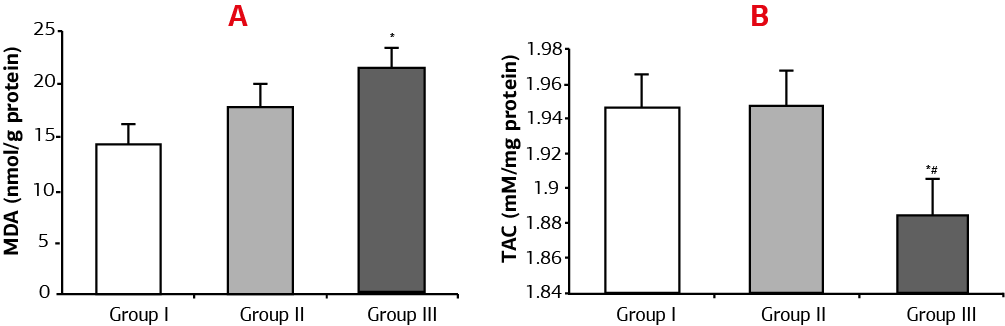
Figure 2. Effect of HCQ intake on decidual oxidative stress. Comparison between the different groups according to MDA (A) and total antioxidant capacity (B) in the decidual tissue homogenate. Values are expressed as mean ± SEM. Significant post hoc test is indicated by asterisks * p ≤0.05 versus control group I, # p ≤0.05 versus short-term HCQ group II.

Figure 3. Light Photomicrograph of H&E-stained sections of the rat uterine horns at 8th day of pseudopregnancy. (A) Crosssection of unstimulated horn layers with normal endometrial histology. (B-D) Cross-sections of decidualized stimulated horn of (B) group I showing obvious thick decidual reaction characterized by numerous rounded epithelial like decidual cells (Black arrows), increased number of secretory glands, and blood vessels, (C) group II showing remarkable stromal cell differentiation into numerous decidualized cells, and (D) group III showing thinner endometrial reaction with impaired differentiation of the stromal cells into decidual cells and decreased number of glands.
Additional Information
Publisher’s Note
Bayrakol MP remains neutral with regard to jurisdictional and institutional claims.
Rights and Permissions

This work is licensed under a Creative Commons Attribution-NonCommercial 4.0 International License (CC BY-NC 4.0). To view a copy of the license, visit https://creativecommons.org/licenses/by-nc/4.0/
About This Article
How to Cite This Article
Asmaa S. El Naggar, Adham R. Mohamed, Eman M. Fawzy, Shaymaa A. Abdulmalek, Eman A. Allam. Negative impact of hydroxychloroquine on artificial decidualization in a rat model of pseudopregnancy. Ann Clin Anal Med 2025;16(4):281-285. doi:10.4328/ACAM.22397
- Received:
- September 8, 2024
- Accepted:
- October 21, 2024
- Published Online:
- November 21, 2024
- Printed:
- April 1, 2025