
Abstract
AimAbdominal distension is a significant problem that may occur after coronary artery bypass graft surgery (CABG). In this study, we aimed to investigate the effects of postoperative gum chewing on bowel function, pain levels, and early discharge in patients who underwent isolated CABG surgery.MethodsPatients who underwent isolated CABG surgery at the Health Sciences University were prospectively included in this non-randomized study between June 2021 and December 2021. The study group (single-use gum chewed for at least 15 minutes (min) and a maximum of 30 minutes each time, at the 4th, 6th, 8th, and 10th hours after checking for swallowing reflex and orientation 4 hours after extubation) included 24 patients. With 24 controls, 48 patients were thus included in the study.ResultsThere was no difference between the groups regarding gender, hypertension (HT), body mass index, diabetes mellitus, chronic obstructive pulmonary disease rates, education levels, and defecation habits. A significant increase in bowel sounds and a significant decrease in pain levels were detected 15 to 30 minutes after chewing gum at all times, during the 4th, 6th, 8th, and 10th postoperative hours (p<0.001 for all parameters).ConclusionChewing gum early after CABG may allow bowel functions to return earlier. It can also reduce pain levels. However, there was no significant effect on early discharge.
Keywords
Introduction
Today, coronary artery bypass graft (CABG) surgery is successfully applied in the treatment of atherosclerotic heart disease. Most of these operations are performed with cardiopulmonary bypass (CPB).1 Although CPB systems are technologically advanced, these operations involve serious surgery with prolonged anesthesia times. Therefore, various postoperative complications that affect all organ systems may occur.2 Abdominal distension is a significant problem that may occur after coronary artery bypass graft surgery (CABG). It may occur due to prolonged bed rest and mobilization issues.3 Although abdominal distention is a painful condition in the postoperative period, serious clinical problems such as paralytic ileus and gastric dilation may occur if the duration is prolonged.4 There are suggestions such as early mobilization, fluid consumption, chewing gum, and hot application, to avoid abdominal distention. Postoperative gum chewing is highly recommended practice because it is easy for patients to adapt to, it can be easily applied, and it is economical.5 Studies have shown that chewing gum at the 4th hour after the operation as the first oral nutrition reduces the ileus development.6
In this study, we aimed to investigate the effects of postoperative gum chewing on bowel function, pain level, and early discharge in patients who underwent isolated CABG surgery.
Materials and Methods
Patients who underwent isolated CABG surgery at the Health Sciences University between June 2021 and December 2021 were prospectively included in this study. Patients with a left ventricular ejection fraction greater than 40%, who had underwent elective isolated CABG surgery, and who did not have an impediment to chewing gum, were included in the study. Patients with preoperative dyspeptic complaints, combined surgery, or a history of abdominal surgery, were not included in the study. Patients who developed early postoperative mortality or morbidity (e.g., prolonged ventilation for12 hours, use of intra-aortic balloons) during this period and who refused to chew gum, were excluded from the study. Demographic data of the patients (age, gender, educational status, body mass index, etc.), operative data (operation time), and postoperative data (total hospitalization time of the patient, time to start oral intake, first flatus passing and stool output time, postoperatively evaluated bowel sound, postoperatively evaluated pain level, postoperative first mobilization time, hospitalization period), were recorded. The total hospital stay was calculated by considering the entire period between preoperative preparation and the time of the patient’s discharge.Sample Size CalculationThe sample included 48 patients undergoing isolated CABG surgery. To detect a statistically significant difference between the two groups with 96% power, a significance level of 0.05, and the possibility of type I error below 5%, the required sample size was calculated to be 24 patients per group. As gender differences were not significant difference in the reference studies, no distinction was made between men and women in the volunteer patients to be included in the study. All patients who met the inclusion criteria and volunteered to participate were included in the sample until the specified sample size was reached.Chewing Gum (Study) GroupFollowing the removal of the intubation tube, patients were assessed for their ability to swallow and orientation after four hours. They were then instructed to chew a single-use gum for a minimum of 15 minutes and a maximum of 30 minutes at the 4th, 6th, 8th, and 10th hours). This group consisted of 24 patients.Control GroupThe chewing gum group was determined first within the specified date range. Then, 24 consecutive patients meeting the inclusion criteria were assigned to the control group. The study continued until both groups had 24 patients within the study period. The timing for the patients to start chewing gum was based on the ERAS (Enhanced Recovery After Surgery) guidelines.5 Swallowing reflex control was initiated once researchers observed that the patients could swallow without aspiration, by giving them swallow a small amount of water. Bowel sounds before and after each chewing were verified by the researcher with a stethoscope. To determine the duration of the first flatus after chewing gum, the patients were asked to verbally state. Pain assessments were assessed using the Visual Analogue Scale (VAS) at the postoperative 4th, 6th, 8th, and 10th hours for all patients.7 Participants were provided with a 10-cm line representing a continuum from “no pain” and “worst possible pain”. Participants were then asked to indicate their level of pain by making a handwritten mark on the line, with “no pain” being represented by a mark at the left end of the line and “worst possible pain” being represented by a mark at the right end of the line.Ethical ApprovalThis study was approved by the Ethics Committee of Adnan Menderes University (Date: 07.09.2020, Decision No: 50107718-050.04.04). After obtaining the ethics committee’s approval, written permission (Date: 26.10.2020, Decision No: 31234050-799) was obtained from the management of Health Sciences University, Bursa Yuksek Ihtisas Training and Research Hospital.Statistical AnalysisStatistical analyses were performed in the JASP (Jeffrey’s Amazing Statistics Program) software, (an open-source program developed by the University of Amsterdam that does not require a license) . Descriptive statistics of qualitative variables in the study were reported as frequency and percentage; while quantitative variables were presented with mean, standard deviation, median, minimum, and maximum values. The normality of quantitative variables was assessed using the Shapiro-Wilk test. The Mann-Whitney U test was used to compare two independent groups of quantitative variables. The quantitative variables were analyzed using the Wilcoxon test to compare two dependent groups. The Yates, Fisher, and Pearson chi-square tests were used for independent group comparisons of qualitative variables. Results below 0.05 were considered statistically significant in all statistical analyses.Reporting GuidelinesThis study was reported in accordance with the STROBE guideline.
Results
A total of forty-eight patients were included in the study; and their preoperative characteristics and demographic data are presented in Table 1. There were twenty-four patients in the study group with a median age of 57.5 (31-68), and there were twenty-four patients in the control group with a median age of 63 (30-76) (p=0.042). There was no difference between the groups in terms of gender, hypertension (HT), body mass index (BMI), diabetes mellitus (DM), chronic obstructive pulmonary disease rates (COPD), education levels, and defecation habits. Operative and postoperative data of the patients are presented in Table 2. There was no significant differences between the groups in operation times, perfusion times, postoperative first mobilization hours, pain levels at the 4th hour after extubation, or total hospital stay. The first postoperative bowel sound, time to first flatus, and time to first defecation were significantly earlier in the study group (p<0.001 for all parameters). Table 3 presents the evaluation of pain and bowel sounds in the gum-chewing group before and 15 to 30 minutes after chewing gum. A significant increase in bowel sounds and a significant decrease in pain levels were observed 15 to 30 minutes after chewing gum at all times, at the 4th, 6th, 8th, and 10th postoperative hours (p<0.001 for all parameters).
Discussion
CABG surgeries with cardiopulmonary bypass are commonly performed, and technological advances, mortality rates have reduced mortality rates to 1%.8 However, morbid complications affecting multiple organ systems may still occur after these operations. Gastrointestinal complications occur in up to 6% after cardiac surgeries.4 Abdominal distention is one such complication and can be painful, potentially leading to ileus. In this prospective non-randomized single-center study, we demonstrated that early gum chewing positively affects bowel function after CABG surgery and reduces postoperative pain levels.
Advanced age plays a role in the development and prognosis of many diseases. Because our study was not a randomized controlled trial, age was slightly higher in our control group (p=0.042). This may affect the study results. However, there are also studies indicating that advanced age does not affect postoperative bowel sounds.9-10 Auscultation of bowel sounds is an important manual assessment method, but it lacks objectivity. In our study, bowel sound assessments were performed manually. An electronic bowel sound recording system has been developed and is safely used in bowel sound analyses.11
Most studies investigating postoperative outcomes with gum chewing have focused on abdominal surgery. In a study by Turkay et al.12 the effect of postoperative gum chewing on pain and bowel movements in patients who underwent laparoscopic total hysterectomy was investigated. In the study group (n = 58), patients began chewing sugarless gum every two hours for fifteen minutes, beginning at the second postoperative hour. The control group (n = 51) did not chew gum and patients received standard postoperative care. The study demonstrated the positive and significant effects of chewing gum on pain and bowel movements. In a meta-analysis study by Roslan et al.13 the effect of chewing gum on the ileus after colorectal surgery was investigated. The meta-analysis, which included 970 patients across 10 studies, concluded that postoperative gum chewing significantly reduced the incidence of ileus. Unlike these patient groups, our study focused on patients who underwent CABG surgery. No cases of ileus were observed in our study. We demonstrated that chewing gum had positive and significant effects on pain and bowel movements.
There have been studies investigating the effects of chewing gum on postoperative outcomes following surgical operations without peritoneal incisions. A study conducted on adolescent idiopathic scoliosis patients scheduled for posterior spinal fusion surgery, the effectiveness of chewing gum in promoting bowel function recovery was investigated. Although the study did not find a positive effect of postoperative gum chewing on intestinal functions, it did report a positive effect on postoperative pain.14 Another study, the effect of postoperative gum chewing on the development of ileus was investigated in patients over 65 years of age with hip fractures. The study concluded that postoperative gum chewing reduced the incidence of ileus.15 In cardiovascular surgery, a study investigating the effect of chewing gum on intestinal function was conducted on transperitoneal abdominal aortic surgery patients. This study included 44 patients, divided into a control group (n = 21) and a study group (n = 23), that chewed gum three times a day. In this study, the authors found that flatus was passed on postoperative day (POD) 1.49 in the gum group and on POD 2.35 in the control group (p=0.0004) and the time to oral intake was 3.09 days in the gum group and 3.86 days in the control group (p=.023). At the end of their study, the authors emphasized that chewing gum after abdominal aortic surgery positively affects intestinal function.16 Unlike this study, we performed coronary artery surgery on our patients and the abdomen was not opened.
ERAS is a perioperative management protocol originally designed to improve patient recovery after colorectal surgery.17 A study by Hendy et al.6 it was revealed that the ERAS protocol can also be applied to cardiac surgery patients. However, the protocol covers a diverse group of cardiac surgery patients. A protocol suitable for the characteristics of this patient group is necessary.5 Chewing gum is one of the items that should be applied postoperatively in the ERAS protocol. Further studies are needed in the field of cardiac surgery.
In our study, the number of bowel sounds before chewing gum in the 10th postoperative hour [6 (5-14)] was significantly lower than that after chewing in the 8th postoperative hour [10 (7-20)] but it was not much different from that before chewing [6 (3-14)] in the 8th postoperative hour. This result indicates that the stimulating effect of chewing gum on bowel sounds is short-lived.
Limitations
The most important limitation of our study is that it was a single-center which limited the number of patients. We found that postoperative gum chewing significantly reduced postoperative pain levels, which is important as it may help prevent complications like postoperative atrial fibrillation. In our study, bowel sounds were recorded by one person using a stethoscope. Automatic systems could not be used.18
Conclusion
It is crucial to reduce morbid outcomes after CABG surgery. Chewing gum early after these surgeries may allow bowel functions to return earlier. It can also reduce pain levels. However, there was no significant effect on early discharge. Our study is the first to investigate the effects of early gum chewing after isolated CABG operations with cardiopulmonary bypass. Multi-center studies using electronic bowel sound recording systems and larger patient populations are needed.
Declarations
Animal and Human Rights Statement
All procedures performed in this study were in accordance with the ethical standards of the institutional and/or national research committee and with the 1964 Helsinki Declaration and its later amendments or comparable ethical standards.
Informed Consent
Written informed consent was obtained from all participants before enrollment in the study.
Data Availability
The datasets used and/or analyzed during the current study are not publicly available due to patient privacy reasons but are available from the corresponding author on reasonable request.
Conflict of Interest
The authors declare that there is no conflict of interest.
Funding
None.
Abbreviations
BMI: Body mass index
CABG: Coronary artery bypass graft
COPD: Chronic obstructive pulmonary disease
CPB: Cardiopulmonary bypass
DM: Diabetes mellitus
ERAS: Enhanced Recovery After Surgery
HT: Hypertension
NACT: Neoadjuvant chemotherapy
VAS: Visual analogue scale
References
- Savran M, Engin M, Guvenc O, et al. Predictive value of HATCH scoring and waist-to-height ratio in atrial fibrillation following coronary artery bypass operations performed with cardiopulmonary bypass. J Saudi Heart Assoc. 2021;33(2):117-123. doi:10.37616/2212-5043.1246
- Demirel A, Engin M, Toktas F, et al. Relationship between platelet-related parameters and new-onset atrial fibrillation after coronary bypass surgery. Rev Assoc Med Bras (1992). 2024;70(5). doi:10.1590/1806-9282.20240076
- Moll V, Khanna AK, Kurz A, et al. Optimization of kidney function in cardiac surgery patients with intra-abdominal hypertension: expert opinion. Perioper Med (Lond). 2024;13(1):72. doi:10.1186/s13741-024-00416-5
- Chor CYT, Mahmood S, Khan IH, Shirke M, Harky A. Gastrointestinal complications following cardiac surgery. Asian Cardiovasc Thorac Ann. 2020;28(9):621-632. doi:10.1177/0218492320949084
- Engelman DT, Ben Ali W, Williams JB, et al. Guidelines for perioperative care in cardiac surgery: Enhanced Recovery After Surgery Society recommendations. JAMA Surg. 2019;154(8):755-766. doi:10.1001/jamasurg.2019.1153
- Hendy A, DiQuinzo C, O’Reilly M, et al. Implementation of enhanced recovery in cardiac surgery: an experimental study with the control group. Asian Cardiovasc Thorac Ann. 2022;30:2184923221138504.
- Padala SRAN, Badhe AS, Parida S, Jha AK. Comparison of preincisional and postincisional parasternal intercostal block on postoperative pain in cardiac surgery. J Card Surg. 2020;35(7):1525-1530. doi:10.1111/jocs.14651
- Gucu A, Ozluk OA, Sunbul SA, Engin M, Seker IB, Sunbul A. Prognostic nutritional index as a marker of mortality: an observational cohort study of patients undergoing cardiac surgery. Rev Cardiovasc Med. 2021;22(2):499-503. doi:10.31083/j.rcm2202057
- Su’a BU, Pollock TT, Lemanu DP, MacCormick AD, Connolly AB, Hill AG. Chewing gum and postoperative ileus in adults: a systematic literature review and meta-analysis. Int J Surg. 2015;14:49-55.
- Li B, Tang S, Ma YL, Tang J, Wang B, Wang JR. Analysis of bowel sounds application status for gastrointestinal function monitoring in the intensive care unit. Crit Care Nurs Q. 2014;37(2):199-206. doi:10.1097/cnq.0000000000000019
- Zhang T, Hong C, Zou Y, Zhao J. Prediction method of human defecation based on informer audio data augmentation and improved residual network. Heliyon. 2024;10(14):e34145. doi:10.1016/j.heliyon.2024.e34145
- Turkay Ü, Yavuz A, Hortu İ, Terzi H, Kale A. The impact of chewing gum on postoperative bowel activity and postoperative pain after total laparoscopic hysterectomy. J Obstet Gynaecol. 2020;40(5):705-709. doi:10.1080/01443615.2019.1652891
- Roslan F, Kushairi A, Cappuyns L, Daliya P, Adiamah A. The impact of sham feeding with chewing gum on postoperative ileus following colorectal surgery: a meta-analysis of randomised controlled trials. J Gastrointest Surg. 2020;24(11):2643-2653. doi:10.1007/s11605-019-04507-3
- Meng Y, Lin T, Shao W, et al. A prospective single-blind randomized controlled trial of chewing gum on bowel function recovery after posterior spinal fusion surgery for adolescent idiopathic scoliosis. Clin Spine Surg. 2018;31(3):132-137. doi:10.1097/bsd.0000000000000629
- Cha YH, Nam DC, Song SY, Yoo JI. A prospective randomized controlled trial to evaluate effect of chewing gum on postoperative ileus in elderly patients after hip fracture. Medicine (Baltimore). 2021;100(13):e25321. doi:10.1097/md.0000000000025321
- Takagi K, Teshima H, Arinaga K, Yoshikawa K, Hori H, Kashikie H, et al. Gum chewing enhances early recovery of bowel function following transperitoneal abdominal aortic surgery. Surg Today. 2012;42(8):759-764. doi:10.1007/s00595-012-0180-2
- Ljungqvist O, Scott M, Fearon KC. Enhanced Recovery After Surgery: a review. JAMA Surg. 2017;152(3):292-298. doi:10.1001/jamasurg.2016.4952
- Morisawa T, Takahashi T, Sasanuma N, et al. Passive exercise of the lower limbs and trunk alleviates decreased intestinal motility in patients in the intensive care unit after cardiovascular surgery. J Phys Ther Sci. 2017;29(2):312-316. doi:10.1589/jpts.29.312
Tables
Table 1. Demographic data and preoperative features of the patients
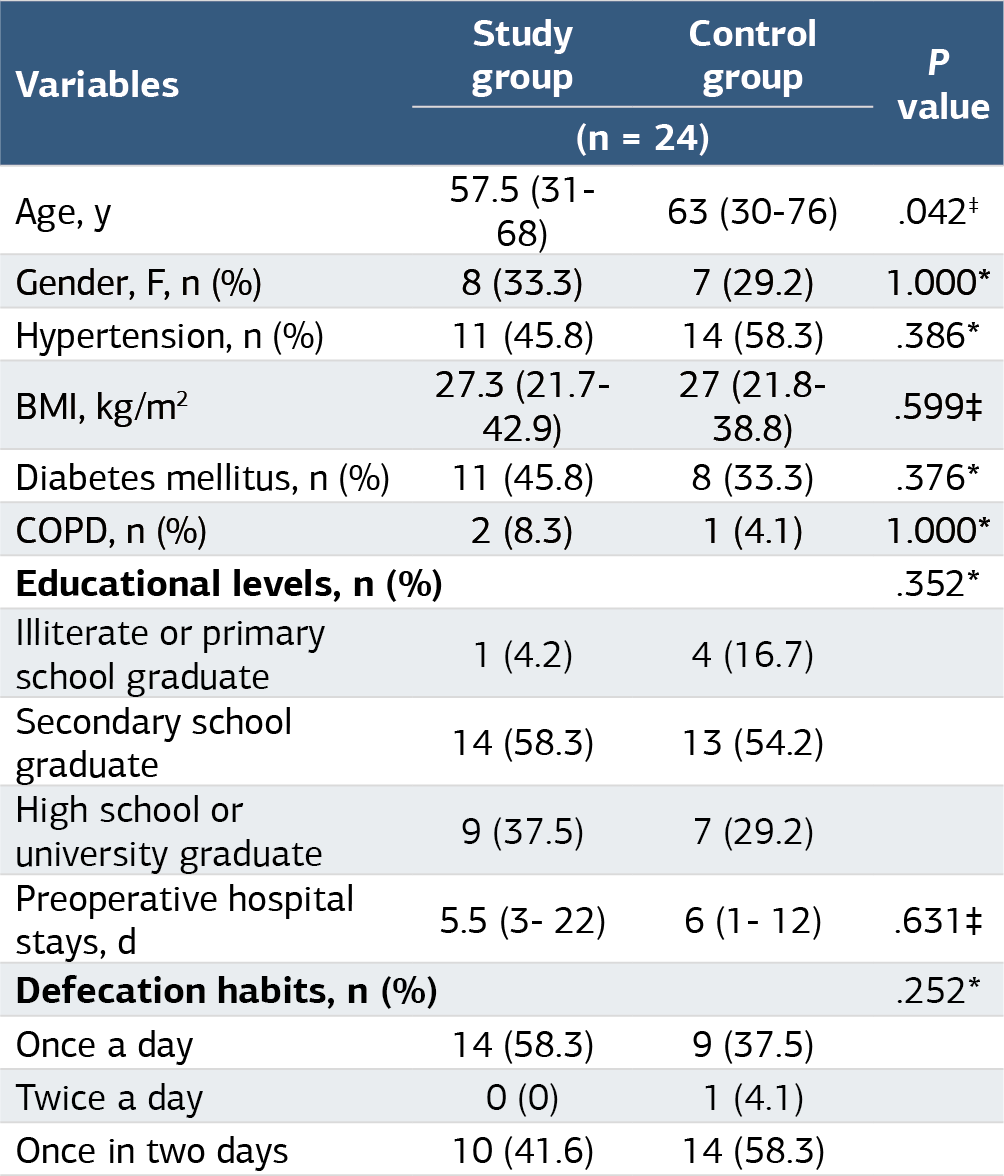
‡Mann whitney U test (Data is expressed as median (minimum-maximum)), *Chi-square or Fisher's exact test, BMI: Body mass index, COPD: Chronic obstructive pulmonary disease,
Table 2. Operative and postoperative features of the patients
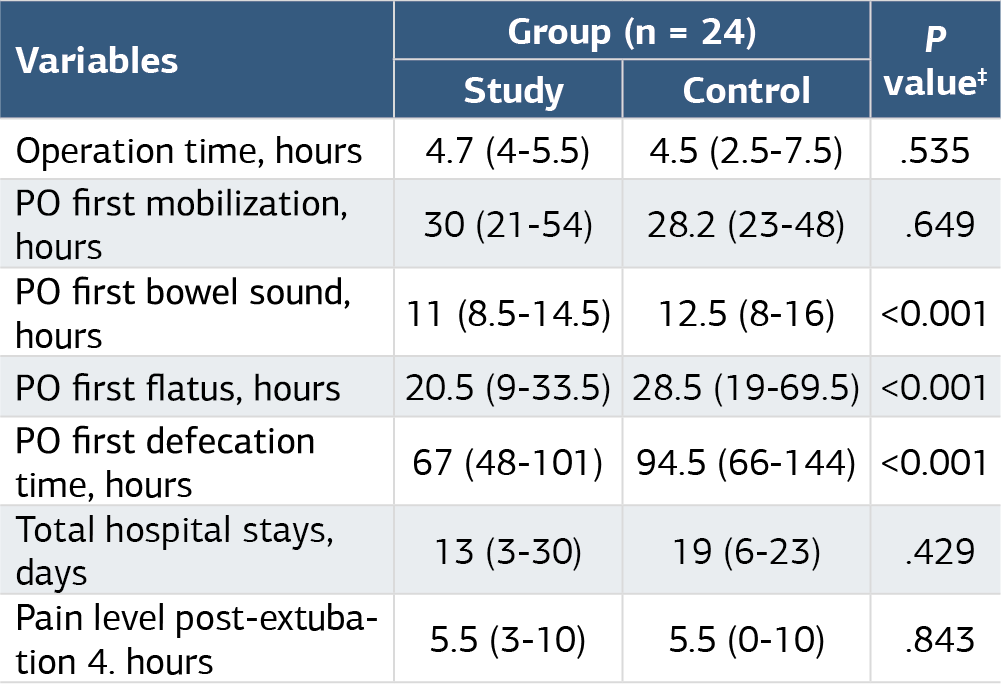
‡Mann whitney U test (Data is expressed as median (minimum-maximum)), PO: Postoperative
Table 3. Evaluations of pain and bowel sound in the gumchewing group before and 15-30 minutes after chewing gum
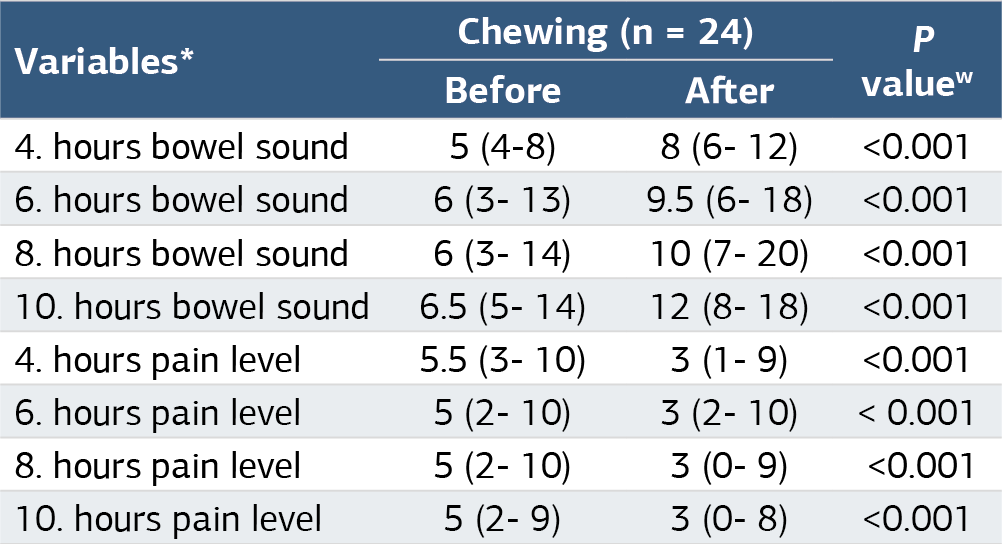
*After extubation, w wilcoxon test.
Additional Information
Publisher’s Note
Bayrakol MP remains neutral with regard to jurisdictional and institutional claims.
Rights and Permissions

This work is licensed under a Creative Commons Attribution-NonCommercial 4.0 International License (CC BY-NC 4.0). To view a copy of the license, visit https://creativecommons.org/licenses/by-nc/4.0/
About This Article
How to Cite This Article
Habibe Çevik, Rahşan Çam, Mesut Engin, Senol Yavuz. The effect of chewing gum on intestinal functions, postoperative pain, and early discharge after isolated coronary bypass surgery. Ann Clin Anal Med 2025;16(6):406-409. doi:10.4328/ACAM.22416
Publication History
- Received:
- 22.09.2024
- Accepted:
- 16.12.2024
- Published Online:
- 11.01.2025
- Printed:
- 01.06.2025