
Is there any association between handedness and breast cancer?
Handedness and breast cancer
Authors
Abstract
Aim It was aimed to evaluate the association between handedness and breast cancer characteristics.
Methods Breast cancer patients diagnosed and treated in 2006 and 2022 were included in the study. Patients with the most frequently used hand registered in the database were divided into two groups left-handed (LH) and right-handed (RH). Age at diagnosis, tumor localization, histological and molecular subtype, grade, and intergroup variability according to TNM stage were statistically investigated.
Results Age at first diagnosis was lower in the LH group (46.2 ± 11.5; 49.1 ± 11.9, p<0.001). The LH group had a higher pre-menopausal status (58.6%; 50%, p=0.03); while the RH group had a higher post-menopausal status (33.5%; 42.8%, p=0.01). The N2 stage was significantly higher in the RH group (6.3%; 14%, p=0.01). No statistically significant difference was found between the groups for tumor characteristics and localization.
Conclusion Breast cancer screening might be recommended earlier for left-handed women since breast cancer is diagnosed earlier in left-handed women.
Keywords
Introduction
Dominant right-handed use is significantly higher than left- handed use in the population. Although it is known that approximately 10% of the entire human population is left- handed, it has been shown that genetic and environmental factors are effective in this dominance.1
While it is known that estrogen exposure in the intrauterine period increases the risk of breast cancer, it has been shown that diethylstilbestrol exposure in the intrauterine period is associated with left-hand use.2,3
An article published in 1985 showed that left-hand use is associated with left-sided breast cancer.4 In the same study, it was shown that breast cancer risk at an early age is approximately two times higher in left-handed users.4 Many studies have been published on handedness and different parameters such as breast cancer laterality, breast cancer diagnosis age, and breast cancer risk.5,6,7,8 In this large cohort study, we aimed to examine the basic characteristics of breast cancer and handedness.
Materials and Methods
Patient PopulationA total of 5,910 breast cancer patients from the personal database of author M.K.A., diagnosed and treated at his private medical practice between 2006 and 2022, were included in this retrospective study. The patients were divided into two groups left-handed (LH) and right-handed (RH). The age at diagnosis and menopausal status of these patients were evaluated. Patients with missing data were excluded. Informed consent was obtained from all individual participants included in the study. This study was conducted retrospectively using patient records from the personal database of author M.K.A., obtained from his private medical practice. All data were anonymized and analyzed without any direct patient interaction or intervention. Since the data were derived solely from M.K.A.’s personal database and did not involve prospective data collection, experimental procedures, or identifiable patient information, institutional ethical approval was not required. The study was conducted in accordance with the principles of the Declaration of Helsinki.
Tumor CharacteristicsTumor localization, tumor histology (invasive ductal carcinoma, others), estrogen receptor status (positive, negative), progesterone receptor status (positive, negative), HER-2/neu amplification status (positive, negative), grade (I, II, III), T stage (T1, T2, T3, T4), N stage (N0, N1, N2, N3), distant metastasis status (M0, M1) and molecular subtypes (Luminal A, Luminal B, HER2-enriched and triple-negative) were recorded. Patients with missing data were excluded from the study.
Ethical ApprovalThis retrospective study was conducted using anonymized data obtained from a private clinical database. No prospective data collection or patient intervention was performed. Formal ethics committee approval was not required.
Statistical AnalysisNormality distribution was evaluated with the Kolmogorov- Smirnov test. The non-normal distribution of the continuous variables was determined by the Mann-Whitney U test for the independent variables. All numeric variables were expressed as mean ± standard deviation and categorical variables were expressed as percentages. For all statistics, a two-sided p-value < 0.05 was considered statistically significant. SPSS for Windows version 15.0 statistical package was used.
Reporting GuidelinesThe study was reported in accordance with STROBE guidelines.
Results
In the study, which included a total of 5910 patients, the number of left-handed (LH) was 251 (4.2%); right-handers (RH) were 5659 (95.8%). The mean age at diagnosis was 46.2±11.5 in the LH group, 49.1 ± 11.9 in the RH group, and the right-handed patients were significantly older (p<0.001). There was no significant difference in tumor localization for handedness (p=0.060). Most of the patients in both groups were in the premenopausal period. However, LH patients were more likely to be premenopausal (58.6%;50%, p=0.030); RH patients were more likely to be postmenopausal (33.5%; 42.8%, p=0.010). In both groups, the most common tumor histology was invasive ductal carcinoma (91.6%). The most frequently detected molecular subtypes in both groups were Luminal A and Luminal B-type cancers. There was no significant difference between the groups according to the molecular subtypes (p=0.827). Grade II and III tumors were the majority in both groups (90.8%; 89.9%). However, there was no statistical difference between the groups according to grade (p=0.598). There was a significant difference in the N stage between the groups. N2 status was significantly higher in the RH group (6.3%; 14%, p=0.010). There was no statistically significant difference between the groups according to T and M stages. The detailed findings are described in Table 1.
Discussion
In this study, in which we evaluated the relationship between basic tumor characteristics and handedness, we showed that left-handed patients were diagnosed with breast cancer approximately three years earlier than right-handed patients. However, we found that right-handers had significantly higher post-menopausal status and N2 stage. Also, we found similar results between the two groups in other findings, and we did not find a significant relationship between handedness and breast cancer localization.
So far, there are many speculative studies examining different characteristics of handedness and breast cancer. Howard et al. showed that left-handed individuals are more predisposed to have left-sided breast cancer, and they explained this with the hypothesis that left-handed people have a larger left breast and a more complex left breast tissue.5 Similarly, in their study by Hsielh et al evaluating breast size, breast cancer localization, and cancer risk by handedness, reported that left-handed patients had larger left breast size and left-sided breast cancers were more common (Odds ratio: 1.22, 95% CI 0.96–1.56).6 The study of Fritschi et al. showed that left- handed individuals were at higher risk for breast cancer (HR 1.71, 95% CI 0.79 –3.74).7 Also, in the study of Titus-Ernstoff et al., it was shown that left-handed individuals were more at risk for breast cancer (OR: 1.42; 95% CI: 1.10–1.83), and the riskiest group was post-menopausal women with advanced age.8 However, a more recent systematic review and Mendelian randomization analysis by Oh CY et al. questioned these associations, suggesting that the observed correlations between handedness and breast cancer risk may be influenced by confounding factors rather than a direct causal link.9 On the contrary, in the study of Olsson et al., patients diagnosed with breast cancer were shown to be less left-handed than the reference population.10 In 2020, Sosa et al. in their study with 184 patients diagnosed with breast cancer and 184 control groups, showed that the rates of those who were left-handed in both groups were similar (8.7%; 8.2%), and they argued that being left-handed was not a risk factor for breast cancer.11 The same study also proposed that there was no relationship between handedness and breast cancer laterality. Similarly, in our study, no significant association was found between handedness and tumor localization.
As described above, previous studies focused on handedness and breast cancer risk and laterality. The study evaluating the relationship between handedness and breast cancer characteristics is very limited.12
In addition to our previous study on this subject with 898 patients, we also evaluated the relationship between molecular subtype and handedness in this study. In both of our studies, we did not find any significant difference between tumor localization, subtypes, T and M stage, and handedness. Also, we found that the age of diagnosis was earlier in the LH group than in the RH group (48-46 years (median), p=0.02; 49.1-46.2 (mean), p<0.001).12
The relationship between handedness and breast cancer mortality is also an enigma. Ramadhani et al. in their study with 12,178 patients included patients with different types of cancer, it was shown that being left-handed is associated with high mortality rates for all types of cancer.13 On the contrary, studies are showing that being left-handed does not increase mortality rates.14 Handedness may also be important in terms of treatment. Khosravifarsani et al. showed that women with left-handed breast cancer responded better to radiotherapy.15 This result may be a light for future studies.
Limitations
Our study has some limitations. Most importantly, overall survival and disease-free survival rates were not evaluated in our study. Also, the chemotherapy and radiotherapy responses of these patients were not examined.
Conclusion
As a result, although tumor localization and characteristics of right-handed patients and left-handed patients were similar, left-handed patients were diagnosed with breast cancer approximately three years earlier. It may be necessary to start breast cancer screening earlier in left-handed patients.
Declarations
Ethics Declarations
The authors declare that all procedures performed in this study were conducted in accordance with institutional, national, and international ethical standards.
Animal and Human Rights Statement
All procedures involving human participants were conducted in accordance with the Declaration of Helsinki and its later amendments.
Informed Consent
Written informed consent was obtained from all participants included in the study.
Data Availability
The datasets used and/or analyzed during the current study are not publicly available due to patient privacy reasons but are available from the corresponding author on reasonable request.
Conflict of Interest
The authors declare that there is no conflict of interest.
Funding
None.
Author Contributions (CRediT Taxonomy)
Conceptualization: A.N.S., M.K.A.
Methodology: A.N.S., D.E.T.S.
Data Curation: A.N.S., D.E.T.S.
Formal Analysis: A.N.S.
Investigation: A.N.S., D.E.T.S., M.K.A.
Writing – Original Draft: A.N.S.
Writing – Review & Editing: D.E.T.S., M.K.A.
Supervision: M.K.A.
Abbreviations
CI: Confidence interval
HER2: Human epidermal growth factor receptor 2
LH: Left-handed
OR: Odds ratio
RH: Right-handed
SPSS: Statistical Package for the Social Sciences
TNM: Tumor-node-metastasis
References
-
Sha Z, Pepe A, Schijven D, et al. Handedness and its genetic influences are associated with structural asymmetries of the cerebral cortex in 31,864 individuals. Proc Natl Acad Sci U S A. 2021;118(47):e2113095118. doi:10.1073/pnas.2113095118
-
Trichopoulos D. Hypothesis: does breast cancer originate in utero. Lancet. 1990;335(8695):939-940. doi:10.1016/0140-6736(90)91000-z
-
Schachter SC. Handedness in women with intrauterine exposure to diethylstilbestrol. Neuropsychologia. 1994;32(5):619-623. doi:10.1016/0028-3932(94)90149-x
-
Kramer MA, Albrecth S, Miller RA. Handedness and the laterality of breast cancer in women. Nurs Res. 1985;34(6):333-337. doi:10.1097/00006199-198511000-00003
-
Howard J, Petrakis NL, Bross ID, et al. Handedness and breast cancer laterality: testing a hypothesis. Hum Biol. 1982;54(2):365-371.
-
Hsieh CC, Trichopoulos D. Breast size, handedness and breast cancer risk. Eur J Cancer. 1991;27(2):131-135. doi:10.1016/0277-5379(91)90469-t
-
Fritschi L, Divitini M, Talbot-Smith A, Knuiman M. Left-handedness and risk of breast cancer. Br J Cancer. 2007;97(5):686-687. doi:10.1038/sj.bjc.6603920
-
Titus-Ernstoff L, Newcomb PA, Egan KM, et al. Left-handedness in relation to breast cancer risk in postmenopausal women. Epidemiology. 2000;11(2):181-184. doi:10.1097/00001648-200003000-00017
-
Oh CY, Kim E, Kim K, et al. Exploring the handedness-breast cancer nexus: a comprehensive analysis via systematic review, meta-analysis, and Mendelian randomization. Ther Adv Med Oncol. 2024;16(4):1-11. doi:10.1177/17588359241305096
-
Olsson H, Ingvar C. Left handedness is uncommon in breast cancer patients. Eur J Cancer. 1991;27(12):1694-1695. doi:10.1016/0277-5379(91)90448-m
-
Sosa M, Saavedra P, Alonso B, et al. Left-handedness is not associated with breast cancer. Breast J. 2020;26(12):2449-2451. doi:10.1111/tbj.14061
-
Altundag K, Isik M, Sever AR. Handedness and breast cancer characteristics. J BUON. 2016;21(3):576-579.
-
Ramadhani MK, Elias SG, van Noord PA, et al. Innate handedness and disease-specific mortality in women. Epidemiology. 2007;18(2):208-212. doi:10.1097/01.ede.0000253923.68352.48
-
Ellis PJ, Marshall E, Windridge C, et al. Left-handedness and premature death. Lancet. 1998;351:1634. doi:10.1016/s0140-6736(05)77690-x
-
Khosravifarsani M, Monfared AS, Elahimanesh F, et al. Is there association between handedness and radiosensitivity in breast cancer women? Med Oncol. 2012;29(4):2552-2555. doi:10.1007/s12032-011-0153-0
Tables
Table 1. Patient and disease characteristics
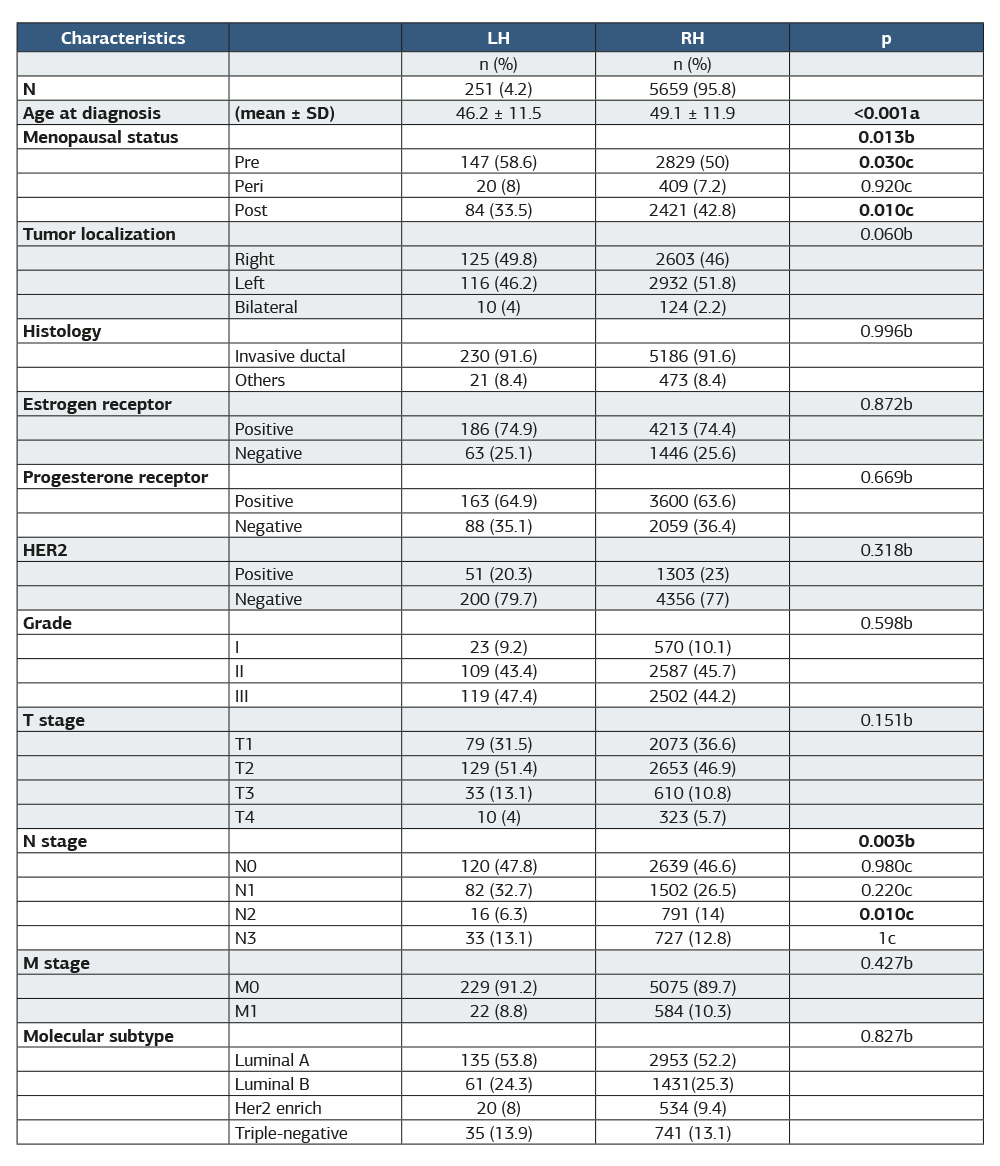
a-Mann-Whitney U, b-Pearson Chi-Square. c-Post hoc analysis
Additional Information
Publisher’s Note
Bayrakol MP remains neutral with regard to jurisdictional and institutional claims.
Rights and Permissions

This work is licensed under a Creative Commons Attribution-NonCommercial 4.0 International License (CC BY-NC 4.0). To view a copy of the license, visit https://creativecommons.org/licenses/by-nc/4.0/
About This Article
How to Cite This Article
Ahmet Necati Sanli, Deniz Esin Tekcan Sanli, Mustafa Kadri Altundag. Is there any association between handedness and breast cancer? Ann Clin Anal Med 2026;17(6):572-575. doi:10.4328/ACAM.22662
- Received:
- March 19, 2025
- Accepted:
- April 24, 2025
- Published Online:
- December 9, 2025
- Printed:
- June 1, 2026