
Abstract
Noise pollution has become an important public health issue, particularly in densely populated urban areas. Emerging evidence suggests that exposure to environmental noise during pregnancy may be associated with adverse maternal and fetal outcomes, including low birth weight, preterm birth, gestational hypertension, and impaired fetal development. This review summarizes current evidence on the effects of environmental noise exposure during pregnancy and discusses major sources such as traffic, industrial activities, and construction work. Potential mechanisms include stress-related hormonal changes, sleep disturbance, and cardiovascular effects that may adversely affect the intrauterine environment. Although growing evidence supports these associations, important gaps remain regarding dose-response relationships, long-term effects on offspring, and the influence of socioeconomic and geographic factors. Greater awareness and further research may help improve reproductive health outcomes and support the development of effective public health policies.
Keywords
Introduction
Although there is no agreed-upon single definition of noise pollution, it can best be defined as “unwanted or excessive sound that can have deleterious effects on human health, wildlife, and environmental quality.” Unwanted or harmful sounds from transportation, industry, or community sources are a growing public health concern.
Loudness is quantified using logarithmic units known as decibels. The sound that the human being is capable of hearing ranges from zero to one hundred forty decibels. The loudness of sound between one hundred twenty to one hundred forty can induce pain, known as the pain threshold. The Loudness is also referred to as sound pressure level (SPL).
In a library, the typical ambient SPL is around thirty-five decibels, whereas within a moving vehicle, it is approximately eighty-five decibels. The SPL could be one hundred and five at the site of construction. It is important to note that SPLs diminish as the distance from the source increases.1
Wang et al reported that the risk of pre-eclampsia increases after exposure to occupational noise in expecting mothers.2 A study conducted between 1999 and 2002 found a negative correlation between noise pollution & birth weight at term.3 Living within 50 meters of highways has been linked to a 22% rise in the incidence of low birth weight (LBW).4 Exposure to environmental pollutants during pregnancy and fertilization may influence future health outcomes. The stages of pregnancy and infancy represent critical periods of susceptibility.
Increased noise exposure to the expecting mother correlates with the greater crown-rump length. Nevertheless, no relationship was observed with fetal growth metrics, neonatal measurements, or negative birth outcomes.5
Pregnant individuals may be especially susceptible to its effects because of the physiological & psychological changes in pregnancy. While air and chemical pollution have garnered considerable focus, the impact of noise as an environmental stressor has not been thoroughly investigated in relation to maternal and fetal health. Recognizing its effects is essential for informing public health initiatives and addressing environmental inequalities.
The aim of this study was to evaluate the surgical management and outcomes of incidental asymptomatic contralateral inguinal hernias identified by preoperative imaging.Search StrategyThe research is performed across databases such as PubMed, Web of Science, Scopus & Google Scholar, to find out the peer- reviewed publications that examined the possibility of a link between noise pollution and adverse pregnancy outcomes. The search encompassed publications from [insert year range, e.g., January 2000 to March 2025]. The following keywords are used for the search: “noise pollution”, “traffic noise”, “aircraft noise”, “pregnancy outcome”, “birth outcome”, “low birth weight”, “preterm birth”, “miscarriage”, “stillbirth”, and “maternal exposure”. Boolean operators (AND, OR) and truncation symbols were employed to enhance sensitivity and precision.Inclusion Criteria• Peer-reviewed articles
• Publications in English
• Human epidemiological studies (cohort, case-control, or cross- sectional designs)
• Assessed noise exposure during pregnancy
• Reported at least one quantifiable pregnancy outcome (birth weight, gestational age, incidence of preterm birth, stillbirth, or fetal growth restriction)
• Provided clearly defined exposure assessment methods and outcome measuresExclusion Criteria Included• Non-human (animal or in vitro) studies
• Editorials, commentaries, and conference abstracts without full text
• Studies with insufficient methodological detail or lacking outcome dataStudy Selection & Data ExtractionThe research papers were screened initially on the basis of titles and abstracts. The full text articles of the selected papers are collected for the review process. Two independent reviewers conducted the process, and discrepancies were resolved through discussion or consultation with a third reviewer. A structured form is employed for the collection of information from each paper, which includes the following details:
• Author(s), year of publication, and country of research
• Study design and sample size
• Population demographics
• Type, level, and source of noise exposure
• Exposure Assessment Methodology (e.g., modeling, monitoring, self-report)
• Pregnancy outcomes and definitions
• Confounders are adjusted for in statistical analysis
• Main findings and effect estimatesQuality AssessmentThe methodological quality and risk of bias of included studies were appraised using the Newcastle-Ottawa Scale (NOS) for non-randomized studies. Studies have been evaluated on the basis of study groups as well as the assessment of outcomes. The studies were scored from zero to nine, and on the basis of scores, these studies have been categorized as high, moderate, or low quality accordingly.Ethical ApprovalEthical approval was not required.
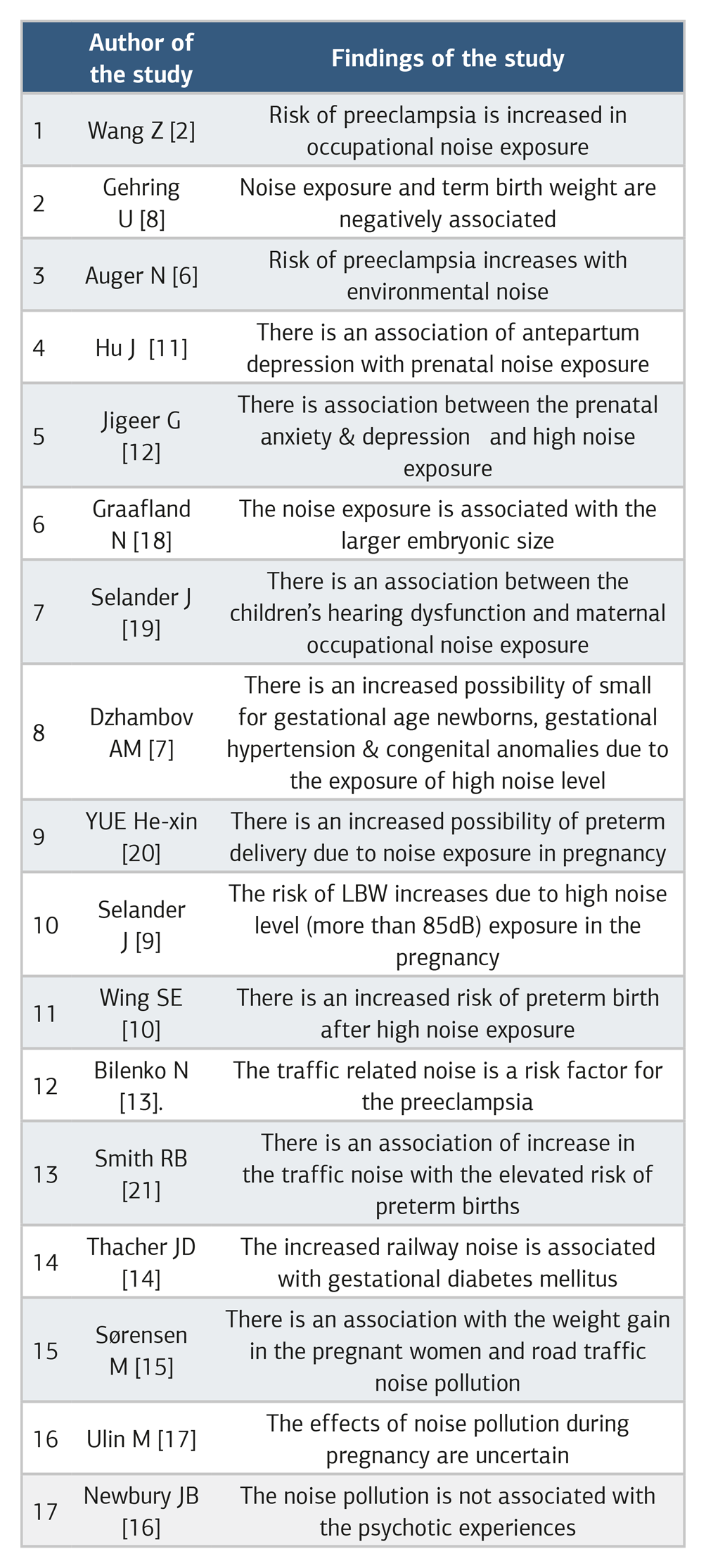
Statistical AnalysisNo statistical analysis was performed. The findings were summarized narratively.Reporting GuidelinesNo specific reporting guideline was applicable to this review.Materials and MethodsAnalysis of various studies indicated high associations between prenatal noise exposure and a range of negative outcomes for both mothers and fetuses. The studies have shown that both occupational and environmental noise are associated with heightened risks of conditions such as preeclampsia, gestational hypertension, PTB, LBW, SGA infants, and congenital defects.2,6-7 Several investigations3,8-9 have identified a connection between noise levels exceeding 80–85 dB and adverse birth outcomes, while others10-11 have linked high noise exposure to maternal mental health challenges, including anxiety and antepartum depression. Specifically, noise from traffic and railways has been associated with preeclampsia, gestational diabetes, and increased maternal weight gain.12-14 Conversely, one study15 found no link between noise exposure and psychotic experiences, and another16 suggested that the overall impact remains unclear, highlighting the necessity for additional research. Results are summarized in Table 1.
Many studies revealed the significant association of noise pollution and negative effects on the mother and the infant. Certain studies indicated potential associations between heightened noise exposure and increased risk of preeclampsia and gestational hypertension. There is an overall confidence that the elevated noise impact on all outcomes was minimal. This low certainty stems from issues related to risk of bias, variability among studies, and imprecision in the effect estimates.17
Certain studies did not show a correlation with birth weight, preterm birth, congenital anomalies, or perinatal and neonatal mortality. Some studies revealed the linkage of chronic noise exposure to increased systolic blood pressure and high levels of stress hormones in the urine and saliva of children.18
Figure 1 gives a summary of the pathogenesis of noise pollution on congenital anomalies, perinatal mortality, and congenital hearing impairments.19-20
The presentation of possible pathways and biological mechanisms from noise to congenital anomalies and perinatal mortality.19-20
The important thing to note here is that most of the studies have been done in countries with strict regulations for noise and pollution control, but none of the study seems to have been done in countries where pollution is rampant and uncontrolled, like in parts of Southeast Asia, Africa, etc.Sources and Exposure AssessmentEnvironmental noise commonly originates from different vehicles (traffic on roads, railways, and airplanes), industrial and occupational activities, as well as construction work. The measurement of exposure is usually expressed in decibels (dB), with levels exceeding 55 dB(A) regarded as potentially detrimental, particularly when experienced over extended durations.21 Research has employed both objective monitoring techniques and self-reported assessments; however, the inconsistency in evaluation methods continues to be a limitation within the existing literature.Biological Mechanisms of ActionEnvironmental noise can influence pregnancy outcomes through various interconnected mechanisms:
Neuroendocrine Response: The noise exposure activates the hypothalamic-pituitary-adrenal axis, leading to increased cortisol release and catecholamines. Increased levels of maternal cortisol have been linked to changes in placental function and hindered fetal development.22
Sleep Disruption: Nighttime noise negatively affects sleep quality, which is associated with maternal fatigue, insulin resistance, and cardiovascular irregularities—elements that can lead to negative outcomes during pregnancy.23
Chronic exposure to noise can result in endothelial dysfunction and higher blood pressure, which may elevate the likelihood of developing gestational hypertension and preeclampsia.24
Psychological Stress and Mental Health: Noise serves as a persistent environmental stressor that can lead to increased anxiety and depressive symptoms in pregnant individuals. Both of these conditions are linked to adverse birth outcomes.25Epidemiological EvidenceSeveral cohort studies have established the association between exposure to noise in pregnancy and a higher occurrence of LBW. A meta-analysis indicated a significant statistical relationship between chronic noise exposure exceeding 65 decibels and the risk of LBW.26
Exposure to noise, especially in the third trimester, has been correlated with preterm delivery. A systematic review from 2019 revealed that this exposure raises the risk of PTB by 1.2 to 1.4 times.27 Scientific evidence points to an association of noise pollution and a greater risk of gestational hypertension & preeclampsia.28 Newer findings suggest that significant noise exposure to pregnant women negatively impacts the development of the fetal auditory system and early neurodevelopment.29Disparities and Vulnerable PopulationsLow-income and marginalized populations are at higher risk of noise pollution, largely due to their proximity to transportation corridors, industrial facilities, and areas with high housing density. This ‘environmental inequity’ could further deepen the disparities observed in maternal and infant health outcomes.30 A collective effort is required for the reduction of the toxicities of excessive noise pollution.
To safeguard maternal-fetal health, multi-level strategies are needed. Some of the recommendations can be as follows; Public health implications and recommendations
1. Policy and Regulation: Implementing WHO recommendations for acceptable environmental noise levels and incorporating noise evaluations into urban development plans.
2. Workplace Protections: Enhancing occupational safety standards for expectant mothers working in noisy environments.
3. Clinical Counseling: Including environmental exposure records in prenatal care and providing guidance to patients on methods to minimize noise exposure.
4. Urban Planning: Noise barriers, green spaces, and zoning laws to buffer residential areas from highways/airports.
• Public Health Measures: WHO’s recommended noise limits (<55 dB daytime, <45 dB nighttime) should be enforced, especially near hospitals and schools.
• Individual-Level Solutions: Soundproofing homes, white noise machines, and stress-reduction techniques (e.g., mindfulness) for at-risk pregnant individuals.
Limitations
Despite the increasing evidence connecting noise pollution to negative pregnancy outcomes, several limitations must be recognized. First, numerous studies depend on observational and epidemiological designs, which, although informative, cannot prove causality due to possible confounding factors like air pollution, socioeconomic status, and maternal health behaviors. Second, the inconsistency in methods for assessing noise exposure, ranging from self-reported data to modeled or measured environmental noise, can influence the accuracy and comparability of findings across different studies. Third, there is a lack of standardization in defining exposure thresholds and timing, complicating the identification of critical vulnerability periods during gestation. Furthermore, most existing research is geographically focused on high-income countries, which restricts the applicability of findings to low and middle- income contexts where noise exposure patterns and healthcare access vary significantly. Lastly, the biological mechanisms that explain the observed associations are still not thoroughly investigated, highlighting the necessity for interdisciplinary research that combines environmental science, obstetrics, and neurodevelopmental biology.
Conclusion
Noise pollution is a modifiable environmental risk factor that may adversely affect pregnancy outcomes through complex physiological mechanisms. Current evidence suggests associations with low birth weight, preterm birth, and hypertensive disorders of pregnancy. Further research is needed to clarify dose-response relationships and long-term effects on offspring. Integrating noise exposure assessment into environmental health policies and prenatal care may contribute to improved maternal and fetal health outcomes.
Declarations
Animal and Human Rights Statement
This study did not involve human participants or animals.
Informed Consent
Not applicable.
Data Availability
All data analyzed in this review are available in the published articles cited in the reference list.
Conflict of Interest
The authors declare no conflict of interest.
Funding
This research work is funded by the Deanship of Scientific Research, Northern Border University, Arar, KSA, project number NBU-FFR-2025-848-02.
Author Contributions (CRediT Taxonomy)
Conceptualization: W.A.C.,A.S.
Methodology: W.A.C.,A.S.,D.S.K.
Investigation: W.A.C.,A.S.,D.S.K.,E.M.E.,A.A.,S.S.H.S.
Data Curation: W.A.C.,D.S.K.
Formal Analysis: W.A.C.,A.S. Writing–Original Draft: W.A.C. Writing–Review & Editing: A.S.,D.S.K.,E.M.E.,A.A.,S.S.H.S.,A.M.S.H.,S.E.S.
Supervision: A.M.S.H.,S.E.S.
AI Usage Disclosure
The authors declare that no AI-assisted technologies were used.
Acknowledgements
The authors extend their appreciation to the Deanship of Scientific Research at Northern Border University, Arar, KSA, for their support.
Abbreviations
LBW: Low birth weight
NOS: Newcastle-Ottawa Scale
PTB: Preterm birth
SGA: Small for gestational age
SPL: Sound pressure level
WHO: World Health Organization
References
- Švec JG, Granqvist S. Tutorial and guidelines on measurement of sound pressure level in voice and speech. J Speech Lang Hear Res. 2018;61(3):441-461. doi:10.1044/2017_jslhr-s-17-0095
- Wang Z, Qian R, Xiang W, et al. Association between noise exposure during pregnancy and pregnancy complications: a meta-analysis. Front Psychol. 2022;13:102996. doi:10.3389/fpsyg.2022.1026996
- Gehring U, Tamburic L, Sbihi H, Davies HW, Brauer M. Impact of noise and air pollution on pregnancy outcomes. Epidemiology. 2014;25(3):351-358. doi:10.1097/ede.0000000000000073
- Brauer M, Lencar C, Tamburic L, Koehoorn M, Demers P, Karr C. A cohort study of traffic-related air pollution impacts on birth outcomes. Environ Health Perspect. 2008;116(5):680-686. doi:10.1289/ehp.10952
- Graafland N, Essers E, Posthumus A, et al. Exposure to outdoor residential noise during pregnancy, embryonic size, fetal growth, and birth outcomes. Environ Int. 2023;171:107730. doi:10.1016/j.envint.2023.107730
- Auger N, Duplaix M, Bilodeau-Bertrand M, Lo E, Smargiassi A. Environmental noise pollution and risk of preeclampsia. Environ Pollut. 2018;239:599-606. doi:10.1016/j.envpol.2018.04.060
- Dzhambov AM, Dimitrova DD, Dimitrakova ED. Noise exposure during pregnancy, birth outcomes and fetal development: meta-analyses using quality effects model. Folia Med (Plovdiv). 2014;56(3):204-214. doi:10.2478/folmed-2014-0030
- Selander J, Rylander L, Albin M, et al. Full-time exposure to occupational noise during pregnancy was associated with reduced birth weight in a nationwide cohort study of Swedish women. Sci Total Environ. 2019;651(Pt 1):1137-1143. doi:10.1016/j.scitotenv.2018.09.212
- Wing SE, Larson TV, Hudda N, et al. Aircraft noise and vehicle traffic-related air pollution interact to affect preterm birth risk in Los Angeles, California. Sci Total Environ. 2022;829:154678. doi:10.1016/j.scitotenv.2022.154678
- Hu J, Liu B, Cui H, et al. Dose-response associations of maternal prenatal noise exposure duration with antepartum depression status. BMC Pregnancy Childbirth. 2024;24(1):7. doi:10.1186/s12884-023-06200-5
- Jigeer G, Tao W, Zhu Q, et al. Association of residential noise exposure with maternal anxiety and depression in late pregnancy. Environ Int. 2022;168:107473. doi:10.1016/j.envint.2022.107473
- Bilenko N, Ashin M, Friger M, Fischer L, Sergienko R, Sheiner E. Traffic noise and ambient air pollution are risk factors for preeclampsia. J Clin Med. 2022;11(15):4552. doi:10.3390/jcm11154552
- Thacher JD, Roswall N, Damm P, et al. Transportation noise and gestational diabetes mellitus: A nationwide cohort study from Denmark. Int J Hyg Environ Health. 2021;231:113652. doi:10.1016/j.ijheh.2020.113652
- Sørensen M, Sørensen TIA, Ketzel M, Raaschou-Nielsen O. Exposure to traffic noise and gestational weight gain and postpartum weight retention: a cohort study. Occup Environ Med. 2020;77(2):107-114. doi:10.1136/oemed-2019-105843
- Newbury JB, Heron J, Kirkbride JB, et al. Air and noise pollution exposure in early life and mental health from adolescence to young adulthood. JAMA Netw Open. 2024;7(5):e2412169. doi:10.1001/jamanetworkopen.2024.12169
- Ulin M, Edokobi N, Ganjineh B, Magann EF, Whitham MD. The impact of environmental and occupational noise on maternal and perinatal pregnancy outcomes. Obstet Gynecol Surv. 2024;79(4):219-232. doi:10.1097/ogx.0000000000001262
- Sivakumaran K, Ritonja JA, Waseem H, et al. Impact of noise exposure on risk of developing stress-related obstetric health effects: a systematic review and meta-analysis. Noise Health. 2022;24(114):137-144. doi:10.4103/nah.nah_22_22
- Hohmann C, Grabenhenrich L, de Kluizenaar Y, et al. Health effects of chronic noise exposure in pregnancy and childhood: a systematic review initiated by ENRIECO. Int J Hyg Environ Health. 2013;216(3):217-229. doi:10.1016/j.ijheh.2012.06.001
- Vincens N, Persson Waye K. Occupational and environmental noise exposure during pregnancy and rare health outcomes of offspring: a scoping review focusing on congenital anomalies and perinatal mortality. Rev Environ Health. 2023;38(3):423-438. doi:10.1515/reveh-2021-0166
- Nieuwenhuijsen MJ, Ristovska G, Dadvand P. WHO environmental noise guidelines for the European region: a systematic review on environmental noise and adverse birth outcomes. Int J Environ Res Public Health. 2017;14(10):1252. doi:10.3390/ijerph14101252
- Clark C, Paunovic K. WHO environmental noise guidelines for the European region: a systematic review on environmental noise and quality of life, wellbeing and mental health. Int J Environ Res Public Health. 2018;15(11):2400. doi:10.3390/ijerph15112400
- Van den Bergh BR, Mulder EJ, Mennes M, Glover V. Antenatal maternal anxiety and stress and the neurobehavioural development of the fetus and child: links and possible mechanisms. A review. Neurosci Biobehav Rev. 2005;29(2):237-258. doi:10.1016/j.neubiorev.2004.10.007
- Chang JJ, Pien GW, Duntley SP, Macones GA. Sleep deprivation during pregnancy and maternal and fetal outcomes: is there a relationship? Sleep Med Rev. 2010;14(2):107-114. doi:10.1016/j.smrv.2009.05.001
- Babisch W. Updated exposure-response relationship between road traffic noise and coronary heart diseases: a meta-analysis. Noise Health. 2014;16(68):1-9. doi:10.4103/1463-1741.127847
- Glover V. Maternal depression, anxiety and stress during pregnancy and child outcome; what needs to be done. Best Pract Res Clin Obstet Gynaecol. 2014;28(1):25-35. doi:10.1016/j.bpobgyn.2013.08.017
- Dzhambov AM, Lercher P. Road traffic noise exposure and birth outcomes: an updated systematic review and meta-analysis. Int J Environ Res Public Health. 2019;16(14):2522. doi:10.3390/ijerph16142522
- Smith RB, Fecht D, Gulliver J, et al. Impact of London’s road traffic air and noise pollution on birth weight: retrospective population based cohort study. BMJ. 2017;359:j5299. doi:10.1136/bmj.j5299
- Pedersen M, Halldorsson TI, Olsen SF, et al. Impact of road traffic pollution on pre-eclampsia and pregnancy-induced hypertensive disorders. Epidemiology. 2017;28(1):99-106. doi:10.1097/ede.0000000000000555
- Kight CR, Swaddle JP. How and why environmental noise impacts animals: an integrative, mechanistic review. Ecol Lett. 2011;14(10):1052-1061. doi:10.1111/j.1461-0248.2011.01664.x
- Casey JA, Morello-Frosch R, Mennitt DJ, Fristrup K, Ogburn EL, James P. Race/ ethnicity, socioeconomic status, residential segregation, and spatial variation in noise exposure in the contiguous United States. Environ Health Perspect. 2017;125(7):077017. doi:10.1289/ehp898
Tables
Table 1. Effects of noise pollution exposure during pregnancy
Figures
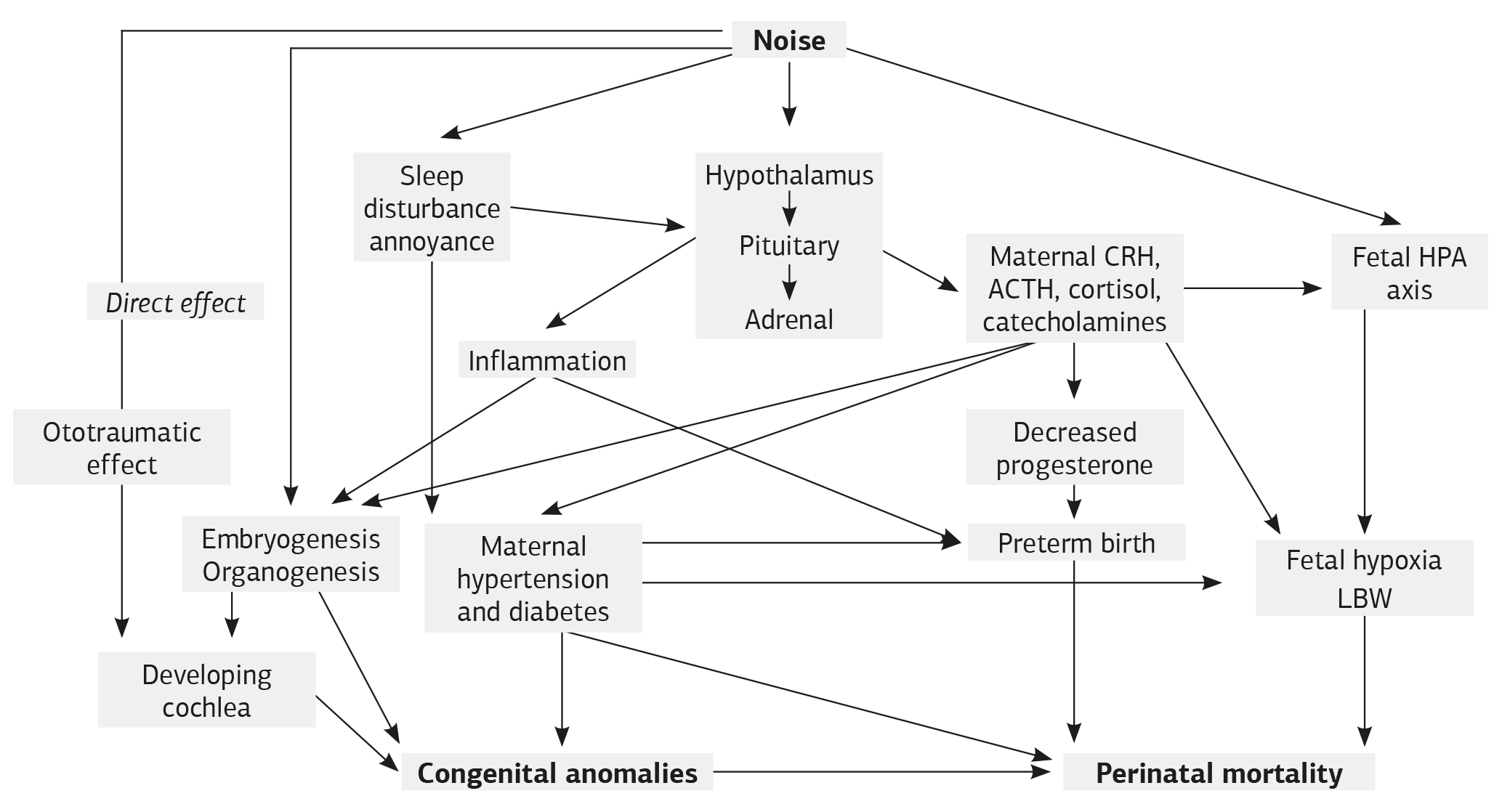
Figure 1. Presentation of possible pathways and biological mechanisms from noise to congenital anomalies and perinatal mortality
Additional Information
Publisher’s Note
Bayrakol MP remains neutral with regard to jurisdictional and institutional claims.
Rights and Permissions

This work is licensed under a Creative Commons Attribution-NonCommercial 4.0 International License (CC BY-NC 4.0). To view a copy of the license, visit https://creativecommons.org/licenses/by-nc/4.0/
About This Article
How to Cite This Article
Wajid Ali Chatha, Asmara Syed, Durre Sameen Khan, Ekramy M Elmorsy, Anshoo Agarwal, Syed Sajid Hussain Shah, Ahmed M S Hegazy, Saad El Shafey. Maternal exposure to environmental noise: current evidence on pregnancy outcomes. Ann Clin Anal Med 2026;17(7):763-767. doi:10.4328/ACAM.22736
Publication History
- Received:
- 21.05.2025
- Accepted:
- 25.08.2025
- Published Online:
- 28.09.2025
- Printed:
- 01.07.2026