
Abstract
AimSeptic arthritis among adults most commonly affects the knee, hip, and shoulder joints, and is often treated with urgent surgical intervention. Although certain laboratory findings are considered definitive for diagnosis, a broad range of clinical and laboratory parameters can be observed. In this study, we evaluated the clinical and laboratory characteristics of adult patients who underwent joint aspiration with a preliminary diagnosis of septic arthritis.MethodsA retrospective chart review was conducted to identify patients who underwent knee joint arthrocentesis for suspected septic arthritis between January 2020 and March 2024. Demographic data, synovial fluid analyses, laboratory parameters, physical examination findings, empirically initiated and culture-guided antibiotic treatments were recorded.ResultsTotal of 159 patients included. Of those, 81 (50.9%) were male and 78 (49.1%) were female. Median age was 58 years (range 18-88). Mean WBC count was 10,366/mL (SD+ 4051.1), and the mean CRP was 106.84 mg/L (SD +87.2). 71 (44.6%) were clinically diagnosed with septic arthritis. Positive cultures were obtained in 36 patients. The most frequently isolated organisms were Staphylococcus aureus (n = 20). Among the physical examination findings, pain was the most frequently observed, present in 92 of 159 patients (57.8%). Swelling was the second most common finding, identified in 90 patients (56.6%), followed by limitation of movement in 68 patients (42.7%).ConclusionSeptic arthritis of the knee may present with a wide spectrum of clinical and laboratory findings. Diagnosis should rely on the synthesis of these parameters and remain essentially clinical, rather than being based on a single variable.
Keywords
Introduction
The annual incidence of septic arthritis is estimated at 2 to 10 cases per 100,000. Its pathogenesis includes hematogenous spread, direct inoculation, contiguous extension from adjacent infections, and iatrogenic causes.1 A critical aspect of clinical practice is distinguishing septic arthritis from conditions such as gout, pseudogout, rheumatoid arthritis, and tumors, which can mimic its classic presentation.2-4 The typical findings, including a red, warm, swollen knee with painful restriction of motion, are not unique to septic arthritis. Therefore, accurate differentiation is essential for timely and effective treatment.
Septic arthritis of the knee requires urgent surgical intervention combined with culture-specific antibiotic therapy. While most studies on septic arthritis focus on prognostic markers, diagnostic criteria, or uncommon pathogens, presenting updated epidemiological data and identifying local pathogens along with resistance patterns remain highly valuable. Such information could support timely empirical treatment, improve the likelihood of successful outcomes, and help prevent permanent sequelae.5-9
The most valuable diagnostic tools for knee septic arthritis are white blood cell (WBC) counts, Gram staining, and cultures obtained through joint aspiration.1,10-12 Typical cases present with clinical findings such as erythema, warmth, pain, and inability to bear weight, along with elevated WBC counts in synovial fluid and increased serum WBC, erythrocyte sedimentation rate (ESR), and C-reactive protein (CRP) levels.7,10,13-15
Materials and Methods
A retrospective chart review was conducted to identify patients who underwent knee joint arthrocentesis for suspected septic arthritis and were evaluated at the Infectious Diseases and Orthopedics Clinic between January 2020 and March 2024.
Inclusion criteria: consultation with an infectious disease and/or orthopaedic clinic during the specified period due to suspicion of septic arthritis; being over 18 years of age; and requiring arthrocentesis in a case assessed for suspected septic arthritis.
Exclusion criteria: cases younger than 18 years of age, patients with knee replacements, patients consulted with suspicion of septic arthritis due to involvement of joints other than the knee joint, patients with previously diagnosed rheumatoid arthritis, patients with recently performed knee surgery, patients undergoing arthrocentesis for reasons other than suspected septic arthritis, and patients with incomplete laboratory and clinical documentation.
Demographic variables, including age, sex, and the side of the affected joint, were recorded. For each patient, the results of direct microscopic examination and culture-antibiogram analyses of synovial fluid obtained during diagnostic arthrocentesis were documented. Concurrent laboratory parameters, including CRP levels and WBC counts, were recorded at the time of fluid sampling.
In addition, physical examination findings at the time of joint aspiration, empirically initiated antibiotic regimens, subsequent modifications based on culture susceptibility results, and duration of hospital stay were reviewed and included in the analysis.Ethical ApprovalThis study was approved by the ethics committee of Ege University (Date: 18.09.2025, Decision No: 25-9.1T/13).Statistical AnalysisStatistical analyses were performed using SPSS version 24. Numerical variables were expressed as mean ± standard deviation when normally distributed and as median (range) when not normally distributed. Categorical variables were summarized as frequencies and percentages. No comparative statistical analyses were conducted.Reporting GuidelinesThis study was reported according to the STROBE guideline.
Results
The total number of patients included in the analysis was 159. Of the patients, 81 (50.9%) were male and 78 (49.1%) were female. The median age was 58 years (range 18–88).
The mean WBC count was 10,366/mL (SD ± 4051.1), and the mean CRP was 106.84 mg/L (SD ± 87.2). Of the 159 patients, 71 (44.6%) were clinically diagnosed with septic arthritis, while the diagnosis was excluded in the remaining 88 patients. Positive cultures were obtained in 36 patients, all of whom were among the clinically diagnosed septic arthritis. Thus, the culture positivity rate among clinically diagnosed cases was 36/71 (50.7%).
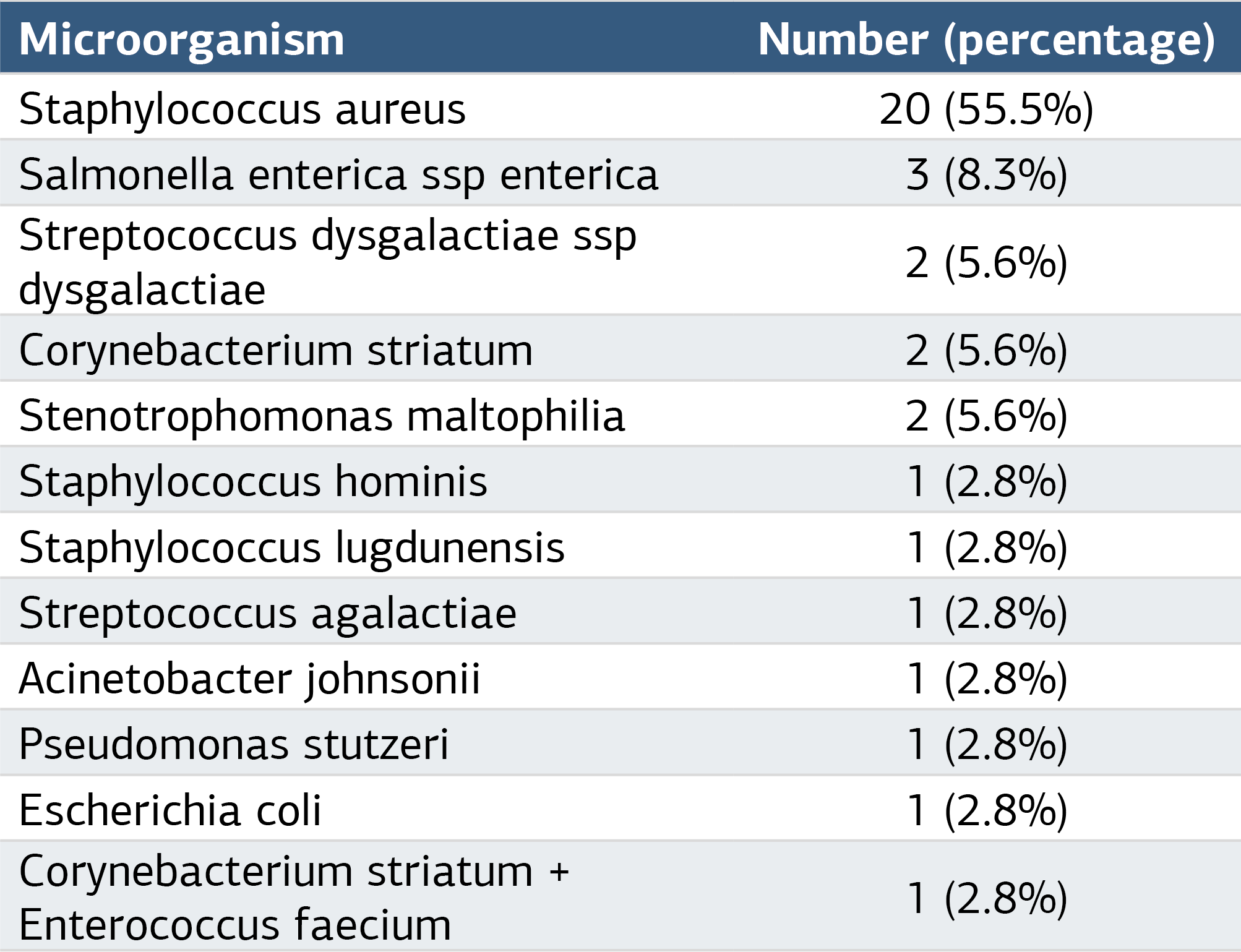
The most frequently isolated organisms were *Staphylococcus aureus* (n = 20), *Salmonella enterica* ssp. *enterica* (n = 3), *Streptococcus dysgalactiae* ssp. *dysgalactiae* (n = 2), *Corynebacterium striatum* (n = 2), and *Stenotrophomonas maltophilia* (n = 2). Methicillin resistance was identified in one of the 20 patients with *S. aureus*, whereas the remaining 19 were methicillin sensitive (Table 1).
Regarding leukocyte counts in the synovial fluid of the 159 patients, 27 patients (16.9%) had counts >50,000, with culture growth observed in 7 of these cases. Thirty-four patients (21.4%) had leukocyte counts between 25,000 and 50,000, of whom 15 showed culture growth. The remaining 98 patients (61.6%) had leukocyte counts <25,000, and culture growth was detected in 14 of these cases.
Among the physical examination findings, pain was the most frequently observed, present in 92 of 159 patients (57.8%). Swelling was the second most common finding, identified in 90 patients (56.6%), followed by limitation of movement in 68 patients (42.7%). Increased local temperature was documented in 58 patients (36.4%), while hyperemia was observed in 25 patients (15.7%).
Among the 71 patients clinically diagnosed with septic arthritis, empirical antibiotic treatment consisted of ampicillin–sulbactam in 21 patients and ceftriaxone–teicoplanin in 24 patients. In this group, the mean CRP level was 125.8 mg/L (Range: 4–393) and the mean WBC count was 10,762/mL (Range: 3,610–23,000).
Discussion
The most notable finding of this study is the presentation of current demographic, laboratory, and microbiological characteristics of patients initially diagnosed with septic arthritis of the knee at a tertiary referral hospital in western Turkey. Patients who were evaluated and treated for the diagnosis of septic arthritis demonstrated a broad spectrum of blood parameters, clinical examination findings, and synovial fluid analysis.
Among the 71 patients clinically diagnosed with septic arthritis, empirical antibiotic therapy consisted of ampicillin–sulbactam in 21 cases and ceftriaxone–teicoplanin in 24 cases. These regimens were initiated despite the fact that international guidelines recommend broader MRSA coverage. In Turkey, where MRSA prevalence is relatively low, ampicillin–sulbactam is considered a valid choice for methicillin-sensitive gram-positive infections, although national/local data is lacking.16 Furthermore, while guidelines suggest ceftriaxone plus vancomycin, the nephrotoxic potential of vancomycin led to the preference for teicoplanin, which provides similar clinical efficacy with a more favorable safety profile. Presenting local data in this context is therefore considered valuable to guide possible future practices.
While synovial fluid WBC counts exceeding 50,000 are often considered diagnostic for septic arthritis, septic arthritis can present across a broad clinical spectrum.17,18 Because delayed or missed diagnosis may lead to severe morbidity due to joint destruction, the threshold for further testing and initiation of treatment should remain low, particularly in high-risk groups. It must also be emphasized that septic arthritis remains primarily a clinical diagnosis.5,15,17
Although a leukocyte count of 50,000 in synovial fluid is generally considered the diagnostic cutoff, this parameter alone may be insufficient for accurate diagnosis.1,10-12 In our study, counts below 25,000 were observed in patients with both clinical suspicion of septic arthritis and positive culture results. A considerable number of patients were also diagnosed clinically despite negative cultures. These findings indicate that the diagnosis of septic arthritis requires careful integration of clinical, laboratory, and microbiological data, rather than reliance on a single parameter.
Limitations
The main limitation of this study was the absence of a standardized, quantitative diagnostic algorithm for determining cases of septic arthritis included in the analysis. This limitation reduces reproducibility but reflects the inherent clinical challenges underlying the study design. Another limitation was the potential selection bias in the choice of empirical antibiotic regimens. However, since clinical outcomes were not presented or analyzed, we consider this limitation to have minimal impact on the validity of the reported results.
Conclusion
Septic arthritis of the knee may present with a wide spectrum of clinical and laboratory findings. Diagnosis should rely on the synthesis of these parameters and remain essentially clinical, rather than being based on a single variable.
Declarations
Animal and Human Rights Statement
All procedures performed in this study were in accordance with the ethical standards of the institutional and/or national research committee and with the 1964 Helsinki Declaration and its later amendments or comparable ethical standards.
Informed Consent
The requirement for informed consent was waived because of the retrospective design of the study.
Data Availability
The datasets used and/or analyzed during the current study are not publicly available due to patient privacy reasons but are available from the corresponding author on reasonable request.
Conflict of Interest
The authors declare that there is no conflict of interest.
Funding
None.
Abbreviations
CRP: C-reactive protein
SD: Standard deviation
WBC: White blood cell
References
- Elsissy JG, Liu JN, Wilton PJ, Nwachuku I, Gowd AK, Amin NH. Bacterial septic arthritis of the adult native knee joint: a review. JBJS Rev. 2020;8(1):1-10. doi:10.2106/jbjs.rvw.19.00059
- Indra F, Anuar-Ramdhan IM, Vick-Duin E, Awang-Ojep DN. Pigmented villonodular synovitis of the knee mimicking septic arthritis in a paediatric patient: a case report. Malays Orthop J. 2021;15(3):122-126. doi:10.5704/moj.2111.019
- Thavasianantham K, Raagul T, Ganesh A, Elangovan P, H P, Regunathan PS. Unusual presentation of synovial lipomatosis mimicking as septic arthritis of knee: a case report. Cureus. 2024;16(4):1-5. doi:10.7759/cureus.58075
- Soule SM, Huntsman A, Chandra S, Thorne T, Holmes S, McKinley K. Inflammatory knee reaction mimicking septic arthritis following closely spaced pneumococcal vaccines in a pediatric patient undergoing immunodeficiency evaluation. Cureus. 2025;17(6):1-5. doi:10.7759/cureus.85537
- Böhle S, Finsterbusch L, Kirschberg J, et al. Incidence of secondary osteoarthritis after primary shoulder and knee empyema and its risk factors. J Pers Med. 2024;14(3):1-13. doi:10.3390/jpm14030264
- Clement RGE, Wong SJ, Hall A, Howie SEM, Simpson AHRW. The long-term time course of septic arthritis. Bone Jt Open. 2024;5(9):785-792. doi:10.1302/2633-1462.59.bjo-2024-0048.r1
- Mathews CJ, Weston VC, Jones A, Field M, Coakley G. Bacterial septic arthritis in adults. Lancet. 2010;375(9717):846-855. doi:10.1016/s0140-6736(09)61595-6
- Ferrand J, El Samad Y, Brunschweiler B, et al. Morbimortality in adult patients with septic arthritis: a 3-year hospital-based study. BMC Infect Dis. 2016;16(1):1-10.
- Baysal NB, Emecen AN, Arslan F, Vahaboğlu H. Methicillin-resistant Staphylococcus aureus septic arthritis: a case report with the possible colchicine effect to the bacterial persistence. Mediterr J Infect Microb Antimicrob. 2019;8:1-3. doi:10.4274/mjima.galenos.2019.2019.12
- Holzmeister A, Frazzetta J, Yuan FFN, et al. Evaluation for septic arthritis of the native adult knee is aided by multivariable assessment. Am J Emerg Med. 2021;46:614-618. doi:10.1016/j.ajem.2020.11.048
- Alexandersson H, Dehlin M, Jin T. Validation of septic arthritis diagnosis and disease characteristics in West Sweden. Infect Dis (Lond). 2025;57(9):850-860. doi:10.1080/23744235.2025.2492606
- Eren TK, Aktekin CN. How reliable are the synovial cell count and blood parameters in the diagnosis of septic arthritis? Jt Dis Relat Surg. 2023;34(3):724-730.
- Gunay H, Bakan OM, Mirzazade J, Sozbilen MC. A new perspective on the diagnosis of septic arthritis: high-resolution thermal imaging. J Clin Med. 2023;12(4):1-13. doi:10.3390/jcm12041573
- Bayram S, Bilgili F, Kıral D, Yağcı TF, Yıldırım AM, Demirel M. Which inflammatory marker is more reliable in diagnosing acute septic arthritis in the pediatric population? Pediatr Int. 2021;63(8):889-894. doi:10.1111/ped.14559
- Tverring J, Johansson A, Bornaei O, Lantz A, Ljungquist O. Septic arthritis score: a novel clinical prediction model for the probability of septic arthritis in the adult native knee. BMC Infect Dis. 2025;25(1):1-9.
- Duran H, Çeken N, Kula Atik T. Çeşitli klinik örneklerden izole edilen Staphylococcus aureus suşlarının antibiyotik direnç oranları [Antibiotic resistance rates of Staphylococcus aureus strains isolated from various clinical samples]. Turk Mikrobiyol Cemiy Derg. 2021;51(3):233-238. doi:10.5222/tmcd.2021.72687
- Sanpera I, Salom M, Alves C, Eastwood D. Diagnosis and management of septic arthritis: a current concepts review. J Child Orthop. 2025;19(1):14-19. doi:10.1177/18632521241311302
- Morgan AM, Ferati S, Fong C, Egol K. Identifying septic arthritis superimposed on crystalline arthropathy: is synovial cell count the answer? J Clin Orthop Trauma. 2025;65:1-6. doi:10.1016/j.jcot.2025.102985
Tables
Table 1. Identified microorganisms
Additional Information
Publisher’s Note
Bayrakol MP remains neutral with regard to jurisdictional and institutional claims.
Rights and Permissions

This work is licensed under a Creative Commons Attribution-NonCommercial 4.0 International License (CC BY-NC 4.0). To view a copy of the license, visit https://creativecommons.org/licenses/by-nc/4.0/
About This Article
How to Cite This Article
Arman Vahabi, Merve Mert Vahabi, Mesut Demirkoparan, Hüseyin Aytaç Erdem, Elcil Kaya Biçer, Gözde Akkuş Kayalı, Şöhret Aydemir, Meltem Taşbakan, Semih Aydoğdu. Evaluation of clinical and laboratory parameters in adults investigated for suspected septic arthritis of the knee. Ann Clin Anal Med 2025;16(Suppl 3):202-205. doi:10.4328/ACAM.22927
Publication History
- Received:
- 05.10.2025
- Accepted:
- 24.10.2025
- Published Online:
- 24.10.2025
- Printed:
- 25.10.2025