
Abstract
AimThis study aimed to assess maternal knowledge, attitudes, and practices regarding childhood immunization in the Northern Border province, Saudi Arabia.MethodsA cross-sectional study was conducted among mothers attending primary health care centers (PHCs) in the Northern Borders region, Saudi Arabia. A structured, self-administered, well-designed questionnaire in Arabic, the region's primary language, was used. The tool was developed based on previously validated tools. Data collection was conducted from May to September 2025. Data entered, cleaned, coded, and then analyzed using IBM SPSS Statistics (Version 26).ResultsA total of 415 mothers surveyed; 32.8% between the ages of 18 and 24; 91.3% were married, and 75.2% university graduates. The majority agreed that immunization is important for a child's health (91.6%), community health (90.8%), morbidity prevention (84.8%), and mortality reduction (81.5%) from infectious diseases. Most participants favored the immunization program (90.8%), agreed that immunization is safe (84.1%), and that it is necessary to follow the immunization schedule (88.7%). Almost all participants (96.1%) followed the immunization schedule, and 90.4% expressed satisfaction with the facilities available.ConclusionThe current study revealed a high level of mother knowledge, favorable attitudes, and practices toward childhood immunization in Northern Saudi Arabia. Furthermore, they expressed a high satisfaction level with the vaccination services offered by the PHCs.
Keywords
Introduction
A vaccine is made from attenuated or killed bacteria or viruses and is administered to humans to activate their immune system and protect them against vaccine-related diseases.1 Vaccines are certainly among the most cost-effective strategies in the healthcare system. They are reasonably priced while offering significant benefits for public health.2
According to the World Health Organization (WHO), global vaccine coverage in 2024 was as follows: diphtheria-tetanus-pertussis 85%, Haemophilus influenzae type B 78%, hepatitis B (HB) & Measles 84%, Poliomyelitis 84%, Rotaviruses 59%, and Rubella 79%.3
It is the responsibility of parents to guarantee that their children get vaccines. Therefore, parents' perceptions, awareness, and beliefs about vaccination play a crucial role, as these aspects significantly influence their behaviors related to proper and full immunization.4
Saudi Arabia initiated its nationwide vaccination program in 1979. The earliest vaccinations introduced were against pertussis, tetanus, and diphtheria (DPT), which were later expanded to include other vaccines.5 A study in Saudi Arabia revealed that parents are strongly impressed by the positive aspects of vaccination. Myths in vaccination knowledge and attitudes have been established, including the assumption that immunization causes autism, which may lead to vaccine hesitancy.6
Poor vaccination compliance results from mothers' concerns about the vaccine's effectiveness, safety, and potential adverse effects. The current survey aimed to assess the maternal knowledge, attitude, and practices regarding childhood immunization, as well as satisfaction with the immunization services delivered by primary health care centers (PHCs) in the Northern Border province, Saudi Arabia.
Materials and Methods
Study Setting and DesignA cross-sectional study was conducted among mothers attending PHCs in the Northern Borders region (Arar, Rafha, Turaif), Saudi Arabia. The region is mainly served by a national network of PHCs that provide immunization services. Data collection was conducted from May to September 2025.Data Collection ToolsA structured, well-designed self-administered questionnaire in Arabic, the region's primary language, was used. The questionnaire structure was based on previously validated studies.7,8
A 40-item questionnaire was first written in English, then translated into Arabic, and then back into English by two independent multilingual specialists from the College of Arts, Northern Border University.
A committee of family medicine and public health professionals reviewed the questionnaire content for cultural and language suitability for Saudi participants, as well as construct validity, and approved the Arabic version. Cronbach's Alpha was used to assess the questionnaire's reliability, with a result of 0.82, indicating that the tool is suitable for achieving the study objectives.
A pilot study of 20 moms (not included in the results) was conducted to evaluate the tool's simplicity and time to completion. The feedback led to minor modifications to the item's phrasing and format. The tool began with an introduction outlining the study objectives and stating that continuing to complete it signified agreement to participate in the research.
The questionnaire covered five key domains. (1) Sociodemographic information, including age, sex, residence, education, occupation, and income. (2) Maternal knowledge regarding childhood immunization, with a nominal scale: yes, no, or I don't know. (3) Participants' attitudes toward childhood immunization, with nominal scale: agree, disagree, or not sure. (4) Respondents' Practices of Vaccination, with responses yes/no. (5) Respondents' Satisfaction with Immunization Services provided by PHC personnel with a five-item Likert scale (strongly disagree, disagree, neutral, agree, severely disagree).Sample SizeThe sample size was calculated by using the following formula: N = Z2 x (p) x (1-p)/d2, where N = sample size, Z = the statistics corresponding to the confidence level (1.96), P = the expected prevalence of awareness (50%), and d = precision (0.05). The expected minimum sample size corresponding to the previous inputs was 384. We recruited 415 to account for possible incomplete responses.Sampling MethodFour PHCs (representing the north, south, west, and east regions) were randomly selected from each of the three cities. Mothers attending the selected PHCs were conveniently recruited. The questionnaire was administered electronically through a secure web platform (WhatsApp), enabling broad access while maintaining respondent anonymity. The PHC personnel and the study team distributed an invitation link to the online self-administered questionnaire to willing participants.Inclusion and Exclusion CriteriaMothers who lived in the area permanently, were at least 18 years old, had at least one child, and agreed to participate were eligible. Mothers who were temporary residents, under the age of eighteen, unable to interact effectively due to language barriers, and those who refused to participate were excluded.Ethical ApprovalThe study was approved by the Ethics Committee of Northern Border University (Date: 22.05.2025, Decision No: 41-25-H).Statistical AnalysisData entered, cleaned, coded, and then analyzed using IBM SPSS Statistics (Version 26). Categorical data were expressed as frequencies and percentages.Reporting GuidelinesThis study is reported in accordance with the STROBE guidelines for observational studies.
Results
Supplementary Table 1 presents the participants' sociodemographic data. The study included 415 participants; approximately one-third, 136 (32.8%), between the ages of 18 and 24; more than half, 227 (54.7%), lived in Arar; the majority, 379 (91.3%), were married; approximately three-quarters, 312 (75.2%), university graduated; more than half governmental employees; and two-thirds, 277 (66.7%), had a sufficient income. Many participants, 382 (68.2%), claimed the Ministry of Health as their primary source of information about pediatric immunization.
Supplementary Table 2 demonstrated maternal knowledge about child immunization. The majority confirmed that immunization is important for a child's health (380, 91.6%), community health (377, 90.8%), is crucial from the first day (324, 78.1%), prevents morbidity (352, 84.8), and reduces mortality (338, 81.5) from infectious diseases.
Most of the respondents answered that immunization may help reduce the following diseases: DPT (346.83.4%), HB (348.83.9%), and measles (346.83.4%).
Approximately two-thirds of participants stated that mild conditions like fever and diarrhea are not a reason to avoid immunization (266, 64.1%). The majority reported that immunization can cause fever and pain (340,81.9%), and slightly less than seventy percent indicated that some immunizations could cause convulsions (283,68.2).
Many mothers stated that the most diseases against which children are immunized occur during their first years of life (327,78.8%), and immunity is based on receiving many doses of the same vaccine at regular intervals (334,80.5%). A little less than 60% answered that having more than one vaccine at the same time has no detrimental effects on a child's immunity (245,59%), and the majority (326,78.6%) indicated the importance of vaccinating children during an immunization campaign.
Table 1 revealed participants' attitudes toward childhood immunization. The majority were in favor of the immunization program (377,90.8%), child vaccination is essential (366,88.2%), more beneficial than harmful (350,84.3%), safe (348,84.1%), necessary to follow the immunization schedule (368,88.7%), and vaccinations keep a child healthy (273,89.9%).
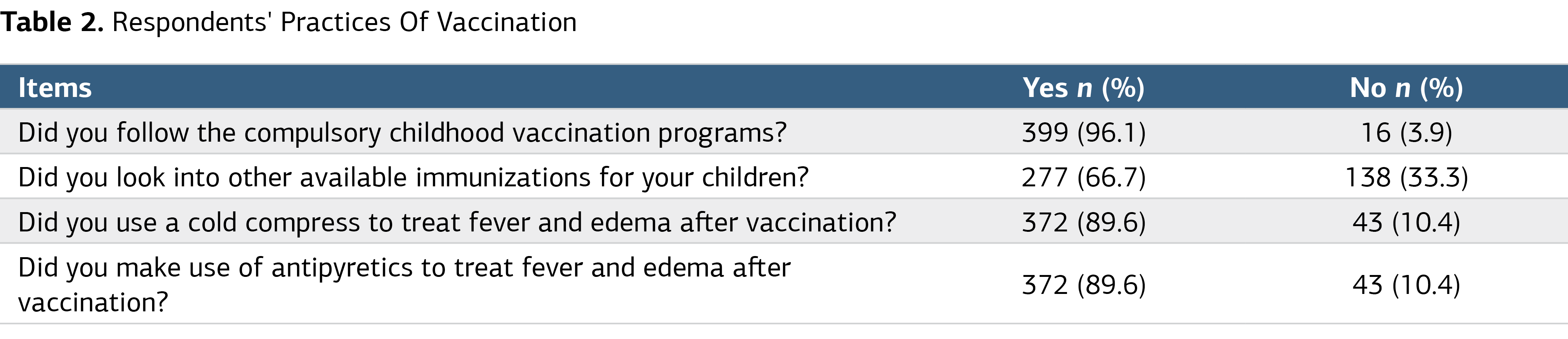
Table 2 summarizes the participants' vaccination practices. Almost all participants (399, 96.1%) followed the immunization schedule, and around two-thirds explored other available immunizations for their children (277, 66.7%). The majority (372,89.6%) used a cold compress and antipyretics to treat fever and edema after vaccination.
Supplementary Table 3 displayed participants' satisfaction with the immunization services offered. The majority expressed satisfaction or high satisfaction with the facilities available (175, 90.4%), communication with healthcare professionals (349, 84.1%), being briefed about the dosage and route of administration of the vaccination (338, 81.5%), and that medical professionals considered their concerns (354, 85.3%). Most participants expressed satisfaction or high satisfaction with the follow-up guidance regarding probable negative effects (367, 88.4%), and compliance with taking the next vaccine on the designated date (371, 89.4%).
Discussion
Concerning the maternal knowledge of immunization, the majority cited the importance for child health (91.6%), community health (90.8%), essential from the 1st day of birth (78.1%), reduces both infectious disease morbidity (84.8%), and mortality (81.5%). Immunization was the most common method for preventing HB (83.9%), followed by DPT and measles (83.4%). More than 60% agreed that mild conditions, such as fever and diarrhea, are not contraindications for vaccination (64.1%). The majority (81.9%) answered that the vaccine could cause fever and pain (81.9%), and convulsions (68.2%). Most respondents (78.8%) replied that infections against which children are immunized occur during their early years of life, immunity is built upon taking many doses of the same vaccination at regular intervals (80.5%), and a little less than 60% claimed receiving more than one vaccine at the same time had no adverse consequences on a child's immunity.
In line with many studies conducted in Saudi Arabia, such as AL Amri et al., in Riyadh, where (91.9%) of parents were well-informed that vaccinations play an essential role in preventing infectious diseases, 1st dose given at birth (86.9%), and most vaccine-preventable diseases occur in the 1st year of life (77.7%).7 Al Rashidi et al., in Riyadh, found that 79.7%,76%, 87.2%, 80.2%, 88% of participants believed that immunization prevents infectious diseases, reduces mortality, maintains child health, prevents DPT, and measles, respectively. Approximately 89% cited that some immunizations might cause pain and fever. Almost 96.3% believed that even healthy children need immunization.8
In Hail, Alshammari et al. revealed that 78.9% were aware of childhood immunization and that it protects against infectious diseases (90.2%).9 In Damam 78.2% of participants recognized that 1st vaccine must be received at birth, and a sizable proportion knew the significance of immunization in preventing DPT, HB, and measles. Nearly two-thirds reported that immunization can induce a fever, and a mild fever is not a contraindication to immunization.10 In Hafr Al-Batin, 91.3% of mothers believed that immunization is essential for a child's health, 87.4% claimed it prevents serious infections, and 91.4% cited its importance for community health.11 In Jeddah, 94.4% of participants believed that immunization protects against infectious diseases and vaccination is essential for community health.12 In Al Qassim, 86.3% of participants claimed that immunization prevents infectious diseases, and 92.1% stated that the first vaccine is given at birth.13
These findings align with research from different cultures, notably Jordan, where 83.2% of participants stated that immunization maintains child health, 92.5% indicated the importance of immunization from the 1st day, 79.6% prevents infectious diseases, and 83.2% decrease infectious diseases mortality. Vaccine-preventable diseases like DPT, Measles, and HB were mentioned by 78.6%, 74.6%, and 71.8% of respondents, respectively. Mild fever and diarrhea are not contraindications for vaccination, according to 60%; 86% agreed that certain vaccines cause pain and fever, and 57.5% believed that vaccination could cause convulsions.14 In Malaysia, 73.5% of mothers believed vaccination protects children against infectious diseases, 68.5% claimed that the first vaccine dose should be administered at birth, and 59% that the child is exposed to the majority of vaccine-preventable diseases within the first year. A total of 53.5% knew that multiple administrations of the same vaccine are beneficial for the child's immunity, and 55% knew that the concurrent administration of numerous immunizations would have no harmful effect.15
In terms of participants' attitude, 90.8% were in favor of the immunization program, 88.2% agreed that immunization is necessary, 84.3% that vaccination is more helpful than harmful, 84.1% that vaccines are safe, and 88.7% that it is required to follow the vaccination schedule.
In line with a similar Saudi survey, 98.4% of respondents agreed that child immunization is essential; 91.5% agreed that immunization is more beneficial than harmful, and 73% believed in vaccine safety.7 Alanzi et al., in Qassim, reported that 79.2% of parents stated that they adhered to the national program.16 Also, in the UAE, more than 80% of participants agreed that immunization is crucial, and adherence is important.17 In keeping with studies conducted outside the Gulf Area, such as Malaysia, 88.5% of participants thought that vaccination is more useful than harmful, and 85% believed in its safety.15 In Sri Lanka, 75% of the participants showed a positive attitude towards the immunization program,18 and 87.8% of parents displayed a good understanding of the overall advantages of immunization.19
The study showed that a sizable proportion of participants followed the compulsory immunization schedule, and roughly two-thirds looked at the available immunizations. In agreement with Alsuwaidi et al., the UAE found that 84% of participants followed the vaccine regimen.20 Also Dileep et al., in the same community, reported that 83% of expatriate mothers (83%) followed compulsory immunization.21 In Jordan, Al-Rashdan et al. reported that 97.5% of respondents had received the required immunizations.22 In the same country, Nassar et al. found that 93% followed the compulsory regimen, and 36% searched for other available vaccines for their children.14
About participants satisfaction with the vaccination services, a considerable proportion expressed satisfaction with the facilities (90.4%), provider communication (84.1%), briefing about the dose and route of administration (81.5%), PHC providers considering their concerns (85.3%), follow-up advice regarding side effects (88.4%), and compliance with taking the next vaccine on the designated date (89.4%).
Consistent with Saudi studies, including Alghamdi et al. in Jeddah, where 85.7% were satisfied with the immunization program, and 82.4% with the providers.12 In Al Qassim, 83% expressed satisfaction with the national program, 81.3% with counseling, and 78.9% with information about side effects.13 In Hafr Al Batin, 76.5% expressed satisfaction with health facilities, 72.6% with provider communication, 74.5% with a briefing about dosage and administration route, 64.3% with receiving follow-up advice regarding potential side effects, 79.2% for adherence to the scheduled date.11
Limitations
It is critical to identify some research limitations that must be considered when interpreting our results. First, the study design is descriptive, which makes it difficult to prove a cause-and-effect relationship. Second, the possibility of bias in self-reported surveys should not be overlooked. Finally, depending on the convenience sampling technique, the findings cannot be generalized.
Conclusion
The current study results showed a high level of maternal knowledge, positive attitudes, and practices regarding childhood immunizations in Northern Saudi Arabia. Additionally, they reported high satisfaction with the immunization services provided at the PHCs.
Declarations
Ethics Declarations
The study was approved by the Ethics Committee of Northern Border University (Date: 22.05.2025, Decision No: 41-25-H). The study was conducted in accordance with the principles of the Declaration of Helsinki.
Animal and Human Rights Statement
All procedures performed in this study were in accordance with the ethical standards of the institutional and/or national research committee and with the 1964 Helsinki Declaration and its later amendments or comparable ethical standards.
Informed Consent
Informed consent was obtained electronically from all participants prior to participation in the study.
Data Availability
The datasets used and/or analyzed during the current study are not publicly available due to patient privacy reasons but are available from the corresponding author on reasonable request.
Conflict of Interest
The authors declare that there is no conflict of interest.
Funding
None.
Author Contributions (CRediT Taxonomy)
Conceptualization: M.M.A.E.M., T.A.S.A., R.A.M.A., F.M.M.A., D.A.S.A., S.M.M.A., A.M.T.A.
Methodology: M.M.A.E.M.
Formal Analysis: M.M.A.E.M.
Investigation: T.A.S.A., R.A.M.A., F.M.M.A., D.A.S.A., S.M.M.A., A.M.T.A.
Data Curation: M.M.A.E.M.
Writing – Original Draft Preparation: M.M.A.E.M.
Writing – Review & Editing: M.M.A.E.M.
Project Administration: M.M.A.E.M.
AI Usage Disclosure
The authors declare that no AI-assisted technologies were used.
Abbreviations
DPT: diphtheria-pertussis-tetanus
HB: hepatitis B
IBM: International Business Machines
SPSS: statistical package for the social sciences
STROBE: Strengthening the Reporting of Observational Studies in Epidemiology
WHO: World Health Organization
References
- Awadh AI, Hassali MA, Al-lela OQ, et al. Immunization knowledge and practice among Malaysian parents: a questionnaire development and pilot-testing. BMC Public Health. 2014;14:1107. doi:10.1186/1471-2458-14-1107
- Aldahmashi FM, Alotaibi AF, Matbouli HM, et al. Systematic review of parents’ knowledge, attitude and practice of children vaccinations in Arab countries. Saudi J Med Pharm Sci. 2025;11(4):322-330. doi:10.36348/sjmps.2025.v11i04.013
- World Health Organization. Immunization coverage. 2025. Accessed xxxx. https://www.who.int/en/news-room/fact-sheets/detail/immunization-coverage.
- Matta P, El Mouallem R, Akel M, et al. Parents’ knowledge, attitude and practice towards children’s vaccination in Lebanon: role of the parent-physician communication. BMC Public Health. 2020;20(1):1439. doi:10.1186/s12889-020-09526-3
- Alsubaie SS, Gosadi IM, Alsaadi BM, et al. Vaccine hesitancy among Saudi parents and its determinants: results from the WHO SAGE working group on vaccine hesitancy survey tool. Saudi Med J. 2019;40(12):1242-1250. doi:10.15537/smj.2019.12.24653
- Eltaib L, Alenzi BW. Parents’ knowledge, attitude and practices regarding children vaccination in Northern Border area (Saudi Arabia): cross sectional study. Indo Am J Pharm Sci. 2020;7(9):850-865.
- AlAmri ES, Horaib YF, Al-Anazi WR. Knowledge and attitudes of parents on childhood immunization in Riyadh, Saudi Arabia. Egypt J Hosp Med. 2018;70(2):251-256. doi:10.12816/0043085
- Saleh A, Alrashidi AA, Bukhari MA, et al. Assessment of knowledge, attitude and practice of parents towards immunization of children in Saudi Arabia, 2018. Egypt J Hosp Med. 2018;71(2):2585-2589.
- Alshammari TM, Subaiea GM, Hussain T, et al. Parental perceptions, attitudes and acceptance of childhood immunization in Saudi Arabia: a cross sectional study. Vaccine. 2018;36(1):23-28. doi:10.1016/j.vaccine.2017.11.050
- ElFeky DS, Alsaif AS, Alkhuwaylidi AA, et al. Assessment of knowledge, attitude, and practice toward childhood vaccination in Riyadh and Dammam, Saudi Arabia. 2022;26(119):1. doi:10.54905/disssi/v26i119/ms3e2015
- Thirunavukkarasu A, Falji AAM, Al-Hazmi AH, et al. Maternal perception, hesitancy, and satisfaction toward childhood immunization in primary health centers, Hafr Al-Batin: a multicenter cross-sectional study from Eastern Saudi Arabia. Risk Manag Healthc Policy. 2023;16:2357-2368. doi:10.2147/rmhp.s406933
- Alghamdi AA, Alghamdi HA. Knowledge, attitude, and practice of vaccination among parents in Jeddah City, Saudi Arabia. Cureus. 2023;15(7):e41721. doi:10.7759/cureus.41721
- Alhasoon MA, Alkhalifah R, Alazzam R, et al. Knowledge, attitude and practice towards vaccination among parents in Al Qassim region, Saudi Arabia. Acad J Pediatr Neonatol. 2020;9(3):24-31. doi:10.19080/ajpn.2020.09.555819
- Nassar O, Alshahwan S, Alshahwan R, et al. Determinants of parents’ knowledge, attitudes, and practice toward childhood vaccination: a national study. Open Nurs J. 2023;17(1). doi:10.2174/18744346-v17-230223-2022-88
- Balbir Singh HK, Badgujar VB, Yahaya RS, et al. Assessment of knowledge and attitude among postnatal mothers towards childhood vaccination in Malaysia. Hum Vaccin Immunother. 2019;15(11):2544-2551. doi:10.1080/21645515.2019.1612666
- Alanzi AS, Abdallah A. Assessment of childhood obligatory vaccination hesitancy in Qassim region, Buraidah governorate, Saudi Arabia. Mansoura Nurs J. 2026;13(1):297-304. doi:10.21608/mnj.2025.400531.1561
- Bernsen RM. Knowledge, attitude and practice towards immunizations among mothers in a traditional city in the United Arab Emirates. Hamdan Med J. 2011;4(3):114-121.
- Ranasinghe R, Liyanage S, Wijerathna M, et al. Knowledge and attitudes of mothers regarding childhood immunisation attending the immunisation clinic of a specialised children’s hospital in Central Sri Lanka. Sri Lanka J Child Health. 2026;55(1):22-27. doi:10.4038/sljch.v55i1.11483
- Ramanayake R, Gajanayake N, Nishanthini M, et al. Parental knowledge and misconceptions toward childhood immunization in the Doluwa MOH area, Sri Lanka. Sri Lanka J Med. 2025;34(1):8-14. doi:10.4038/sljm.v34i1.572
- Alsuwaidi AR, Elbarazi I, Al-Hamad S, et al. Vaccine hesitancy and its determinants among Arab parents: a cross-sectional survey in the United Arab Emirates. Hum Vaccin Immunother. 2020;16(12):3163-3169. doi:10.1080/21645515.2020.1753439
- Dileep N, Patni MA, Manaf W, et al. Understanding immunization perspectives: exploring maternal knowledge, attitudes, practice, and stakeholder perceptions on barriers and challenges in the United Arab Emirates: a mixed methods study. Curr Pediatr Rev. Published online July 21, 2025. doi:10.2174/0115733963385175250630080411
- Al-Rashdan RA, Ta’an WA, Mukattash T, Williams B. Maternal skepticism regarding children’s vaccination in Jordan: investigating the knowledge, attitude, and adherence. PLoS One. 2024;19(7):e0305209. doi:10.1371/journal.pone.0305209
Tables
Table 1. Participants' Attitudes Toward Childhood Immunization
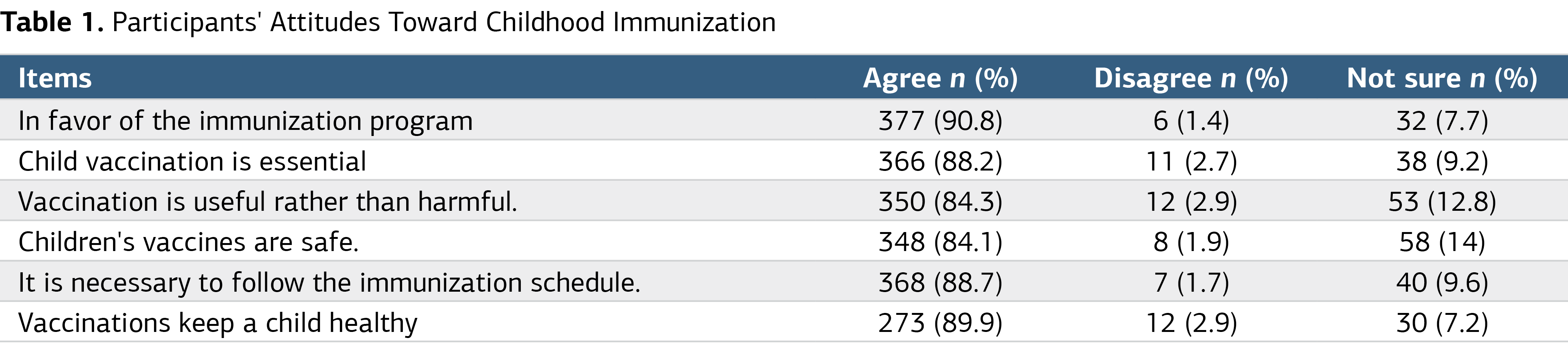
Table 2. Respondents' Practices Of Vaccination
Additional Information
Publisher’s Note
Bayrakol MP remains neutral with regard to jurisdictional and institutional claims.
Rights and Permissions

This work is licensed under a Creative Commons Attribution-NonCommercial 4.0 International License (CC BY-NC 4.0). To view a copy of the license, visit https://creativecommons.org/licenses/by-nc/4.0/
About This Article
How to Cite This Article
Mohamed M. Abd El-Mawgod, Taif Ashwi Sabih Alshulaykhi, Rahaf Abdullah Mutlaq Alharbi, Faten Mshal Mohammed Alrowaili, Danah Ashwi Sabih Alshulaykhi, Sundus Mshal Mohammed Alrowaili, Alanoud Muteb Trad Alhathal. Maternal perspectives and attitudes towards childhood immunization in the northern border region, Saudi Arabia. Ann Clin Anal Med 2026;17(12):00-00. doi:10.4328/ACAM.50153
Publication History
- Received:
- 07.04.2026
- Accepted:
- 14.05.2026
- Published Online:
- 03.05.2026
- Printed:
- 01.12.2026