
Abstract
AimAppendectomy is one of the most common emergent surgery and is performed open or laparoscopically. Previous abdominal surgery (AS) is a limiting factor in all procedures, including laparoscopic appendectomy. In this study, we aimed to investigate effect of previous abdominal surgery on laparoscopic appendectomy.MethodsWe retrospectively reviewed 164 patients who underwent laparoscopic appendectomy in the General Surgery Department of XXX Hospital between January 2019 and December 2021. Seven were excluded due to missing data, and histopathology was not appendicitis. Patients were divided into two groups, abdominal surgery and non-abdominal surgery, and compared in terms of open conversion, complication rates, operation time, and length of stay. Statistically, significance was accepted as p<0.05.Results88 (56.1%) were female, 69 (43.9%) were male of 157 patients. The mean age was 32.9 ± 14.4 (18-74) years. 14 (8.9%) patients were with previous abdominal surgery. The mean operative time was 30.5 ± 9.9 (17-102) minutes, and the length of hospital stay was 27.2 ± 12.9 (15-163) hours. No mortality or intraoperative complications were observed, and the postoperative complication rate was 10.2%. There were no statistically significant differences between the groups for age (p=0.478), gender (p=0.075), postoperative complication (p=0.28), and length of hospital stay (p=0.075). There were statistically significant differences between the groups for conversion to open appendectomy rate (p=0.016) and operation time (p=0.008).ConclusionWe recommend that laparoscopy should be started in all cases of acute appendicitis since there was no significant difference between the groups in complication rates and length of hospitalization.
Keywords
Introduction
Acute appendicitis (AA) is one of the most common causes of emergency surgery. The lifetime risk of AA is 7-8%.1 The primary treatment is surgery and performed open or laparoscopically. Laparoscopic appendectomy (LA) is one of the most commonly performed laparoscopic procedures. Advances in surgical techniques and the development of technology make laparoscopic surgery more effective.
In comparative studies on the efficiency of LA and open appendectomy (OA), factors such as postoperative pain, operative time (OT), conversion to open surgery, intraoperative/postoperative complications, length of stay (LOS), and cost-effectiveness are investigated.1-2
Previous abdominal surgery (AS) is a limiting factor in any procedure, whether open or laparoscopic. When LA was first introduced, AS was considered a relative contraindication. In our study, we aimed to evaluate whether previous abdominal surgery is a complicating factor.
Materials and Methods
Between January 2019 and December 2021, 164 patients underwent laparoscopic appendectomy at the Department of General Surgery of Gazi Yasargil Training and Research Hospital. All patients over 18 years of age who underwent laparoscopic appendectomy for acute appendicitis were retrospectively analyzed. Seven patients were excluded due to missing data, histopathological results of malignancy, and absence of appendicitis. The patients were divided into two groups, AS and NAS, and compared in terms of open conversion, complication rates, OT, and LOS.Ethical ApprovalThis study was approved by the Ethics Committee of Gazi Yasargil Training and Research Hospital (Date: 30.12.2022, Decision No: 302).Statistical AnalysisStatistical data are presented as mean ± standard deviation. Parametric test assumptions were examined before the difference analysis was performed. Normality was checked by the Shapiro-Wilk test. Differences between groups were evaluated by the unpaired t-test. Qualitative data were evaluated by Fisher’s exact test. Differences were considered statistically significant if p<0.05.Reporting GuidelinesThis study was reported in accordance with the STROBE guideline.
Results
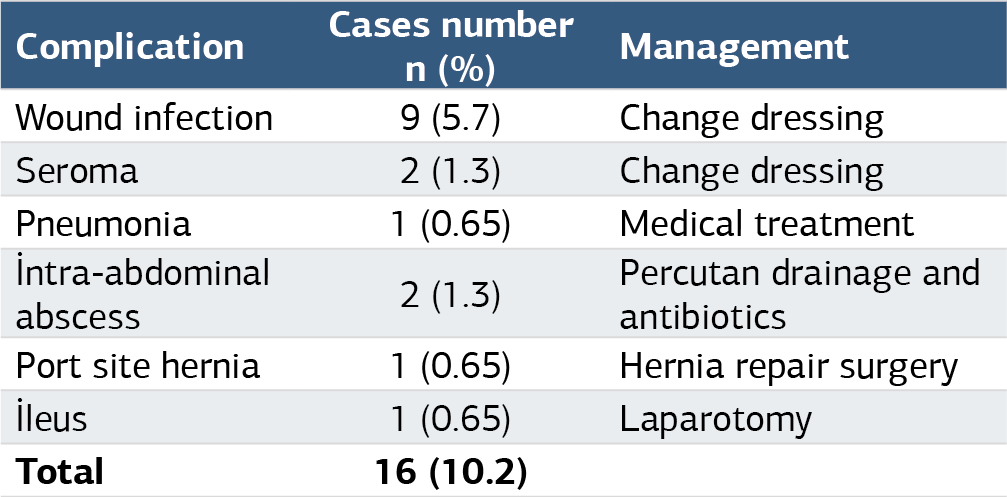
In our clinic, 157 cases of laparoscopic appendectomy were performed in the last three years. 88 (56.1%) were female and 69 (43.9%) were male. The mean age was 32.9 ± 14.4 (range, 18-74) years. 14 (8.9%) patients were with previous abdominal surgery. The types and number of previous abdominal surgeries are listed in Table 1. 28 (17.8%) of the cases were perforated. 10 (6.4%) patients were converted to open appendectomy (OA) due to technical difficulty and adhesions. The risk of conversion to OA was found to be approximately 5.3 times higher in patients with previous abdominal surgery (odds ratio; OR = 5.29). The mean operative time was 30.5 ± 9.9 (range, 17-102) minutes. The mean length of hospital stay was 27.2 ± 12.9 (range, 15-163) hours. No mortality or intraoperative complications were observed. The postoperative complication rate was 10.2% (n = 16). Minor complication (The Clavien-Dindo Classification 1-2) rate was 7.7% (n = 12), and major complication (The Clavien-Dindo Classification 3) rate was 2.5% (n = 4). One patient had pneumonia, the only non-surgical complication in our series, and was treated with medication. Wound seroma and wound infection (1.3% and 5.7%, respectively) were treated by changing the dressing at the outpatient department. 2 (1.3%) patients were complicated with intra-abdominal abscess and treated with percutaneous drainage and antibiotherapy in the nonoperative setting. 2 (1.3%) patients required surgical intervention following major complications. The postoperative complications and management of cases are listed in Table 2.
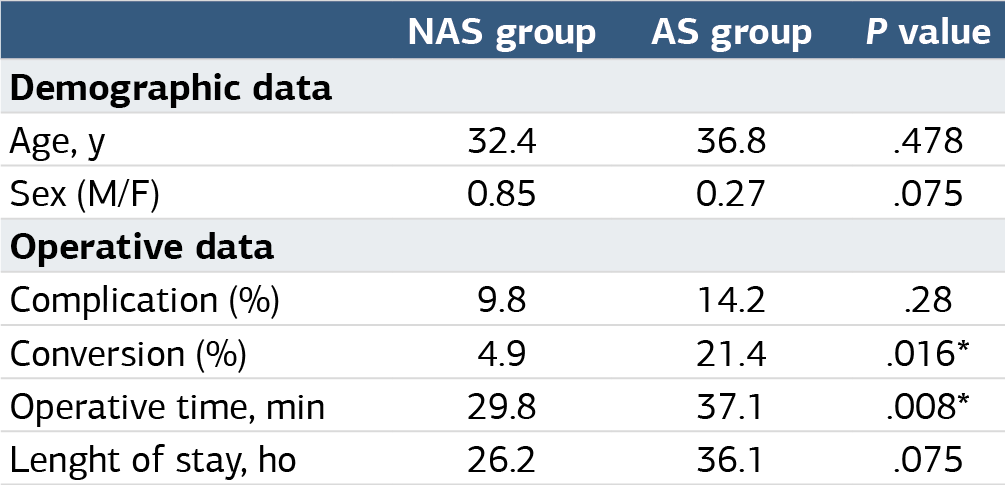
There were no statistically significant differences between the groups for age (32.4 vs. 36.8 years, p=0.478), gender ratio (M/F 0.85 vs. 0.27, p=0.075), postoperative complication (9.8 vs. 14.2%, p=0.28) and length of hospital stay (26.2 vs. 36.1 hours, p=0.075). There were statistically significant differences between the groups for conversion rate (5.1 vs. 21.4%, p=0.016) and operation time (29.8 vs. 37.1 min, p=0.008). The demographic and operative data of the groups are listed in Table 3.
Discussion
Due to advances in surgical techniques, laparoscopic procedures are commonly performed in daily practice. In many studies, the advantages of laparoscopic procedures have been described as lower wound infection rate, less postoperative pain, rapid recovery, and short hospital stay, while the disadvantages have been longer operative time and cost-effectiveness.2 Laparoscopic appendectomy is an effective and feasible procedure for acute appendicitis. It should be kept in mind that previous abdominal surgery may complicate laparoscopic surgery, as in all surgical procedures.
In the literature, studies evaluating the effect of previous abdominal surgery on laparoscopic surgical procedures are well documented, especially in colorectal and gallbladder surgeries.3-5 There is only one study that reported previous abdominal surgery on laparoscopic appendectomy.6 Although different groupings have been made in terms of methodology, similar factors were researched in this study.
In our study, we found that there were no statistically significant differences between AS versus NAS groups in demographic data, postoperative complication rate, and length of hospital stay (p-value, respectively; >0.05, 0.28, and 0.075). Wu et al. reported that female gender unfavorably affected the outcomes of laparoscopic appendectomy, especially due to cesarean section. In our study, although approximately one-third of the AS group had a history of cesarean section, there was no significant difference between genders. In our data, the postoperative complication rate of LA was 10.2%, and wound infection rate was 5.7%. The wound infection rate of LA is reported between 2-9% in different publications.7-10 The complication rate in our data is acceptable, as in the literature. Wu et al. reported that previous abdominal surgery, similar to our study, had no negative effect on complication rate.6 The hospital stay is one to seven days, 27 hours on average. Also, similar to Wu et al., the length of hospital stay was not statistically significantly different between the groups.
We revealed significant differences between the groups in conversion to OA and operative time (p-value, respectively: 0.016 and 0.008). The effect of previous abdominal surgery on the conversion rate to OA is controversial. The conversion rate was found to be 6.4% in our study and is similar to the literature. Conversion rates to OA ranged between 1-10% in the literature.6-10 Masoomi et al. reported a conversion rate to open appendectomy of 6.3% according to Nationwide Inpatient Sample (NIS) data12. In our study, the conversion rate was statistically significant between the groups (AS 20.4% vs. NAS 4.9%, p=0.016). Lezama et al. found that previous abdominal surgery is an independent risk factor for conversion to OA.10 In our study, subgroup analysis showed that all three patients in the AS group with conversion to OA had perforated appendicitis. The reason for the statistically significant conversion rates in the AS group may be the coexistence of perforation. The mean operative time was approximately 30 minutes and significantly different between groups (AS 29.8 vs. 37.1 minutes, p=0.008). Despite our study, Wu et al. did not find significant differences between the groups in operative time. Condition of previous surgery may prolong the duration of surgery. A possible side effect of prolonged operation time is an increased risk of postoperative complications. We think that prolonged operation time can be ruled out because of no significant difference in postoperative complication rates.
Limitations
The limitations of this study may be the low number of patients.
Conclusion
Finally, we consider that laparoscopic appendectomy has no negative effect on patients with a history of previous abdominal surgery, and we recommend starting laparoscopically for all patients presenting with acute appendicitis. Due to the limited number of studies on this subject, more studies are needed.
Declarations
Ethics Declarations
This study was approved by the Ethics Committee of Gazi Yasargil Training and Research Hospital (Date: 2022-12-30, No: 302)
Animal and Human Rights Statement
All procedures performed in this study were in accordance with the ethical standards of the institutional and/or national research committee and with the 1964 Helsinki Declaration and its later amendments or comparable ethical standards.
Informed Consent
Informed consent was waived.
Data Availability
The datasets used and/or analyzed during the current study are not publicly available due to patient privacy reasons but are available from the corresponding author on reasonable request.
Conflict of Interest
The authors declare that there is no conflict of interest.
Funding
None.
Abbreviations
AA: Acute appendicitis
AS: Abdominal surgery
LA: Laparoscopic appendectomy
LOS: Length of stay
NAS: Non-abdominal surgery
OA: Open appendectomy
OR: Odds ratio
OT: Operative time
References
- Stewart B, Khanduri P, McCord C, et al. Global disease burden of conditions requiring emergency surgery. Br J Surg. 2014;101(1). doi:10.1002/bjs.9329
- Jaschinski T, Mosch CG, Eikermann M, Neugebauer EA, Sauerland S. Laparoscopic versus open surgery for suspected appendicitis. Cochrane Database Syst Rev. 2018;11(11). doi:10.1002/14651858.cd001546.pub4
- Yamamoto M, Okuda J, Tanaka K, et al. Effect of previous abdominal surgery on outcomes following laparoscopic colorectal surgery. Dis Colon Rectum. 2013;56(3):336-342. doi:10.1097/dcr.0b013e31827ba103
- Figueiredo MN, Campos FG, D’Albuquerque LA, Nahas SC, Cecconello I, Panis Y. Short-term outcomes after laparoscopic colorectal surgery in patients with previous abdominal surgery: a systematic review. World J Gastrointest Surg. 2016;8(7):533-540. doi:10.4240/wjgs.v8.i7.533
- Akyurek N, Salman B, Irkorucu O, et al. Laparoscopic cholecystectomy in patients with previous abdominal surgery. JSLS. 2005;9(2):178-183.
- Wu JM, Lin HF, Chen KH, Tseng LM, Tsai MS, Huang SH. Impact of previous abdominal surgery on laparoscopic appendectomy for acute appendicitis. Surg Endosc. 2007;21(4):570-573. doi:10.1007/s00464-006-9027-5
- Masoomi H, Nguyen NT, Dolich MO, Mills S, Carmichael JC, Stamos MJ. Laparoscopic appendectomy trends and outcomes in the United States: data from the Nationwide Inpatient Sample, 2004-2011. Am Surg. 2014;80(10):1074-1077. doi:10.1177/000313481408001035
- Sakpal SV, Bindra SS, Chamberlain RS. Laparoscopic appendectomy conversion rates two decades later: an analysis of surgeon and patient-specific factors resulting in open conversion. J Surg Res. 2012;176(1):42-49. doi:10.1016/j.jss.2011.07.019
- Wagner PL, Eachempati SR, Aronova A, et al. Contemporary predictors of conversion from laparoscopic to open appendectomy. Surg Infect (Larchmt). 2011;12(4):261-266. doi:10.1089/sur.2010.079
- Monrabal Lezama M, Casas MA, Angeramo CA, Bras Harriott C, Schlottmann F. Conversion from laparoscopic to open appendectomy: trends, risk factors and outcomes. A 15-year single-center analysis of 2193 adult patients. World J Surg. 2022;46(11):2642-2647. doi:10.1007/s00268-022-06670-2
Tables
Table 1. Types and number of previous abdominal surgery
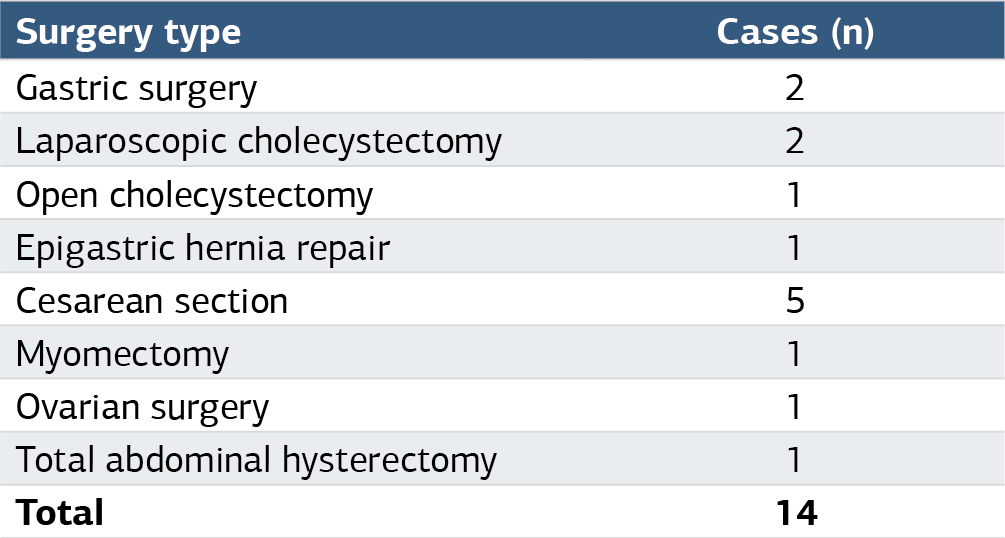
Table 2. Types and number of postoperative complications and the management of cases
Additional Information
Publisher’s Note
Bayrakol MP remains neutral with regard to jurisdictional and institutional claims.
Rights and Permissions

This work is licensed under a Creative Commons Attribution-NonCommercial 4.0 International License (CC BY-NC 4.0). To view a copy of the license, visit https://creativecommons.org/licenses/by-nc/4.0/
About This Article
How to Cite This Article
Deniz Tikici, Salim İlksen Başçeken. Is previous abdominal surgery a challenge for laparoscopic appendectomy?. Ann Clin Anal Med 2025;16(6):394-296. doi:10.4328/ACAM.22350
Publication History
- Received:
- 01.08.2024
- Accepted:
- 02.12.2024
- Published Online:
- 19.01.2025
- Printed:
- 01.06.2025